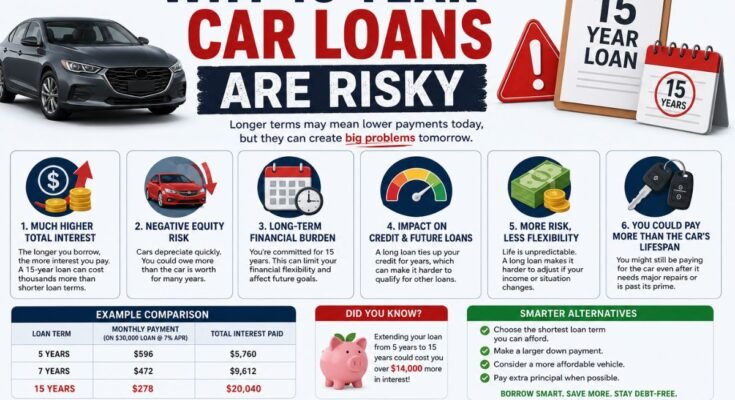
A low monthly car payment sounds like a dream. But the reality behind very long loan terms can be a financial nightmare. More Americans are now asking about 15-year car loans as car prices climb higher. On the surface, the idea seems helpful. But when you look closely, why 15 year car loans are risky becomes very clear. At Quickguidespace, we want every buyer to understand the full picture before signing any loan agreement.
Understanding Why 15 Year Car Loans are Risky
To understand why 15 year car loans are risky, you need to think beyond the monthly payment. A 15-year loan stretches your repayment across 180 months. That is a very long time to be tied to one vehicle. During those 15 years, your car loses value, your life changes, and interest keeps adding up every single month.
The core reason why 15 year car loans are risky is simple math. The longer you borrow money, the more it costs you in the end. What looks like an affordable monthly bill can secretly become one of the most expensive financial decisions of your life. Let us break down each risk one by one so you can see exactly what is at stake.
Risks of Long-Term Car Financing
The risks of long-term car financing are numerous and serious. Most people only look at the monthly number. They do not look at what they will pay in total over the life of the loan.
The risks of long-term car financing start with interest. Every month you owe money, interest grows. On a 15-year loan, that interest has 180 months to build. Even at a moderate rate of 6 or 7 percent, you could end up paying back nearly double what you originally borrowed. That is a staggering amount of extra money for the same vehicle.
Another one of the risks of why 15 year car loans are risky is commitment. You are locked into a payment for 15 years. If your job changes, your family grows, or an emergency hits, that payment still needs to be made. Missing payments damages your credit and can lead to repossession. The longer the loan, the more chances there are for something to go wrong.
Negative Equity in Auto Loans: A Serious Trap
One of the biggest reasons why 15 year car loans are risky is negative equity in auto loans. This happens when you owe more on your car than it is actually worth. And with a 15-year loan, this situation can last for a very long time.
Negative equity in auto loans is almost guaranteed with extremely long loan terms. Here is why. Cars lose value fast. In the first year alone, a new car can lose 15 to 20 percent of its value. By year three, that loss could be 40 percent or more. But your loan balance goes down very slowly when the term is stretched over 15 years.
This gap between why 15 year car loans are risky and what the car is worth is called negative equity in auto loans. If you need to sell the car, trade it in, or if it gets totaled in an accident, you will still owe money even after the car is gone. That leftover debt becomes your problem. Quickguidespace has seen this situation cause real financial hardship for buyers who did not see it coming.
High Interest Costs Over Time
High interest costs over time are perhaps the most damaging part of a 15-year car loan. Many buyers focus only on the low monthly payment and ignore the total interest they will pay.
Here is a real example to show high interest costs over time. Suppose you borrow $32,000 at 7% interest. On a 5-year loan, your total interest might be around $5,800. On a 15-year loan at the same rate, your total interest could exceed $19,000. You would pay nearly $20,000 extra just for the privilege of borrowing longer.
High interest costs over time also get worse if the lender charges a higher rate for longer terms. Many lenders do exactly that. They see longer loans as riskier and charge accordingly. So you end up with both more months of interest and a higher rate per month. This combination is one of the clearest examples of why 15 year car loans are risky for everyday American buyers.
Extended Vehicle Loan Repayment Dangers
The extended vehicle loan repayment dangers go beyond just money. Think about the practical side of paying for a car over 15 years.
Extended vehicle loan repayment dangers include reliability problems. A car you buy today will be 15 years old when you make your last payment. Most cars need significant repairs between years 8 and 15. Engine problems, transmission issues, and other costly repairs are common in older vehicles. You could be making monthly loan payments while also paying for major repairs at the same time.
Another of the why 15 year car loans are risky is lifestyle change. Over 15 years, your needs will likely change. Maybe you will need a bigger vehicle for a growing family. Maybe you will want to upgrade to a newer model. But if you are underwater on your current loan, switching vehicles becomes very difficult and expensive. Quickguidespace always warns buyers that long loan terms limit your future options significantly.
Car Depreciation and Long Loan Terms
Car depreciation and long loan terms do not mix well. Depreciation is the loss of value a car experiences over time. Every car depreciates. But the rate of depreciation is fastest in the early years.
The problem with car depreciation and long loan terms is that the two work against each other. Your car loses value quickly while your loan balance falls slowly. This mismatch leaves you underwater for a very long time. On a 15-year loan, you might not reach a point where you have positive equity for five to seven years or more.
Car depreciation and long loan terms also create insurance challenges. If your car is totaled in an accident, your insurance company pays what the car is currently worth. But you still owe the full loan balance. That gap could be thousands of dollars that you must pay out of pocket. This is exactly why 15 year car loans are risky for buyers who are not prepared for this scenario.
Smarter Choices Instead of a 15-Year Loan
Now that you understand why 15 year car loans are risky, what should you do instead? There are smarter paths to car ownership that protect your finances.
First, save a larger down payment before buying. Putting 20 percent or more down reduces what you borrow and shrinks your monthly payment without needing a very long term. Second, choose the shortest loan term your budget can handle. A 48 or 60-month loan costs far less in total interest. Third, buy a car that fits your actual budget rather than stretching with a long loan. Fourth, compare rates from multiple lenders. Credit unions often why 15 year car loans are risky offer better rates than dealerships. And fifth, always calculate the total repayment cost before you decide, not just the monthly payment.
Conclusion
Why 15 year car loans are risky comes down to several serious factors. The risks of long-term car financing include massive interest costs and long-term commitment. Negative equity in auto loans can trap you for years. High interest costs over time can make you pay back nearly double what you borrowed. Extended vehicle loan repayment dangers include repair costs and lifestyle limitations. And car depreciation and long loan terms create a painful mismatch between what you owe and what your car is worth. Visit Quickguidespace for more honest why 15 year car loans are risky, practical guides to help you make smart and confident car financing decisions across the USA.
FAQs
Q1. Why 15 year car loans are risky for American buyers?
They come with very high total interest costs, long periods of negative equity, and the risk of paying for a car that is no longer reliable or valuable by the time the loan ends.
Q2. What is negative equity in auto loans?
Negative equity means you owe more on your car than it is currently worth. This is very common with long loan terms because the car loses value faster than the loan balance drops.
Q3. How do high interest costs over time affect a 15-year loan?
Over 15 years, interest builds up significantly. You could end up paying tens of thousands of dollars more than the original price of the car just in interest charges.
Q4. What are the extended vehicle loan repayment dangers?
These include being stuck with an aging, unreliable car while still making payments, limited ability to upgrade or change vehicles, and financial stress if your income or life situation changes.
Q5. How does car depreciation affect long loan terms?
Cars lose value quickly, especially in the first few years. With a why 15 year car loans are risky, your car’s value drops far faster than your loan balance, leaving you underwater for many years.
Q6. What is a smarter alternative to a 15-year car loan?
Save a larger down payment, choose a shorter loan term of 48 to 60 months, buy within your budget, and compare rates from multiple lenders including credit unions.
Q7. Where can I find more guidance on car loan risks?
Visit Quickguidespace for clear, simple, and honest guides on car loans, interest rates, depreciation, and smart financing tips designed for everyday American car buyers.