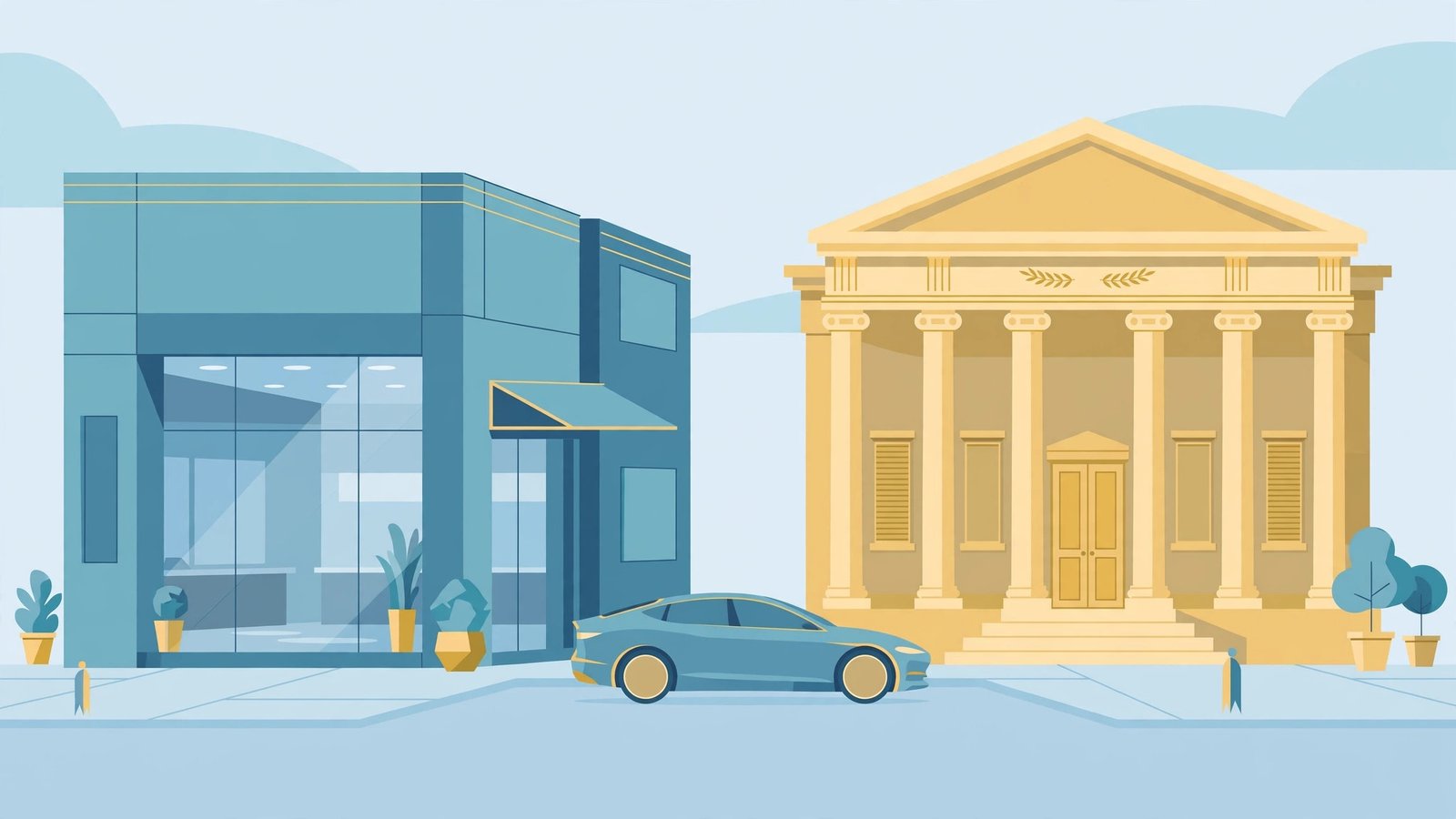
When you buy a car, you will face a choice: finance through the dealership or get a loan from your bank or credit union first. Dealers make financing sound easy — "we'll handle everything, drive out today" — but convenience is not the same as cheap.
Neither option is automatically better. The cheaper choice depends on your credit, the current promotions, and how well you negotiate. This guide compares dealer financing and bank auto loans head to head so you can spot the better deal.
How Dealer Financing Works
When you finance through a dealer, the dealer is usually not the actual lender. The dealership's finance department sends your application to several partner banks and lenders, picks one, and presents you with loan terms.
Here is the part many buyers do not know: the dealer is often allowed to mark up the interest rate. The lender approves you at a "buy rate" — say 6% — and the dealer offers you 8%, keeping the difference as profit. This markup is legal in most states and is a major source of dealer income.
Dealers can also offer genuine manufacturer promotions, like 0% APR or low-rate financing on new cars. Those special rates come from the automaker's finance company and can be the cheapest financing available anywhere. The catch is that you usually need strong credit to qualify, and you often have to give up a cash rebate to take the low rate instead.
How a Bank or Credit Union Auto Loan Works
With a bank or credit union loan, you apply before you shop (or while you shop) and get pre-approved for a set amount at a set rate. You then walk into the dealership as a "cash buyer" — you already have financing lined up.
Credit unions in particular are known for competitive auto loan rates, often beating both banks and dealer offers. Because you arrange the loan yourself, there is no dealer markup. The rate you are approved for is the rate you pay.
Getting pre-approved also gives you a powerful negotiating tool: you can focus on the car's price instead of the monthly payment, and you can let the dealer try to beat your pre-approved rate if they want your financing business.
Side-by-Side Comparison
Interest rates
- Dealer: Can be very low with manufacturer promos (0% to 2.9% APR is common on new cars for well-qualified buyers), but standard dealer-arranged loans often carry a markup above what the lender approved.
- Bank/credit union: You get the rate you qualify for with no markup. Credit unions frequently offer some of the lowest standard rates.
Fees
- Dealer: May include documentation fees and other add-ons. Some dealers also push extras like extended warranties and paint protection into the financed amount.
- Bank/credit union: Usually just the loan itself, sometimes with a small origination fee. Fewer surprise add-ons.
Convenience
- Dealer: One-stop shopping — pick the car and the loan in one visit.
- Bank/credit union: Requires a separate application step before or during the purchase, though many now approve online in minutes.
Negotiating power
- Dealer: The dealer controls the financing conversation and may steer you toward the loan that profits them most.
- Bank/credit union: You negotiate the car price separately from financing, which usually leads to a better overall deal.
Loan terms
- Dealer: Terms are set by the partner lender; the dealer may push longer terms to lower the monthly payment, which increases total interest.
- Bank/credit union: You choose the term when you apply, and you can compare total cost easily.
When Dealer Financing Wins
Dealer financing is genuinely the cheaper option in a few situations:
- Manufacturer 0% or low-APR promotions. If you qualify for 0% APR on a new car, almost nothing beats it. Just compare it against taking a cash rebate instead — sometimes the rebate plus a low bank rate costs less overall.
- Subprime credit. If your credit is rough, a dealer's network of lenders (including special finance departments) may approve you when your bank will not. The rate will be high either way, so compare carefully.
- You negotiate the rate. Some buyers successfully get the dealer to drop the markup by showing a competing pre-approval. Let them compete for your business.
When a Bank or Credit Union Wins
A bank or credit union loan is usually cheaper when:
- There is no manufacturer promotion on the car you want. Standard dealer-arranged rates with markup will typically lose to a direct bank or credit union rate.
- You are buying used. Manufacturer 0% deals are almost always for new cars. For used cars, credit unions consistently offer some of the best rates.
- You want a clean negotiation. With pre-approval in hand, you can haggle on the car's price alone and refuse to discuss monthly payments.
- You want to avoid add-ons. Finance managers are trained to sell extras. Arranging your own loan removes that pressure from the financing step.
The Smartest Strategy: Do Both
You do not have to pick one path blindly. The strategy that gets the best rate most of the time is:
- Get pre-approved by your bank or credit union before visiting the dealer. This is your baseline.
- Negotiate the car price first, without discussing financing or monthly payments.
- Let the dealer try to beat your rate. Tell the finance manager your pre-approved rate and ask if they can do better. Sometimes they can — especially with a manufacturer promotion.
- Compare the full picture, not just the monthly payment. Look at the interest rate, the loan term, the total amount financed (including any extras), and all fees.
- Read before you sign. Check that the rate, term, and numbers on the contract match what you agreed to.
- Payment packing: the dealer quotes a monthly payment higher than the loan requires, hiding extras in the difference. Always ask for an itemized breakdown.
- Focusing only on monthly payment: a lower payment over 84 months can cost thousands more in interest than a slightly higher payment over 60 months.
- Spot delivery or "yo-yo" financing: you drive the car home "approved," then the dealer calls days later saying financing fell through and you must accept worse terms. Do not take the car until financing is final.
- Skipping the rebate-vs-rate math: on a $30,000 car, a $2,000 rebate with a 5% bank loan can beat 0% dealer financing with no rebate, depending on the term. Run both numbers.
This approach costs you nothing extra and guarantees you never pay more than your pre-approved rate.
Red Flags to Watch For
Whether you finance at the dealer or the bank, watch out for these:
How Credit Score Affects Both Options
Your credit score is the biggest factor in the rate you get from either source. With excellent credit, you qualify for the best bank rates and the promotional dealer rates. With fair or poor credit, expect higher rates everywhere — and be extra careful about dealer markups, which tend to be larger on subprime loans.
If your score is on the borderline, even a small improvement before you shop can move you into a better rate tier. Paying down credit card balances and avoiding new applications in the months before you buy can help.
FAQ
Q: Is dealer financing always more expensive than a bank loan?
A: No. Manufacturer promotions like 0% APR can make dealer financing the cheapest option. But standard dealer-arranged loans often include a rate markup, so always compare against a pre-approved bank or credit union rate.
Q: Should I get pre-approved before going to the dealership?
A: Yes. Pre-approval gives you a baseline rate, turns you into a cash buyer for negotiation, and lets you judge whether the dealer's offer is actually better.
Q: Can a dealer mark up my interest rate?
A: In most states, yes. The lender approves a buy rate and the dealer may add a markup as profit. Ask what the buy rate was, or simply compare against your own pre-approval.
Q: Is 0% dealer financing really 0%?
A: The rate itself is real, but check the trade-offs: you usually need excellent credit, the term may be short (raising the monthly payment), and you typically give up a cash rebate to get it.
Q: Are credit unions better than banks for auto loans?
A: Often, yes. Credit unions are nonprofit and frequently offer lower auto loan rates and fewer fees than traditional banks, making them a strong first stop for pre-approval.
Disclaimer: This content is for general educational purposes only and is not professional financial advice.