If you have ever looked at a loan statement and wondered why your balance barely moved even though you have been paying for a year, loan amortization is the answer. Amortization is simply the process of paying off a loan in regular, scheduled payments over time.
Most common loans — mortgages, auto loans, and personal loans — are amortized loans. You pay the same amount every month, but what happens inside that payment changes over the life of the loan. Understanding this helps you see why early payments feel slow and how extra payments can save you thousands.
The Basic Idea
With an amortized loan, each monthly payment has two parts:
- Interest: the cost of borrowing the money, based on the current loan balance
- Principal: the part that actually reduces what you owe
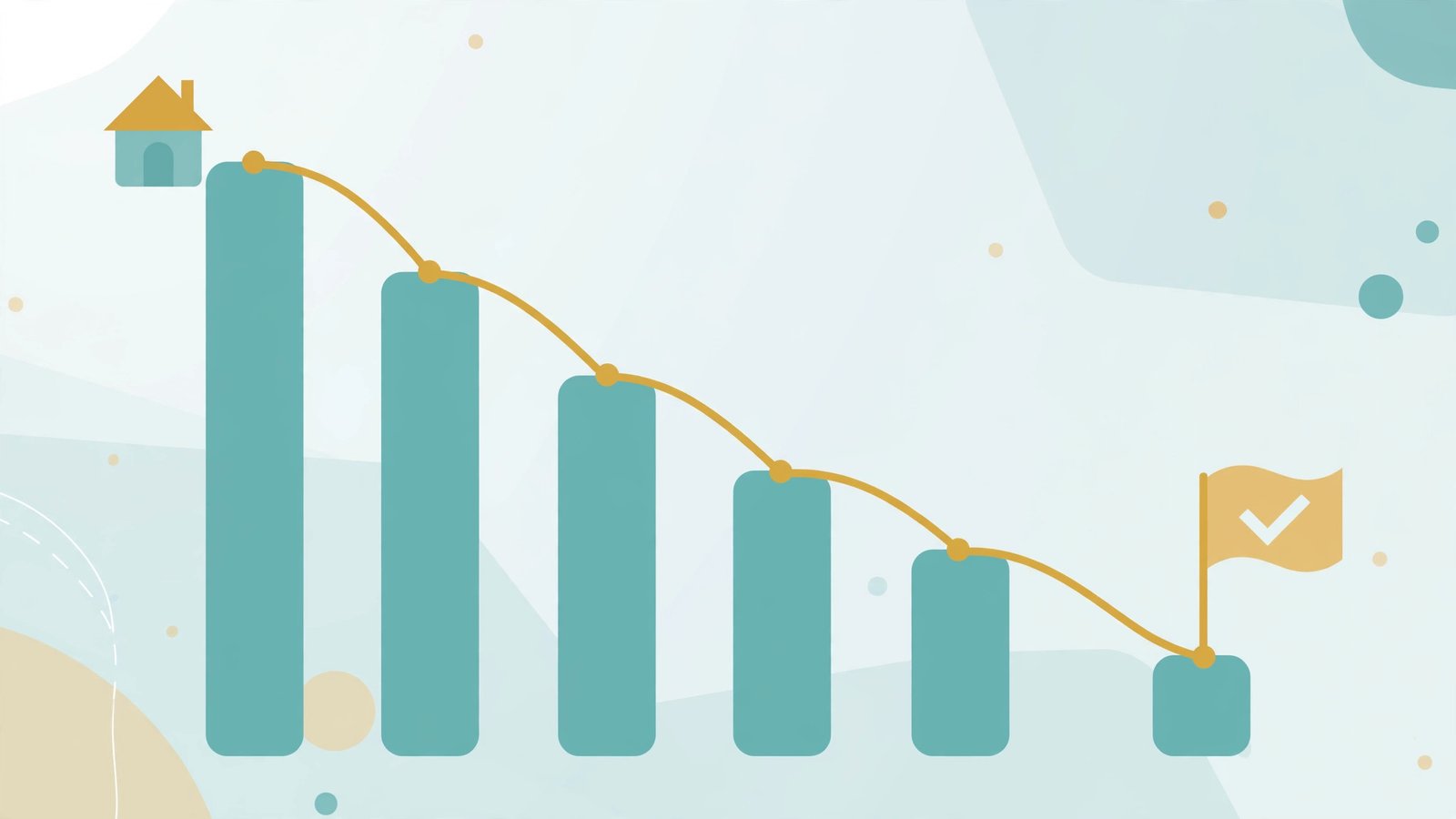
Early in the loan, most of your payment goes to interest because the balance is large. Late in the loan, most of your payment goes to principal because the balance is small. The monthly payment amount stays the same — only the split changes.
That is amortization in one sentence: fixed payments over time, with interest shrinking and principal growing as the balance falls.
A Simple Example
Imagine you borrow $10,000 at a fixed interest rate, paid back over 3 years (36 monthly payments). Your monthly payment would be roughly $304.
Here is what the first few payments look like:
- Payment 1: About $58 goes to interest, about $246 goes to principal. Balance: ~$9,754.
- Payment 2: About $57 goes to interest, about $247 goes to principal. Balance: ~$9,507.
- Payment 3: About $55 goes to interest, about $249 goes to principal. Balance: ~$9,258.
Now look at the last few payments:
- Payment 34: About $9 goes to interest, about $295 goes to principal.
- Payment 35: About $6 goes to interest, about $298 goes to principal.
- Payment 36: About $3 goes to interest, about $301 goes to principal. Balance: $0.
Same $304 payment every month. In the beginning, interest eats a bigger share. By the end, almost the whole payment goes to principal. That gradual shift is amortization in action.
The Amortization Schedule
A lender can give you an amortization schedule: a table showing every payment, how much goes to interest, how much goes to principal, and the remaining balance. It is worth asking for one (or finding a free online calculator) before you sign a loan, because it shows you two important things:
- How much interest you will pay in total over the life of the loan
- How slowly the balance drops at first, which matters if you might sell or refinance early
- All future interest is calculated on a smaller balance
- The loan ends sooner
- You pay less total interest
- Amortized loans (mortgages, auto loans, most personal loans): fixed payments, fixed end date, interest/principal split shifts over time.
- Credit cards: minimum payments vary with the balance, and there is no fixed payoff date unless you pay more than the minimum. This is not amortization.
- Interest-only loans: you pay only interest for a period, then the full balance comes due or payments jump. These are riskier because the balance never shrinks during the interest-only phase.
- Loan amount: more borrowed means more interest and a slower start.
- Interest rate: a higher rate means more of each early payment goes to interest.
- Loan term: a longer term means smaller monthly payments but much more total interest, and a slower payoff.
For example, on a 30-year mortgage, the first several years of payments are mostly interest. If you sell the house after three years, you will have paid down far less of the balance than many borrowers expect.
Why Early Payments Feel So Slow
This is the number one surprise for new borrowers. On a long loan, your balance drops slowly at first because each payment is dominated by interest. This is not a trick — it is just math. Interest is calculated on the current balance, and the balance is largest at the start.
Think of it this way: if you owe $200,000 and your rate is 6%, one month of interest alone is about $1,000. If your monthly payment is $1,200, only $200 reduces the balance that month. Next month the balance is slightly smaller, so interest is slightly smaller, and a bit more goes to principal. Over years, the shift compounds.
How Extra Payments Change Everything
Because early payments are mostly interest, extra payments made early in the loan have an outsized effect. Any extra amount you pay goes entirely toward principal (as long as you specify it is an extra principal payment), which means:
Even small extras add up. On that $10,000 three-year loan example, adding just $50 a month to the payment would cut roughly several months off the loan and save hundreds in interest. On a 30-year mortgage, one extra payment per year can shave years off the term.
Before making extra payments, check two things: that your lender applies extras to principal (not just to future payments), and that there is no prepayment penalty on your loan. Most modern mortgages and auto loans do not have prepayment penalties, but it is worth confirming.
Amortization vs. Other Ways of Paying Off Debt
Not all debt works this way:
When comparing loans, the amortization schedule lets you compare total cost, not just the monthly payment. A lower monthly payment over a longer term often means much more total interest.
What Affects Your Amortization
Three factors determine how a loan amortizes:
This is why shortening the term — for example, choosing a 15-year mortgage instead of a 30-year — builds equity so much faster. The payments are higher, but far more of each payment attacks principal from day one.
Reading Your Loan Statement
Your monthly loan statement usually shows the interest/principal split for that payment. If it does not, your amortization schedule will. Checking this once or twice a year helps you understand your real progress and decide whether extra payments make sense for you.
FAQ
Q: What is loan amortization in simple terms?
A: It is the process of paying off a loan with fixed monthly payments. Each payment covers that month's interest plus a piece of the balance, and over time more of each payment goes toward the balance.
Q: Why does my loan balance drop so slowly at first?
A: Because early payments are mostly interest. Interest is charged on the full balance, which is largest at the start, so only a small part of each early payment reduces what you owe.
Q: Do extra payments really save that much money?
A: Yes, especially early in the loan. Extra payments go straight to principal, which lowers all future interest charges and shortens the loan.
Q: Is an amortization schedule the same for every loan?
A: No. The schedule depends on the loan amount, interest rate, and term. Any change to one of these — or extra payments — changes the schedule.
Q: Are credit cards amortized?
A: No. Credit cards have variable minimum payments and no fixed payoff date. Amortization applies to installment loans with fixed payments, like mortgages, auto loans, and personal loans.
Disclaimer: This content is for general educational purposes only and is not professional financial advice.