Most budgets fail for one reason: they’re too complicated. Twenty categories, daily tracking, guilt over a $4 coffee — no wonder most people quit by February.
The 50/30/20 budget rule is the opposite of all that. It splits your money into just three buckets — and that’s the whole system. No spreadsheets required, no finance degree needed. If you can do third-grade math, you can run this budget.
Popularized by Senator Elizabeth Warren and her daughter Amelia Warren Tyagi in their 2005 book All Your Worth, this rule has survived for two decades because it does something rare in personal finance: it actually fits in your head. Here’s how it works, with real numbers, and how to make it work for your life in 2026.
What Is the 50/30/20 Budget Rule?
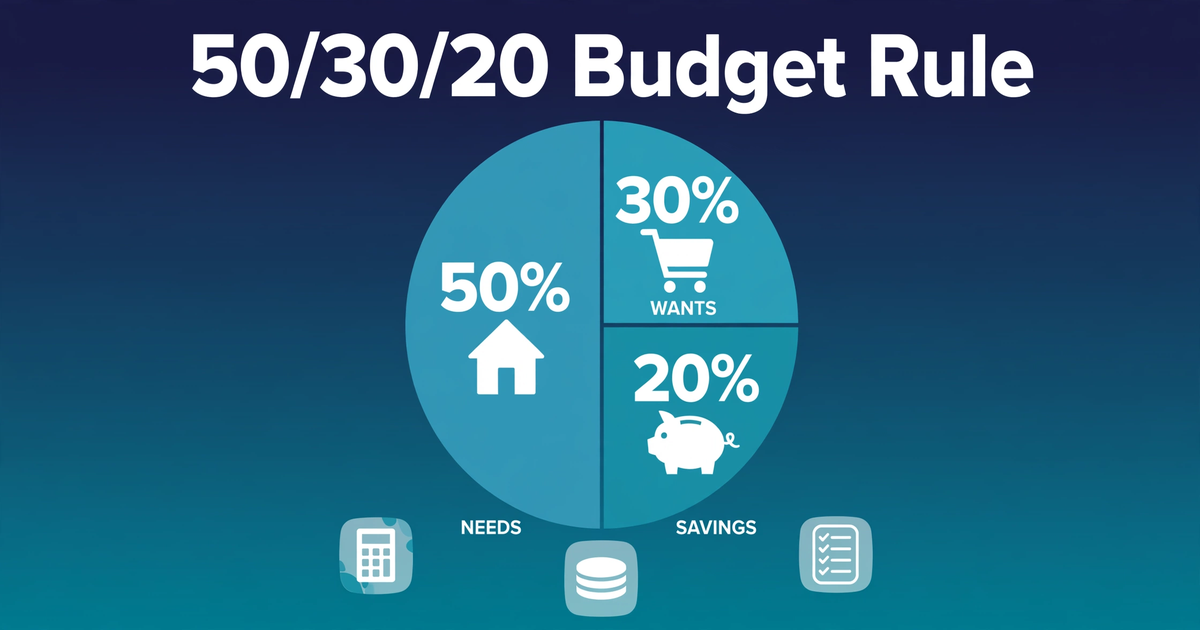
The 50/30/20 budget rule is a simple budgeting framework that divides your after-tax income — your take-home pay, the money that actually lands in your bank account — into three categories:
- 50% for Needs — the essentials you can’t skip: rent, groceries, utilities, insurance, transportation, minimum debt payments
- 30% for Wants — the fun stuff: dining out, hobbies, streaming, travel, shopping that’s not essential
- 20% for Savings and Debt Payoff — your emergency fund, retirement contributions, and any extra payments above the minimum on debts
That’s it. Three numbers. Every dollar you earn gets a job in one of those three buckets.
The 50/30/20 budget rule is just three buckets: 50% needs, 30% wants, 20% savings — all based on your take-home pay, not your salary.
The key detail most people miss: this rule runs on after-tax income, not your gross salary. If you earn $60,000 a year but take home $3,800 a month after taxes and deductions, your budget starts at $3,800 — not $5,000. Budgeting from your gross pay is like planning a road trip with gas money you don’t have.
How the 50/30/20 Budget Rule Works: The Three Buckets
Let’s open each bucket and see what actually goes inside.
Bucket 1: Needs (50%)
Needs are the non-negotiables — the bills that keep a roof over your head, food on the table, and the lights on. This bucket covers:
- Housing — rent or mortgage payment
- Utilities — electricity, water, gas, trash, basic phone plan
- Groceries — actual food, not restaurant delivery
- Transportation — car payment, gas, bus pass, insurance
- Insurance — health, renters/homeowners, the essentials
- Minimum debt payments — the smallest amount your lenders require each month
- Childcare — if you need it to work
One rule of thumb inside this bucket: try to keep housing under 30% of your total take-home pay. That leaves 20% for everything else in the needs category. In expensive cities, that’s genuinely hard — we’ll deal with that later.
Bucket 2: Wants (30%)
Wants are everything that makes life enjoyable but won’t ruin you if you skip them for a month:
- Dining out, takeout, and coffee shops
- Streaming services and subscriptions
- Hobbies, gym memberships, sports
- Clothes beyond the basics
- Vacations and weekend trips
- Gifts and entertainment
Here’s the mindset shift: the 30% bucket isn’t “wasted money.” It’s planned enjoyment. A budget with zero fun is a budget you’ll abandon. The rule just puts a fence around the fun so it doesn’t eat your future.
Bucket 3: Savings and Debt Payoff (20%)
This is your future-self bucket:
- Emergency fund contributions
- Retirement — 401(k), IRA, or whatever you use
- Extra debt payments — anything above the minimums
- Sinking funds — saving monthly for big irregular bills like car insurance or holidays
Minimum debt payments are a need (50% bucket). Extra payments above the minimum count as savings (20% bucket) — that’s how you attack debt faster without breaking the system.
50/30/20 Budget Examples: Real Numbers at Three Incomes
Theory is nice. Numbers are better. Here are 50/30/20 budget examples at three different take-home incomes so you can see exactly what each bucket holds:
| Monthly take-home | Needs (50%) | Wants (30%) | Savings (20%) |
|---|---|---|---|
| $3,000 | $1,500 | $900 | $600 |
| $5,000 | $2,500 | $1,500 | $1,000 |
| $8,000 | $4,000 | $2,400 | $1,600 |
Example 1: Maya takes home $3,000/month
- Needs — $1,500: $950 rent, $250 groceries, $120 utilities, $100 bus pass, $80 minimum credit card payment
- Wants — $900: $200 dining out, $60 streaming + subscriptions, $150 clothes, $490 for whatever she enjoys
- Savings — $600: $400 emergency fund, $200 extra credit card payment
Maya’s savings rate puts $7,200 a year toward her future. That’s a full emergency fund in about six months, built on an average income.
Example 2: James takes home $5,000/month
- Needs — $2,500: $1,500 mortgage, $400 groceries, $200 utilities, $250 car insurance + gas, $150 minimum student loan payment
- Wants — $1,500: $400 restaurants, $200 hobbies, $300 travel fund, $600 flexible fun money
- Savings — $1,000: $500 retirement, $300 emergency fund top-up, $200 extra student loan payment
James is saving $12,000 a year without feeling deprived — because the fun money is planned, not guilty.
Example 3: Priya and Sam take home $8,000/month combined
- Needs — $4,000: $2,200 mortgage, $700 groceries, $350 utilities, $400 car payment + insurance, $350 minimum debt payments
- Wants — $2,400: plenty of room for dining, travel, kids’ activities
- Savings — $1,600: maxing retirement contributions and crushing remaining debt
Notice the pattern: the percentages never change, but the dollars scale with your life. That’s the beauty of the rule — it grows with you.
Needs vs Wants: How to Sort Your Spending
The whole needs vs wants budget split hinges on one question, and most people get it wrong at first. Here’s the test: could you reasonably skip this expense for a month without serious consequences? If yes, it’s probably a want.
| Expense | Need or Want? | Why |
|---|---|---|
| Rent/mortgage | Need | You need shelter |
| Basic groceries | Need | You need to eat |
| Restaurant delivery | Want | Groceries cover the need |
| Electric bill | Need | Lights and heat matter |
| Premium phone plan | Want (partly) | A basic plan is the need; the upgrade is the want |
| Car insurance | Need | Legally required, protects you |
| Car payment (basic car) | Need | If you need it for work |
| Gas for commuting | Need | Gets you to your job |
| Streaming services | Want | Entertainment, not survival |
| Gym membership | Want | You can exercise free — but be honest about what keeps you healthy |
| Minimum loan payment | Need | Miss it and face fees + credit damage |
| Extra loan payment | Savings | Goes in the 20% bucket |
| Haircut (basic) | Need | Grooming for work/life |
| Salon color + styling | Want | The upgrade is optional |
The tricky ones are the gray areas — things that feel like needs because you’re used to them. That $80/month premium cable package? The basic internet you need for work is a need; the 200-channel upgrade is a want. Daily $6 lattes? Coffee at home is the need version.
Be honest, not punishing. The goal isn’t to label everything a want and feel miserable — it’s to see your spending clearly so the 30% wants bucket reflects choices, not autopilot.
How to Set Up Your 50/30/20 Budget in 30 Minutes
You can build this whole budget tonight. Here’s the step-by-step:
Step 1: Find your real monthly take-home pay (5 minutes). Look at your last 2–3 pay stubs or bank deposits. If you’re paid biweekly, multiply one paycheck by 26 and divide by 12 — that gives you the true monthly average. Use the number that hits your account.
Step 2: Multiply by 0.50, 0.30, and 0.20 (2 minutes). On a $4,200 take-home: needs = $2,100, wants = $1,260, savings = $840. Write these three numbers where you’ll see them — a sticky note, your phone notes, the fridge.
Step 3: List your actual spending and sort it (15 minutes). Pull up last month’s bank and credit card statements. Put every expense into one of the three buckets using the needs-vs-wants test above. Don’t judge yet — just sort.
Step 4: Compare and find the gaps (5 minutes). Ask three questions:
1. Are my needs near 50% — or way over?
2. Are my wants near 30% — or secretly 45%?
3. Am I actually saving 20%?
Most people discover one bucket is badly off. That’s not failure — that’s the diagnosis the rule was designed to give you.
Step 5: Automate the 20% on payday (3 minutes). Set up an automatic transfer that moves your savings amount out of checking the day after each payday — into a separate savings account. Start with whatever you can, even $50 per paycheck, and work toward the full 20%.
Automate the 20% on payday. Money you never see sitting in checking is money you never miss — willpower is unreliable, automation isn’t.
Don’t Forget Irregular Expenses: The Sinking Fund Trick
Here’s where most 50/30/20 budgets quietly break: the non-monthly bills. Car insurance due twice a year ($900). Christmas gifts ($600). Annual car registration ($150). Back-to-school supplies ($200). None of these show up in a “monthly” budget — until they ambush you all at once.
The fix is a sinking fund: take each irregular expense, divide by 12, and save that slice every month inside your 20% bucket.
| Irregular bill | Yearly cost | Monthly sinking fund amount |
|---|---|---|
| Car insurance (2 payments) | $1,800 | $150 |
| Holiday gifts | $600 | $50 |
| Car registration + maintenance | $900 | $75 |
| Annual subscriptions | $240 | $20 |
| Total | $3,540 | $295/month |
So on a $5,000 take-home, your $1,000 savings bucket might split into $295 sinking funds + $705 for emergency fund and retirement. You’re still saving 20% — you’ve just given part of it a specific job.
Without sinking funds, every irregular bill becomes a “surprise” that raids your emergency fund or lands on a credit card. With them, December and insurance-renewal month feel like every other month. Boring — in the best way.
A sinking fund turns “surprise” bills into planned ones: divide any yearly cost by 12 and save it monthly inside your 20% bucket.
When the 50/30/20 Rule Doesn’t Fit (and What to Do Instead)
Honest truth: for a lot of households in 2026, the standard split doesn’t fit on the first try. Rent is high, groceries cost more than they did five years ago, and childcare can swallow a paycheck whole. If your needs genuinely cost 65% of your take-home pay, pretending they’re 50% helps nobody.
The fix isn’t to throw out the rule — it’s to adjust the percentages while keeping the three-bucket idea:
| Your situation | Adjusted split | When to use it |
|---|---|---|
| Standard | 50 / 30 / 20 | Costs are manageable; the classic starting point |
| High-cost area | 60 / 25 / 15 | Rent alone eats 35–40%; protect savings even if it’s smaller |
| Aggressive debt payoff | 50 / 20 / 30 | High-interest debt is an emergency — starve wants temporarily |
| High income, big goals | 40 / 20 / 40 | Earning well and want to build wealth fast |
| Survival mode | 70 / 10 / 20 | Bare-bones: needs dominate, wants nearly zero, but savings stay |
If your needs cost more than 50%, don’t quit the rule — shrink your wants first, then adjust the percentages. A 60/25/15 budget you follow beats a 50/30/20 budget you abandon.
What about the 50/30/20 rule on low income?
It still works — but the order of operations changes. On a tight budget, protect the 20% first, even if it’s small. Someone taking home $2,200 a month might run 70/15/15: needs dominate, wants are tiny, but $330 a month still goes to savings. That’s $3,960 a year — a real emergency fund, built on a low income.
The worst move on a low income is deciding the rule “isn’t for people like me” and saving nothing. A small 20% (or even 10% while you get stable) beats a perfect plan you never start.
Also note: the 50/30/20 framework assumes fairly stable income. If your paycheck swings wildly month to month — freelancing, gig work, seasonal jobs — run the percentages on your lowest typical month, not your average. Budget the floor; save the surplus months’ extra.
50/30/20 vs Other Budgeting Methods: Which Fits You?
The 50/30/20 rule isn’t the only way to budget. Here’s how it stacks up against the other popular systems, so you can pick honestly:
Zero-based budgeting (every dollar gets a named job until income minus spending equals zero) is more precise — and much more work. It’s the right choice if you love detail and your spending has lots of small leaks. But most beginners quit it within weeks because tracking 25 categories is exhausting. 50/30/20 gives you 80% of the control with 20% of the effort.
Pay-yourself-first (save a fixed amount or percent off the top, spend the rest freely) is even simpler than 50/30/20 — but it gives zero guidance on the spending side. If your problem is overspending rather than under-saving, pay-yourself-first won’t diagnose it. 50/30/20’s three buckets show you the overspending instead of just hiding the savings from yourself.
The envelope system (cash in physical envelopes per category) is powerful for people who overspend on cards — studies consistently show cash hurts more to spend. But it’s impractical if most of your bills are autopay and you shop online. A good hybrid: run 50/30/20 for the big picture, and use a cash envelope just for the wants bucket if that’s where you leak.
Bottom line: 50/30/20 wins on simplicity and staying power. The best budget isn’t the most sophisticated one — it’s the one you’re still following in six months.
Simple beats sophisticated: the best budget is the one you’re still following six months from now, not the one with the most categories.
5 Mistakes People Make With the 50/30/20 Budget Rule
Mistake 1: Using gross income instead of take-home pay. The most common error, and it breaks everything. A $70,000 salary might mean $4,400 a month in your account — budget from $4,400, not $5,833. The rule only works on money you actually control.
Mistake 2: Calling everything a need. “I need my $150/month meal kit subscription” — no, you need food; the meal kit is a want wearing a need costume. Audit the gray areas ruthlessly once, then relax.
Mistake 3: Putting the full credit card payment in needs. Only the minimum goes in the 50% bucket. The rest is savings-bucket money attacking your debt. Mixing them up hides how much interest you’re really paying.
Mistake 4: Treating the percentages as law. The rule is a diagnostic tool, not a religion. If 52/28/20 fits your life better than 50/30/20, that’s a win. The people who fail are the ones who hit 55% on needs in month one, declare the system broken, and go back to no budget at all.
Mistake 5: Never reviewing it. Your first 50/30/20 budget is a draft, not a final answer. Rent goes up, you get a raise, a debt gets paid off — review the split once a month for the first six months, then quarterly. Ten minutes, three numbers, done.
The rule is a diagnostic tool, not a law. Its real job is showing you where your money actually goes — then you decide what to change.
50/30/20 Budget Rule FAQs
Do I use gross income or net income for the 50/30/20 budget rule?
Net income — your take-home pay. The 50/30/20 budget rule is built on the money that actually hits your bank account after taxes, health insurance premiums, and retirement contributions come out. Using gross income inflates every bucket with money you never see, which guarantees the budget won’t match reality.
What counts as a need vs a want?
A need is spending required to live and work: housing, basic groceries, utilities, transportation to your job, insurance, childcare, and minimum debt payments. A want is everything else — dining out, subscriptions, hobbies, travel, upgraded versions of things you already have. The test: could you skip it for a month without serious consequences? Gray areas (like a gym membership that keeps you healthy) get an honest call from you — just don’t let every gray area land in “need.”
Does the 50/30/20 rule work on a low income?
Yes, with adjusted expectations. The percentages are targets, not pass/fail grades. On a $2,200/month take-home, a realistic split might be 70/15/15 — and that 15% savings is still $330 a month toward your emergency fund. The key shift: fund the savings bucket first, even if it’s small, then fit needs and wants into what’s left. Saving 10% consistently beats planning 20% and saving zero.
What if my needs are more than 50% of my income?
You’re normal — especially in high-cost cities in 2026. Don’t abandon the framework; adjust it. Try 60/25/15 as a starting point, and attack the problem from both sides: trim the biggest need (usually housing — a roommate, a move, or refinancing can move the needle more than 100 small cuts) and temporarily squeeze wants while you stabilize. Revisit the split every few months as your situation changes.
Where do debt payments go in the 50/30/20 budget rule?
Minimum payments go in the 50% needs bucket — they’re obligations, and missing them has real consequences. Anything you pay above the minimum goes in the 20% savings bucket, because extra debt payoff builds your net worth exactly like saving does. This split matters: it stops you from feeling like debt payoff “doesn’t count” as progress, and it keeps the true cost of your debt visible.
Start Tonight, Not Someday
The 50/30/20 budget rule won’t make you rich by itself. What it does is harder and more valuable: it gives every dollar a job, puts a fence around fun spending without killing it, and guarantees your future self gets paid every single month.
You don’t need an app, a spreadsheet, or a perfect first attempt. Tonight: find your take-home pay, multiply by 0.5, 0.3, and 0.2, and sort last month’s spending into three buckets. Thirty minutes. That’s the whole setup.
Then automate the 20%, review once a month, and adjust without guilt. Simple beats perfect — every time.
Quick recap: take-home pay × 0.5 for needs, × 0.3 for wants, × 0.2 for savings and extra debt payments. Minimum debt payments live in needs; everything above the minimum lives in savings. Irregular yearly bills get their own monthly sinking fund inside the 20%. If the classic split doesn’t fit your city or your income, adjust the percentages — 60/25/15 or 50/20/30 — and keep going. The system works because it’s simple enough to survive real life.