When money gets tight, your regular budget breaks. You don’t need a better budget — you need a survival budget.
A bare bones budget is the simplest budget you will ever make. It covers only what keeps a roof over your head, food on the table, and you employed. That’s it. No dining out. No subscriptions. No fun money. Just survival.
Think of it like triage in an emergency room. Doctors don’t fix everything at once — they stop the bleeding first. A bare bones budget does the same thing for your money. It stops the bleeding so you can get through the crisis without going under.
This guide walks you through the whole thing: what to keep, what to cut, and how to build your own emergency budget plan step by step, with real numbers. By the end, you’ll know exactly how many months your money can last — and what to do this week to stretch it further.
What Is a Bare Bones Budget?
A bare bones budget is a stripped-down spending plan that covers only your survival expenses. It is not about saving for vacation or paying extra on debt. It is about making sure you can pay for the essentials until things get better.
Here’s how it differs from the budget you normally use:
| Normal Budget | Bare Bones Budget | |
|---|---|---|
| Goal | Spend smart, save, enjoy life | Survive the crisis |
| Covers | Everything: needs, wants, goals | Needs only: the “big four” |
| Eating out | Allowed, within limits | Paused completely |
| Subscriptions | Kept if affordable | Paused or canceled |
| Debt payments | Extra payments encouraged | Minimums only |
| Savings | 10–20% of income | Paused (except tiny buffer) |
| Timeframe | Ongoing | Temporary: weeks to months |
Most people are surprised by how different the two feel. A normal budget asks, “How can I spend wisely?” A bare bones budget asks a harder question: “What can I live without for the next 90 days?”
The whole point of a bare bones budget is buying time — every dollar you cut is another day of breathing room.
When Do You Need One?
You don’t need a crisis the size of a movie plot to use one. Here are the real-life moments when people switch to survival mode:
- Job loss. Your paycheck stops, but rent doesn’t. A bare bones budget tells you exactly how long your savings will carry you.
- Hours or pay cut. You went from $4,200 a month to $2,800. Your old budget no longer fits your new reality.
- Medical emergency. A $6,000 hospital bill just landed. Every spare dollar needs to go toward staying afloat.
- Debt emergency. You’re behind on payments and collectors are calling. Survival mode frees up cash to stop the damage.
- Building an emergency fund fast. Some people use a bare bones budget on purpose for 2–3 months just to pile up savings at record speed.
- Recession prep. If layoffs are circling your industry, switching early means you face the storm with a smaller burn rate.
Notice something? In every case, the goal is the same: spend less than you must, keep what matters, and buy yourself time.
There’s also a mental shift worth naming. A normal budget is about optimization — squeezing a little more joy or savings out of each dollar. A bare bones budget is about permission. It gives you permission to stop feeling guilty about what you can’t afford right now. The gym, the takeout Fridays, the birthday gifts that stretch you thin — pausing them isn’t failure. It’s strategy. People who accept the temporary nature of survival mode get through it faster than people who half-commit and keep leaking money while feeling bad about it. Go all in, get through it, come back stronger.
Step 1: List Your True Survival Expenses
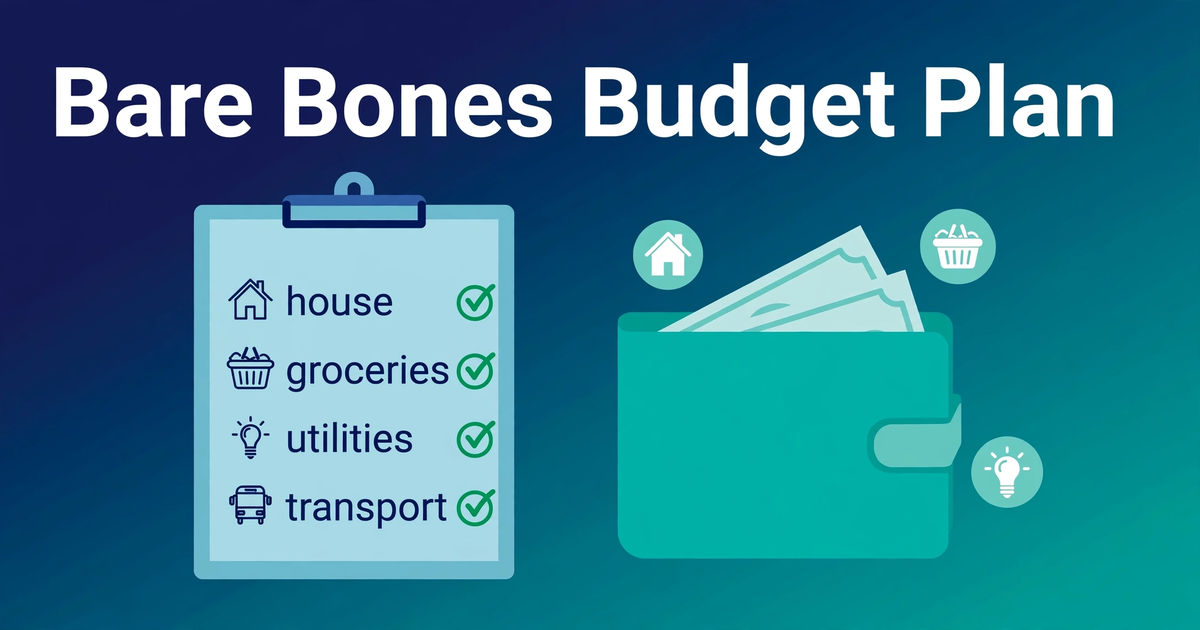
Every bare bones budget is built on what money experts call the “big four.” These are the four walls of your financial house — if one of them falls, everything else collapses:
- Housing — rent or mortgage. This is always first. Without it, nothing else matters.
- Utilities — electricity, water, gas, basic phone. The things that keep the lights on and the house livable.
- Food — groceries, not restaurants. Rice, beans, eggs, frozen vegetables. The goal is fed, not fancy.
- Transportation — whatever gets you to work. Car payment, gas, insurance, or a bus pass. If you can’t get to work, you can’t earn.
Then add a fifth line most people forget:
- Minimum debt payments — the smallest amount each lender requires. Paying minimums keeps accounts current and stops late fees from piling on.
What does not count as survival? Be honest with yourself here:
- Dining out and takeout (that’s not “food” — groceries are food)
- Subscriptions of any kind (streaming, apps, boxes, memberships)
- New clothes (unless something is literally falling apart)
- Gifts, entertainment, hobbies that cost money
- Extra debt payments beyond the minimum
A few gray areas deserve a straight answer. Medications and basic healthcare count as survival — never skip prescriptions to save money; call your pharmacy about discount programs instead. Kids’ school essentials (supplies, lunches) count too. Work-required costs count — if your job needs steel-toe boots or a uniform replacement, that’s survival, not shopping. But be strict with yourself on the fuzzy stuff: the “I need new workout clothes” urge, the “kids deserve a treat” guilt, the “it’s only $12” subscriptions. In survival mode, if you have to talk yourself into it, the answer is no.
Here’s your minimum monthly expenses list — copy it, fill in your numbers, and be ruthless:
- ☐ Rent / mortgage: $______
- ☐ Electricity: $______
- ☐ Water / sewer / trash: $______
- ☐ Gas / heating: $______
- ☐ Basic phone plan: $______
- ☐ Groceries (basics only): $______
- ☐ Car payment (if needed for work): $______
- ☐ Car insurance: $______
- ☐ Gas / bus fare: $______
- ☐ Minimum credit card payments: $______
- ☐ Other minimum loan payments: $______
- ☐ TOTAL: $______
That total is the most important number in this entire guide. Write it down and circle it — everything else in this plan flows from that one number.
Your bare bones number is your monthly “cost of staying alive.” Know it cold.
Step 2: Sort Every Expense — Keep, Reduce, Pause
Now grab your last two or three bank statements and sort every single expense into one of three buckets. This is the heart of learning how to make a survival budget — and it’s oddly satisfying once you start.
Set aside 45 quiet minutes for this. Print the statements or open them on a laptop — phone screens make it too easy to skim. Go line by line, and for each charge ask: “If I lost my income tomorrow, would I still pay this?” If you share money with a partner, do it together; survival mode only works when both people agree on the rules. You’ll find charges you forgot existed. That’s normal — and that’s exactly why this exercise works.
KEEP means it stays, untouched. REDUCE means you keep it but shrink it. PAUSE means it goes away until the crisis passes. Paused is not canceled forever — it’s just sleeping.
| Expense | Decision | Typical Monthly Savings |
|---|---|---|
| Rent / mortgage | Keep | $0 — non-negotiable |
| Electricity | Reduce (thermostat discipline) | $30–$60 |
| Groceries | Reduce (basics, store brands, meal plan) | $150–$300 |
| Car insurance | Keep (shop for cheaper rate) | $20–$50 |
| Gas / transit | Reduce (combine trips) | $40–$80 |
| Basic phone plan | Reduce (drop to cheaper plan) | $20–$40 |
| Minimum debt payments | Keep | $0 — protects your credit |
| Internet | Reduce (downgrade speed) | $15–$30 |
| Dining out / takeout | Pause | $120–$250 |
| Netflix / streaming | Pause | $16–$23 per service |
| Spotify / music apps | Pause (use free tier) | $11–$12 |
| Gym membership | Pause (walk, bodyweight workouts) | $30–$60 |
| Subscriptions boxes | Pause | $20–$50 |
| Coffee shops | Pause (brew at home: ~$0.30/cup) | $80–$150 |
| New clothes | Pause | $50–$100 |
| Gifts / entertainment | Pause | $50–$150 |
| Haircuts / salon | Reduce (stretch appointments) | $20–$40 |
| Extra debt payments | Pause (minimums only for now) | $100–$300 |
| Savings contributions | Pause (keep a $500 mini-buffer) | Varies |
| Hobbies that cost money | Pause (find free versions) | $30–$100 |
Add up the “savings” column for your own life and you’ll probably find $500 to $1,000 a month hiding in expenses that felt mandatory last week. They weren’t. They were just habits.
A quick word on the hard ones. Pausing the gym when workouts keep you sane feels awful. Canceling the streaming service the whole family watches together feels petty. Do it anyway — temporarily. You can restart every single paused expense the month the crisis ends, but you can’t un-spend the money.
Pro tip for the Pause column: write every paused expense on a piece of paper and stick it on the fridge, with the date you paused it. This does two things — it stops the “out of sight, out of mind” creep where paused spending sneaks back, and it turns restarting into a celebration later. People who track their paused list save an average of one extra month of expenses compared to people who just “try to spend less,” because the list makes the cuts visible and deliberate instead of vague and guilty.
Sort every expense into Keep, Reduce, or Pause — most people free up $500 to $1,000 a month without touching the big four.
Step 3: A Full Worked Example
Let’s make this concrete with a bare bones budget example using real numbers. Meet a realistic household: one person earning $4,000 a month normally, now down to $2,900 after a layoff and a part-time bridge job.
| Category | Normal Spend | Bare-Bones Spend | You Save |
|---|---|---|---|
| Rent | $1,200 | $1,200 | $0 |
| Electricity | $140 | $95 | $45 |
| Water / trash | $60 | $60 | $0 |
| Phone plan | $75 | $40 | $35 |
| Internet | $70 | $50 | $20 |
| Groceries | $550 | $320 | $230 |
| Dining out / takeout | $180 | $0 | $180 |
| Car payment | $320 | $320 | $0 |
| Car insurance | $130 | $110 | $20 |
| Gas | $160 | $100 | $60 |
| Minimum debt payments | $280 | $280 | $0 |
| Extra debt payments | $200 | $0 | $200 |
| Streaming services | $45 | $0 | $45 |
| Gym | $40 | $0 | $40 |
| Coffee shops | $90 | $0 | $90 |
| Clothes / misc | $120 | $25 | $95 |
| Savings | $340 | $0 | $340 |
| TOTAL | $4,000 | $2,600 | $1,400 |
Look at that bottom line. By pausing the nice-to-haves and trimming the flexible bills, this household freed up $1,400 a month — and the new income of $2,900 still covers the $2,600 survival number with $300 to spare.
That’s the power of the worked example: it turns “spend less” from vague advice into an exact plan. Your numbers will differ, but the method is identical. Build your own version of this table tonight — it takes 30 minutes and it changes everything.
A realistic bare-bones budget typically cuts 25–35% off normal spending — run your own numbers and see.
Step 4: Prioritize Debt Payments
In survival mode, you pay minimums only on every debt. Not extra. Not “as much as I can.” Minimums. Every dollar above the minimum goes toward keeping you alive longer, not toward debt that can wait.
But when cash is truly short — when even minimums don’t all fit — pay in this order:
- Housing first. Miss rent or mortgage and you risk eviction or foreclosure. Nothing outranks a roof.
- Car, if you need it for work. Lose the car, lose the income. (If you take the bus, this drops off the list.)
- Utilities. Most have hardship programs — call and ask before you fall behind.
- Minimum credit card payments. Keeps accounts current and avoids penalty APRs.
- Everything else waits. Medical bills, personal loans, and old collections can usually be negotiated later.
An honest note: missing payments will hurt your credit score, and late fees are real. But here’s the thing nobody tells you — a damaged credit score is repairable, but an eviction or repossession follows you for years. Protect the big things first. You can rebuild a score. It’s much harder to rebuild from losing your home.
Here’s what “minimums only” looks like in real dollars. Say you owe $4,200 across two credit cards at around 24% APR. Your minimums are roughly $105 and $85 — $190 total. Paying just that keeps both accounts current and avoids the $30–$40 late fee per card plus penalty interest. Paying an extra $200 toward the balance would feel productive, but in survival mode that $200 is two weeks of groceries. The math of staying alive beats the math of getting ahead — for now.
If you’re already behind, call your lenders before they call you. Ask about hardship programs, deferred payments, or reduced minimums. You’d be shocked how often the answer is yes — but only if you call first.
Know Your Cash Runway
Here’s the simplest, most powerful formula in this guide:
Cash runway = Your savings ÷ Your bare-bones monthly number
That’s it. The answer tells you how many months you can survive with zero income.
Let’s run it with the example household from Step 3, which has $6,000 in savings:
| Savings | Monthly Burn | Runway |
|---|---|---|
| $6,000 | $4,000 (normal spending) | 1.5 months |
| $6,000 | $2,900 (light cuts) | ~2 months |
| $6,000 | $2,600 (full bare bones) | ~2.3 months |
| $6,000 | $2,200 (bare bones + side gig income) | ~2.7 months |
See what happened? The same $6,000 lasts 1.5 months at normal spending but nearly 3 months in full survival mode. You didn’t earn a dollar more — you just stopped the bleeding.
Now do yours. Take your savings, divide by your bare-bones number from Step 1. If your runway is under 2 months, cutting expenses this week isn’t optional — it’s urgent. If it’s over 4 months, you have breathing room to make calm, smart decisions instead of panicked ones.
And remember: every expense you pause lengthens the runway. Canceling a $50 subscription doesn’t save $50 — it buys you extra days of survival.
One more scenario, because two-income households face this too. A couple with $10,000 saved spends $5,200 normally — that’s under two months of runway, panic territory. On a $3,400 bare-bones budget, the same $10,000 stretches to nearly three months. And if one partner picks up weekend work bringing in $800 a month, the real monthly burn drops to $2,600 and the runway pushes past three and a half months. Same savings, completely different level of calm — all from the budget, not the bank account.
Divide your savings by your bare-bones monthly number — that’s your runway, and every cut you make lengthens it.
How to Cut Expenses Fast
Knowing how to cut expenses fast matters because the first week sets the tone. Don’t aim for perfect — aim for done. Here’s your this-week hit list, with what each move typically saves:
1. Pause every subscription today (30 minutes, saves $50–$150/month).
Open your bank statement and kill them all: Netflix ($15.49), Hulu ($9.99), Spotify ($11.99), gym ($30–$60), subscription boxes, cloud storage upgrades, app subscriptions you forgot about. The average American has $50 to $80 a month in subscriptions they’ve forgotten. Be ruthless — you can resubscribe later in about four clicks.
2. Call three companies and ask for less (1 hour, saves $40–$100/month).
Call your internet provider and downgrade your speed — most households pay for speed they never use. Call your phone carrier and switch to a cheaper plan or prepaid. Call your car insurer and ask about low-mileage or safe-driver discounts. Use this sentence: “I’m going through a tough time and need to lower my bill — what are my options?” It works far more often than people expect.
3. Meal-plan from your pantry first (1 hour, saves $100–$200/month).
Before buying a single grocery, inventory what you already own. Build this week’s meals around it. Then shop with a list, buy store brands, and stick to cheap staples: rice, beans, eggs, oats, frozen vegetables, bananas. A family can eat well on $80 to $100 per person per month when they plan around basics.
4. Sell one thing this weekend (2 hours, earns $50–$300 once).
Everyone owns something worth real money that they never use: a bike, a console, tools, designer bag, old phone. List it today. That one-time cash injection goes straight into your runway — $150 from a sold bike is half a month of groceries.
5. Drop your thermostat and kill phantom power (15 minutes, saves $30–$60/month).
Two degrees lower in winter, two degrees higher in summer. Unplug the TV, game console, and chargers when not in use. Wash laundry cold. These sound tiny because they are tiny — but tiny times twelve months is real money.
Do all five and a typical household banks $300 to $600 a month starting within days. Not theory. This week.
Five moves this week — pause subscriptions, negotiate three bills, pantry meal plan, sell one thing, trim energy use — can free up $300 to $600 a month.
How Long Should You Stay on a Bare Bones Budget?
A bare bones budget is a cast, not a lifestyle. You wear it while the bone heals, then you take it off.
Stay on it until the crisis passes — plus one extra month as a buffer. Got the new job? Great — stay lean for one more month and bank the difference. Paid off the emergency bill? One more month, then loosen up. That buffer month is what turns “survived it” into “stronger than before.”
Signs you’re ready to loosen up:
- Income is stable again for 4–6 weeks
- You have at least one month of expenses saved back up
- The emergency debt is handled or on a plan
- You can cover the big four without anxiety
When you do loosen up, do it on a schedule — not all at once. A simple re-entry plan: month one, add back one paused expense you genuinely missed (not all of them). Month two, restart your regular savings contribution, even a small one. Month three, resume extra debt payments. People who flip straight from survival mode back to full spending usually burn through the buffer they just built within weeks. The gradual climb protects everything you sacrificed to earn.
But watch for the trap on the other side: staying in survival mode too long burns you out. Months of saying no to everything — no coffee with friends, no small treats, no breathing room — grinds people down. Some quit budgeting entirely after a brutal stretch, which is worse than never starting. When the crisis genuinely passes, let yourself live again. Gradually, deliberately — but genuinely.
Rebuilding After: From Survival Back to Normal
Coming out of survival mode is a process, not a party. Reverse it in the right order:
- Rebuild your emergency fund first. Before restarting a single subscription, get back to at least $1,000 in savings, then work toward one month of expenses. The next crisis is always a matter of when, not if.
- Restart paused debt payoff. Go back to paying more than minimums, highest interest rate first.
- Add back paused expenses one at a time. Not all at once. Pick the one you missed most, add it, live with it for two weeks, then add the next.
- Keep one survival habit forever. Most people keep the pantry meal planning, or the cheaper phone plan, or the “pause before subscribing” rule. One habit kept is worth more than the whole ordeal forgotten.
You went through the fire and came out knowing exactly what your money can do. That’s not just survival — that’s a skill most people never learn.
Put a number on it so the lesson sticks. If your bare-bones spending was $2,600 and your normal spending was $4,000, you now know you can live on $1,400 less than you thought. You don’t have to stay there — but imagine directing even half of that difference, $700 a month, into savings going forward. That’s $8,400 a year. The crisis forced you to discover your real number. Don’t let that knowledge go to waste.
Rebuild in order: emergency fund first, then debt payoff, then paused expenses one at a time.
FAQs
What is a bare-bones budget?
A bare-bones budget is a temporary spending plan that covers only your survival expenses: housing, utilities, basic groceries, transportation to work, and minimum debt payments. Everything else — dining out, subscriptions, entertainment, extra savings — is paused until the financial crisis passes. Most households cut 25–35% off their normal spending this way. Unlike a zero-based budget, which assigns every dollar a job, a bare-bones budget has only one job for your dollars: keep you afloat until the storm passes.
What expenses go into a survival budget?
The “big four” plus minimums: (1) housing — rent or mortgage, (2) utilities — electricity, water, gas, basic phone, (3) food — groceries and staples, not restaurants, (4) transportation — whatever gets you to work, and (5) minimum payments on all debts. If an expense doesn’t keep a roof over your head, food on the table, or you employed, it doesn’t make the list.
How long would my emergency fund last on a bare-bones budget?
Divide your savings by your bare-bones monthly number. For example, $6,000 in savings divided by a $2,600 bare-bones budget equals about 2.3 months of survival — versus only 1.5 months at $4,000 normal spending. Cutting to bare bones nearly doubles how long the same savings last.
What should I cancel first?
Cancel in this order: (1) subscriptions you forgot about — streaming, apps, boxes, (2) dining out and takeout, (3) coffee shops and daily treats, (4) gym and memberships, (5) new clothes and non-essential shopping. Keep anything tied to the big four, and downgrade rather than cancel internet and phone since you may need them for job hunting.
Can you show a bare-bones budget example with real numbers?
Sure. A household spending $4,000 normally cut to $2,600 on bare bones: rent $1,200 stayed, groceries dropped from $550 to $320, dining out ($180), streaming ($45), gym ($40), and coffee shops ($90) went to zero, and extra debt payments ($200) paused to minimums only. Total freed up: $1,400 a month — without touching housing, utilities, or transportation.
Final Word
Tough times don’t last, but the lessons from them do. A bare bones budget won’t fix everything overnight — but it will tell you exactly where you stand, how long you can last, and what to do next. That’s not just a budget. That’s control, when control feels impossible.
Start tonight. List your big four, sort one bank statement, and pause three subscriptions. Thirty minutes from now, you’ll already be in a stronger position than you are right now. You’ve got this.