Saving $1,000 feels impossible when every dollar you earn is already spoken for. Rent, groceries, gas, the phone bill — there’s barely anything left, so how is anyone supposed to save a whole thousand dollars?
Here’s the truth: if you’ve been searching for how to save $1000 on low income, you’re not doing anything wrong. The problem isn’t your willpower. It’s that most savings advice was written for people who earn a lot more than you do. “Just save 20% of your income!” doesn’t help much when 20% of your paycheck is the grocery money.
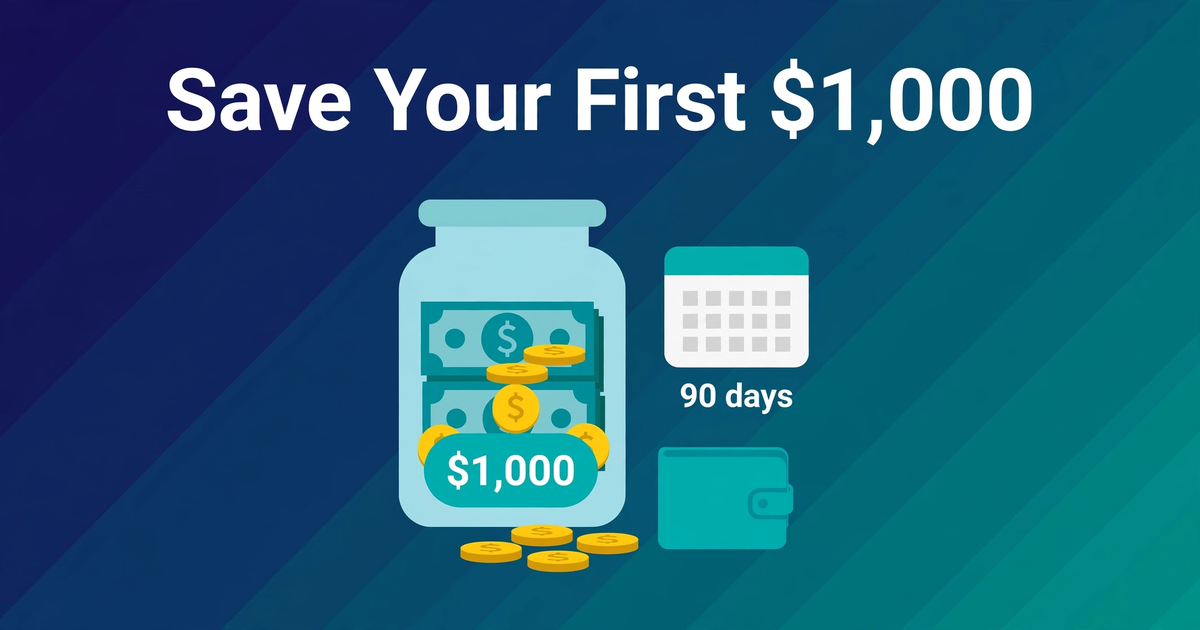
But the math tells a different story. $11 a day for 90 days is $1,000. That’s it. Eleven dollars a day — less than the cost of a fast-food lunch — and in three months you’ve got a four-figure safety net with your name on it.
This guide shows you exactly how. No side hustle required. No selling your car. No ramen-noodle misery. Just a simple plan, real numbers, and small changes that add up fast. Let’s get into it.
The Simple Math Behind $1,000
Big goals feel scary. Small daily numbers don’t. That’s why the first step is breaking $1,000 down into pieces so small they stop feeling impossible.
Pick the timeline that fits your life. All three roads lead to the same place:
| Timeframe | What you need to save | The daily version |
|---|---|---|
| 90 days | $11.11 per day | Skip one takeout lunch |
| 6 months | $38.46 per week | One cheap grocery run’s worth |
| 12 months | $83.33 per month | Less than most phone bills |
The whole trick is this: you don’t save $1,000. You save $11 eleven times, then do it again tomorrow.
The 90-day plan is the most popular because it’s fast enough to stay exciting. Ninety days from now is basically next season — close enough that you can picture it. A full year works too if money is extremely tight right now. There’s no wrong answer here, only the one you’ll actually stick with.
One more helpful number: $1,000 is what financial counselors call a “starter emergency fund.” It covers the surprise car repair, the emergency dentist visit, the phone that dies at the worst moment. It’s not retirement money — it’s “life stops blindsiding me” money. And that changes everything about how stressful your month feels.
Step 1: Find Your Leaks (The 30-Day Spending Audit)
You can’t save what you can’t see. Most people on a tight budget are shocked to learn they’re losing $100–$200 a month to spending they don’t even notice. Not big splurges — tiny, invisible leaks.
Here’s how to find yours. You don’t need a budgeting app or a spreadsheet. Just open the notes app on your phone and write down every single dollar you spend for 30 days. Coffee, gas, the vending machine, everything. It takes about 30 seconds per purchase.
Yes, it’s annoying for the first week. By week two it becomes automatic. And by day 30, you’ll have a list that tells you exactly where your money is going — which is information most people never get.
The Usual Suspects: Common Money Leaks
When you review your 30 days of notes, look for these first. The table below shows what each one really costs you over a full year, because monthly prices lie — they sound small until you multiply by 12:
| The leak | Typical monthly cost | What it really costs per year |
|---|---|---|
| Forgotten subscriptions (streaming, apps, boxes) | $40 | $480 |
| Eating out / takeout 3x a week | $150 | $1,800 |
| Daily coffee or energy drink | $90 | $1,080 |
| Impulse buys (clothes, gadgets, “treats”) | $100 | $1,200 |
| ATM fees and overdraft fees | $25 | $300 |
| Delivery app fees and markups | $60 | $720 |
Read that right-hand column again. Nearly $5,600 a year can vanish into leaks most people never think about. You don’t need to plug all of them — plugging even two gets you most of the way to $1,000.
You don’t have a spending problem. You have a visibility problem — and 30 days of notes fixes it.
Circle the two or three leaks that surprised you most. Those are your first targets. Don’t try to fix everything at once; that’s how people burn out by week two. Two leaks, that’s your mission for now.
Step 2: How to Save $1000 on Low Income in 90 Days
Now let’s turn those leaks into a plan. Below is a week-by-week roadmap for people who want to save $1000 in 90 days. Each phase builds on the last, and the weekly targets are realistic — some weeks are lighter on purpose, because life happens.
| Weeks | Focus | Weekly target | Running total |
|---|---|---|---|
| 1–2 | Finish your spending audit, cancel forgotten subscriptions | $60/week | $120 |
| 3–4 | Start cooking at home, use the 48-hour rule on purchases | $80/week | $280 |
| 5–8 | Run a 2-week no-spend challenge, automate a payday transfer | $90/week | $640 |
| 9–10 | Negotiate one bill, keep the habits rolling | $90/week | $820 |
| 11–13 | Final push — coast on autopilot | $60/week | $1,000 |
A few things to notice about this plan. First, the hardest work is in weeks 1–4 — after that, you’re mostly maintaining habits, not building new ones. Second, the weekly targets go up and down on purpose: weeks 5–10 are your power weeks, and the final stretch is deliberately easy so you finish strong instead of crawling across the line exhausted.
If $90 a week feels like too much during the power weeks, stretch the plan to 6 months and aim for $38 a week instead. The plan still works — it just takes longer. What doesn’t work is a plan so aggressive you quit. Slow and finished beats fast and abandoned, every single time.
Front-load the effort: the habits you build in the first month do 80% of the saving for the other two.
Print this table or screenshot it. Check off each week as you go. Watching that running total climb is weirdly addictive — and that feeling is what carries you through the boring middle weeks when the novelty wears off.
How to Save $1000 on Low Income: 10 Ways Without a Side Hustle
This is the heart of the low income savings challenge: ten practical ways to save $1000 fast on low income that don’t require earning a single extra dollar. Each one includes real math so you can see exactly what it’s worth.
1. Cook dinner at home 5 nights a week
The average takeout meal costs $15–$20 per person. A home-cooked dinner costs $3–$5. If you swap five takeout nights for home cooking, that’s roughly $200 a month back in your pocket. You don’t need to become a chef — rotisserie chicken, rice, frozen vegetables, and pasta cover a lot of ground. Cook double and eat the leftovers for lunch, and the savings stack even higher.
2. Use the 48-hour rule on every non-essential purchase
See something you want? Wait 48 hours before buying it. Put it in your phone notes with the price. Nine times out of ten, the urge fades — and if it doesn’t, you’ve at least proven it’s something you actually want. Most people who try this save around $100 a month without feeling deprived, because they only end up buying the things that survived the wait.
3. Call and negotiate one bill this week
Internet, phone, and insurance companies expect you to negotiate — they literally have “retention departments” whose job is to offer you a better deal when you threaten to leave. Here’s a script that works: “Hi, I’ve been a customer for [X] years, and my bill just went up. A competitor is offering me [lower price]. Can you match that, or should I switch?” Be polite, be firm, and don’t accept the first “no.” One 15-minute call typically saves $30–$60 a month — that’s up to $720 a year for fifteen minutes of mild awkwardness.
4. Cancel the subscriptions you forgot you had
Go through your bank statement line by line and highlight every recurring charge. The streaming service you haven’t opened in months? The app subscription from a free trial you forgot to cancel? The subscription box that felt fun for exactly one month? Cut them all. The average household carries $40 a month in subscriptions they barely use. Cancel first, and if you genuinely miss one in 30 days, you can always resubscribe.
5. Make the library your entertainment budget
A library card is free, and modern libraries lend far more than books — movies, video games, museum passes, even tools and Wi-Fi hotspots in many cities. Replacing even half of your paid entertainment with library options saves roughly $25 a month. Check your library’s website for free events too: many run free classes, movie nights, and kids’ programs.
6. Use cash envelopes for your problem category
Pick the one category where you always overspend — groceries, eating out, clothes, whatever showed up biggest in your audit. Each payday, put that category’s budget in a physical envelope in cash. When the envelope is empty, you’re done spending in that category until next payday. It sounds old-fashioned because it is — and it works because handing over physical cash hurts in a way that tapping a card never does. Most people cut that category’s spending by 20–30%, which is often $60–$80 a month.
7. Meal-plan before you grocery shop
Here’s a sobering stat: the average household throws away about $120 a month in uneaten food. Meal planning fixes this. Once a week, decide what you’ll eat, make a list, and shop from the list — nothing else goes in the cart. Shop with a full stomach if you can. Buy store brands for staples (the savings are real: often 20–30% less than name brands for the same food). Between less waste and fewer impulse grabs, most families save $100–$150 a month.
8. Trim your energy bills with boring habits
You don’t need new appliances — just small habit changes. Wash clothes in cold water. Turn the thermostat down 2 degrees in winter (and up 2 in summer). Unplug the TV and game console instead of leaving them on standby. Switch the five most-used bulbs to LEDs if you haven’t already. None of this is exciting, but together it typically shaves $20–$30 a month off utility bills, which is $300 a year for habits that take zero ongoing effort.
9. Drink water instead of buying drinks out
Soda from a vending machine: $2. Coffee shop latte: $5–$6. Energy drink from the gas station: $3. Buy one of these every workday and you’re spending $60–$100 a month on flavored water. Get a reusable bottle, fill it at home, and keep it with you. This is one of the easiest swaps on this list because the “sacrifice” is genuinely tiny — and the savings are not.
10. Try the “one in, one out” rule
For clothes, shoes, gadgets, and home stuff: nothing new comes in unless something old goes out. This single rule kills most impulse shopping, because it forces a decision — do I want this new shirt enough to get rid of one I already own? Most of the time, the answer is no. People who adopt this rule typically save $40–$60 a month, and their closets stop overflowing as a bonus.
Add up even half of these and you’re looking at $500–$700 a month in potential savings. You won’t do all ten — nobody does. Pick the four or five that fit your life, and that’s your $1,000.
The No-Spend Challenge: Your 2-Week Reset Button
If your spending has crept up everywhere at once, sometimes the fastest fix is a hard reset: a 2-week no-spend challenge. Here’s how it works and exactly what learning how to save $1000 without a side hustle looks like in practice.
The rules are simple. For 14 days, you spend money only on true essentials: rent/mortgage, utilities, groceries (basic ones — no fancy ingredients), gas or transit to work, and required medications. Everything else — eating out, clothes, coffee shops, entertainment spending, Amazon browsing — is paused. Not forever. Just 14 days.
What it typically saves: most people save $150–$300 over the two weeks, because it turns out a shocking amount of normal spending is pure autopilot. But the money is only half the point. The real win is what you learn: which purchases you actually missed (keep those) and which ones you never thought about again (cut those for good).
Three tips to survive it:
- Tell one person. A friend, a partner, anyone. Saying “I’m doing a no-spend challenge for two weeks” out loud makes it real, and they might even join you.
- Uninstall the shopping apps. Not forever — just for 14 days. Out of sight really does mean out of mind.
- Plan free fun in advance. Boredom is the number-one challenge killer. Line up library books, free park days, movie nights at home, and potlucks with friends before day one.
When the two weeks end, don’t “celebrate” with a shopping spree — that wipes out the whole point. Instead, move what you saved straight into your savings and notice how painless it was. Many people run this challenge once a quarter as maintenance.
Automate It: Pay Yourself First
Willpower is unreliable. Automation isn’t. This is the single highest-leverage move in this entire guide: set up an automatic transfer that moves money into savings on payday, before you can spend it.
Here’s the setup, which takes about ten minutes at your bank’s website or app:
- Open a savings account separate from your checking (if you don’t have one).
- Schedule an automatic transfer for the day after each payday.
- Start with $25 per paycheck. That’s it.
Why the day after payday? Because that’s when your account is fullest and the money hurts the least to move. By the time you start spending for the pay period, the savings are already gone — you never had a chance to “accidentally” spend them.
The math is powerful: $25 per paycheck × 26 paydays = $650 a year, with zero decisions after setup day. Once you’re comfortable, bump it to $40 or $50. At $50 a paycheck, you’re saving $1,300 a year on complete autopilot.
Automation beats motivation: the savings that happen without a decision are the savings that actually happen.
If $25 feels like too much right now, start with $10. The amount matters less than the habit. You’re training your brain to treat savings as a bill that gets paid first — not as whatever’s left over at the end of the month (which, let’s be honest, is usually nothing).
5 Pitfalls That Kill Your Progress
Most people who fail at saving don’t fail because the plan was bad. They fail because of one of these five traps. Knowing them in advance is half the battle.
1. Raiding your savings for “emergencies” that aren’t emergencies
Your savings account is not a backup checking account. A sale, a concert, a friend’s birthday dinner — none of these are emergencies. Define an emergency in writing before you start: job loss, medical issue, car repair you need for work, essential home repair. Tape it to your fridge if you have to. Every time you’re tempted, read your own definition out loud. Future you will be grateful.
2. Letting windfalls evaporate
Tax refund, birthday money, a bonus at work — sudden money feels like free money, and it vanishes fast. Decide your rule now: save at least half of every windfall, no debate. A $600 tax refund becomes $300 of instant progress. People who follow this rule often hit $1,000 months ahead of schedule, because windfalls do the heavy lifting.
3. All-or-nothing thinking
“I messed up and ordered takeout twice this week, so the whole plan is ruined.” No, it isn’t. One bad week doesn’t erase three good ones. The goal is progress, not perfection. If you save $800 instead of $1,000 in 90 days, you still saved $800 — which is $800 more than most people. Get back on track the next day, not “next month.”
4. Keeping savings in your checking account
Money in checking gets spent. That’s not a character flaw — it’s how brains work. Out of sight really is out of mind, which is why your savings need to live in a separate account, ideally at a different bank or at least one you don’t check daily. Add a 2–3 day transfer delay if you can. That small friction stops 90% of impulse raids.
5. Telling yourself “I’ll start next month”
Next month is where savings plans go to die. There’s always a reason to wait — a birthday, the holidays, car registration. The perfect month to start saving doesn’t exist. Start today, even if today means just opening the notes app and logging your first purchase. Small starts beat perfect plans that never begin.
A Real-Life Example: Maria’s 90 Days
Let’s make this concrete. Meet Maria — she’s fictional, but her numbers are very real. She’s 29, works as a home health aide, and brings home $2,200 a month after taxes. Rent is $950, and after bills and groceries, she usually had about $60 left over.
Here’s exactly where her first $1000 emergency fund plan came from, month by month:
| Month | What Maria did | Saved |
|---|---|---|
| Month 1 | Canceled 3 forgotten subscriptions ($47), cooked dinner at home instead of takeout ($180), used the 48-hour rule ($60) | $287 |
| Month 2 | Ran a 2-week no-spend challenge ($210), called to negotiate her phone bill down ($35), started meal planning groceries ($120) | $365 |
| Month 3 | Kept the new habits on autopilot ($248), sold her old bike on a local marketplace ($100) | $348 |
| Total | $1,000 |
Notice a few things. First, Maria never got a second job — every dollar came from plugging leaks and one optional sale. Second, month 2 was her biggest month because the no-spend challenge stacked on top of habits she’d already built. Third, by month 3 she was barely thinking about it — the automation and habits were doing the work.
Maria’s secret wasn’t earning more. It was deciding that $11 a day mattered more than $11 a day of autopilot spending.
Your numbers will look different. Maybe your leaks are bigger, maybe smaller. Maybe you’ll do it in 4 months instead of 3. That’s completely fine — the mechanics are the same no matter what. Find the leaks, make a plan, automate what you can, and don’t quit in the messy middle.
What to Do AFTER You Hit $1,000
First: celebrate a little. Seriously. You just did something most Americans haven’t done — only about 4 in 10 adults could cover a $1,000 emergency from savings. You joined that group through pure discipline. That’s worth acknowledging.
Then, do these three things:
1. Don’t spend it. This is the hardest part. That $1,000 is now your financial shock absorber, and its job is to sit there doing nothing until real trouble arrives. Every month it sits untouched, it’s quietly saving you from the debt spiral that starts with “I’ll just put this emergency on the credit card.”
2. Park it in a high-yield savings account. A regular checking account earns basically zero. A high-yield savings account in 2026 earns several percent — which means your $1,000 earns $40–$50 a year just for sitting there. It’s still 100% safe and you can still access it in a day or two. Free money for money you were going to keep anyway.
3. Set your next goal: one month of expenses. Your $1,000 starter fund covers surprises. One full month of expenses — for Maria, that’s about $2,200 — covers a job loss or a real crisis. Use the exact same system that got you here: same habits, same automation, new target. The second $1,000 is always easier than the first, because you’re not building habits anymore — you’re just running them.
FAQs
Can I save $1,000 in 90 days on a tight budget?
Yes — if “tight” means you have at least $11 a day of flexible spending (which almost everyone does once they audit). The 30-day spending audit in Step 1 is the key: most people find $100–$200 a month in leaks they didn’t know existed. Plug two leaks, run one no-spend challenge, automate a small payday transfer, and the 90-day math works. If your budget truly has zero flex after covering basics, stretch to the 6-month plan at $38 a week instead — slower, but the same finish line.
How do I save $1,000 without getting a side hustle?
Every strategy in this guide works without earning extra income — that’s the whole point. The biggest wins come from cutting (cancel subscriptions, cook at home, negotiate bills), pausing (the 48-hour rule, no-spend challenges), and automating (payday transfers). Combined, the ten strategies above can free up $500–$700 a month for the average household. A side hustle speeds things up, but it’s optional, not required.
How much should I save per day to reach $1,000?
It depends on your timeline: $11.11 a day for 90 days, about $5.50 a day for 6 months, or $2.74 a day for a full year. Most people find the daily number easier to think about than the big scary total. Can’t do $11 today? Save $5 — it’s still progress, and progress compounds. The exact daily amount matters less than the consistency of doing it every single day.
What should I do after hitting my first $1,000?
Keep it as your starter emergency fund — don’t spend it. Move it to a high-yield savings account so it earns interest while it waits. Then set your next target: one full month of essential expenses. Use the same habits and automation that got you your first $1,000; the second round is easier because the hard part (building the habits) is already done.
You Can Do This
Let’s bring it back to where we started. Learning how to save $1000 on low income isn’t about finding some secret trick rich people know. It’s about $11 a day. It’s about noticing where your money quietly disappears and deciding — just for 90 days — to point it somewhere better.
You don’t need to be perfect. You don’t need a raise. You don’t need a side hustle. You need a notes app, one automatic transfer, and the willingness to start today instead of “next month.”
Ninety days from now, you could have $1,000 with your name on it — or you could be exactly where you are today. The days are going to pass either way. Start your audit tonight. Future you is counting on it.