You’ve heard the classic budgeting advice a hundred times. “Just set aside 20% of your paycheck!” “Automate your savings on payday!” “Follow the 50/30/20 rule!”
Here’s the problem nobody talks about: all of that advice assumes you know what your paycheck will be. And if you’re a freelancer, a gig worker, a contractor, or anyone whose income changes every month, you don’t.
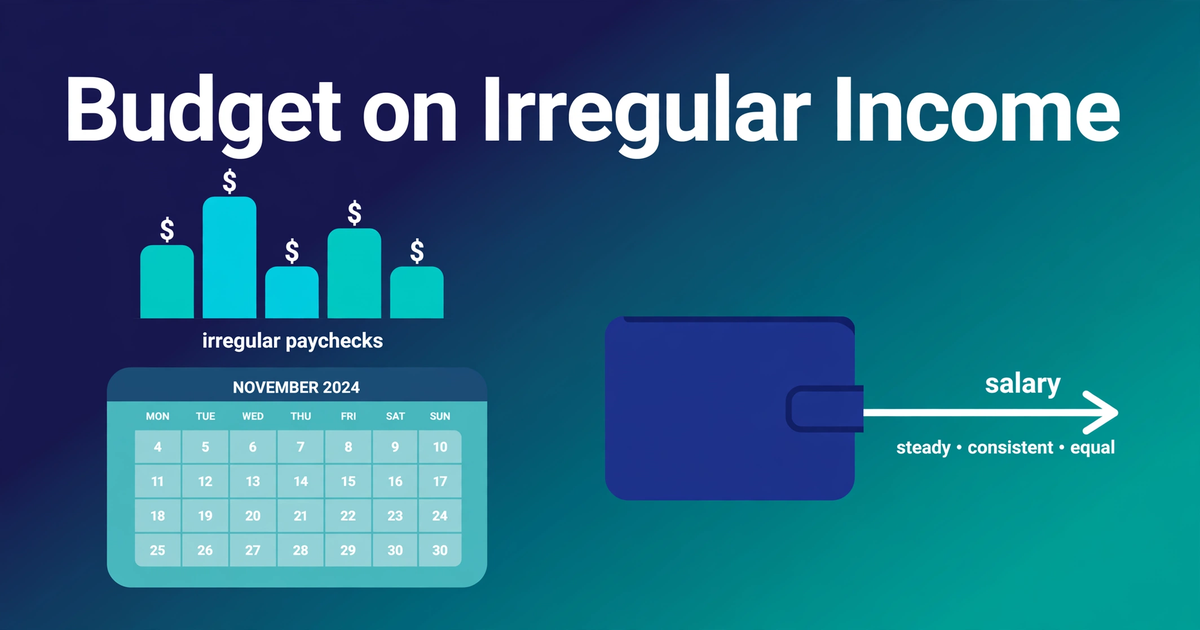
One month you bring in $4,800 and feel like a genius. The next month it’s $2,100 and you’re staring at your bank account wondering how the rent gets paid. Learning how to budget on an irregular income isn’t about being more disciplined — it’s about using a completely different system than the one salary workers use.
This guide gives you that system. No complicated spreadsheets. No finance degree required. Just a simple, calm method that turns unpredictable pay into a steady, predictable life — with real numbers and a template you can copy today.
Why Normal Budgets Fail Freelancers
Let’s start with why everything you’ve tried before probably didn’t stick. It’s not your fault. Traditional budgeting was designed for one very specific situation: the same paycheck, arriving on the same day, every two weeks.
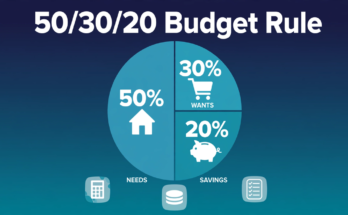
Take the famous 50/30/20 rule. It says: put 50% of your income toward needs, 30% toward wants, and 20% toward savings. Sounds great — until your income swings by $2,000 from one month to the next. Which month’s income do you use? The good one? Then the bad month breaks the whole plan. The bad one? Then you’re living like you’re broke even in months when you’re not.
The deeper problem is the feast-or-famine cycle that comes with budgeting with variable income:
- Feast month ($4,800): You feel rich. You catch up on everything, eat out more, buy the thing you’ve been putting off. The money evaporates.
- Famine month ($2,100): Panic. You slash everything, stress about bills, maybe put groceries on a credit card. You promise yourself you’ll “be better next time.”
- Repeat forever.
Normal budgets fail here because they try to match your spending to your income — and when income is a moving target, spending becomes one too. The system in this guide flips that around. Instead of spending what you earn each month, you’ll pay yourself a steady salary from your own earnings and let the ups and downs happen in the background, where they can’t hurt you.
The secret isn’t budgeting harder — it’s separating what you EARN each month from what you SPEND each month.
Step 1: Find Your Baseline Number
Every irregular-income budget starts with one number. Not your average income. Not your best month. Your baseline — the amount you can count on even in a bad month.
How to calculate it
Look at your last 6 to 12 months of income (bank deposits work fine — don’t overthink which app to use). Find your three lowest months. Average those three. That’s your baseline.
Why the lowest three and not the overall average? Because a budget built on your average still breaks in bad months. A budget built on your worst months never breaks. The good months just become bonus money that builds your safety net.
Here’s a worked example. Meet the numbers first, the person later:
| Month | Income |
|---|---|
| January | $3,400 |
| February | $2,100 |
| March | $4,800 |
| April | $3,200 |
| May | $2,400 |
| June | $4,100 |
The three lowest months: February ($2,100), May ($2,400), April ($3,200). Add them up: $2,100 + $2,400 + $3,200 = $7,700. Divide by 3: $2,567.
That $2,567 is the baseline. It’s not exciting. It’s not what you usually earn. But it’s the number your budget will be built on — and it’s the reason this system actually survives contact with reality.
The “bare minimum” check
Now compare your baseline to your freelancer baseline budget — the bare minimum it costs to run your life for one month. Add up only the non-negotiables: rent, groceries, utilities, insurance, transport, phone, minimum debt payments. Skip everything optional.
If your baseline covers your bare minimum with a little room to spare, you’re in good shape — the system below will work smoothly. If your baseline is below your bare minimum, that’s important information, not a failure. It means you need to either trim the minimum (the usual suspects: subscriptions, eating out, the stuff you already suspect) or find one small recurring income source to lift the floor. Knowing the gap is the first step to closing it.
Your baseline is your average of the three worst months — build the whole budget on that number and bad months stop being emergencies.
Step 2: The Holding Account System
This is the heart of the whole method — and the answer to how to pay yourself a salary as a freelancer.
Here’s the idea in one sentence: all of your income goes into one account, and you pay yourself a fixed “salary” from it twice a month, exactly like an employer would.
How it works, step by step
Think of it as two buckets:
Bucket 1: The Holding Account (a separate checking or savings account)
– Every client payment, every gig payout, every dollar you earn lands here first. All of it. No exceptions.
– This account absorbs the chaos. Big months fill it up. Lean months drain it a little. It breathes in and out — and that’s its entire job.
Bucket 2: Your “Paycheck” Account (your normal everyday checking)
– On the 1st and the 15th of every month, you transfer your fixed salary amount from the Holding Account to this one.
– You spend from this account exactly like a salaried person would. Same amount, same days, every month.
Here’s what it looks like in practice:
| Holding Account | Paycheck Account | |
|---|---|---|
| Money in | All freelance/gig income, any amount, any time | Fixed transfer on the 1st and 15th |
| Money out | Only the two salary transfers | All bills, spending, and saving |
| Balance | Goes up and down with your work | Stays steady and predictable |
| Its job | Absorb the irregularity | Fund your actual life |
Setting your salary number
Your twice-monthly salary should total your baseline number (or slightly below it, to be safe). Using our example: baseline $2,567 per month means a salary of about $1,280 on the 1st and $1,280 on the 15th.
In feast months, the extra income just piles up in the Holding Account — you don’t see it, you don’t spend it, you don’t even think about it. In famine months, the Holding Account covers the gap silently. Your daily life never feels the difference. That’s the whole point: you experience a steady $2,567-a-month life while your actual earnings swing all over the place behind the scenes.
One practical tip: open the Holding Account at a different bank from your everyday checking if you can. The tiny bit of friction — transfers taking a day — stops you from “borrowing” from it on impulse. The system only works if the Holding Account is boring and slightly out of reach.
You become your own employer: clients pay the business (holding account), and the business pays you a steady salary twice a month.
Step 3: Build Your Buffer
The Holding Account handles month-to-month swings. But what about a truly terrible stretch — two or three bad months in a row? That’s what the buffer is for.
Your buffer is one full month of your baseline salary, sitting in the Holding Account at all times, never touched unless things get genuinely dire. In our example: $2,567 parked permanently.
How to build it (without feeling it)
You don’t save up the buffer in one painful chunk. You build it from the surplus months — and the system does it automatically:
- Start the Holding Account system with your baseline salary.
- In every month where you earn MORE than your baseline, the extra stays in the Holding Account. Don’t transfer it to yourself. Don’t “treat yourself because it was a good month.” Just leave it.
- Keep going until the Holding Account holds your baseline salary PLUS one full month’s buffer.
Using our example numbers: say month one you earn $4,100 against a $2,567 baseline. After paying yourself $2,567, there’s $1,533 left over — that goes straight toward the buffer. Month two you earn $3,400: another $833 toward the buffer. By month three, your buffer is basically built, and you barely noticed.
Once the buffer exists, the psychology changes completely. A $1,800 month stops being a crisis and becomes a shrug — the buffer and the Holding Account absorb it, your $1,280 transfers keep arriving on schedule, and you keep living your life. That calm is what you’re really buying.
After the one-month buffer is built, surplus months can go toward bigger goals: a real emergency fund (3–6 months), taxes (more on that next), or investments. But the buffer comes first. Always.
Build a one-month buffer from your surplus months and bad stretches stop feeling like emergencies — they just become quiet months.
A Full Worked Example: Jake’s Freelance Budget
Let’s put the whole system together with a real person. Jake is 31, a freelance graphic designer. His income is all over the place. Here’s three months of his actual life, run through the system:
Jake’s baseline: his three lowest recent months averaged $3,000. So his salary is $1,500 on the 1st and $1,500 on the 15th. His bare-minimum monthly expenses are $2,700, so the $3,000 salary covers life with $300 to spare.
| Month 1: $2,100 earned | Month 2: $4,800 earned | Month 3: $3,200 earned | |
|---|---|---|---|
| Income into holding | $2,100 | $4,800 | $3,200 |
| Salary paid to Jake | $3,000 | $3,000 | $3,000 |
| Holding account change | –$900 | +$1,800 | +$200 |
| Buffer status | Dips slightly | Grows | Steady |
| What Jake feels | Normal month | Normal month | Normal month |
Look at that last row. That’s the magic. Jake earned $2,100 in month one and $4,800 in month two — a $2,700 swing — and his daily life felt identical both months. Same salary hitting his account on the 1st and 15th. Same bills paid. Same groceries bought. Zero stress about which kind of month it was.
Over the three months, Jake earned $10,100 total and paid himself $9,000 — the extra $1,100 quietly built his buffer in the background. Give it a few more cycles and he’ll have the full one-month buffer plus the beginnings of a real emergency fund, all without a single white-knuckle month.
This is what budgeting with variable income is supposed to feel like: boring. Boring is the goal. Boring means the system is working.
Three months, $2,700 of income swings, and Jake’s daily life felt exactly the same every single day — that’s the system working.
Handling Taxes as a Freelancer
There’s one more thing that wrecks irregular budgets, and it’s the one freelancers mention most: taxes. When you’re employed, taxes vanish from your paycheck before you ever see the money. When you’re freelance, the full amount lands in your account — and it feels like yours. It isn’t. About a quarter of it belongs to the IRS.
The simple version (no accountant-speak)
- Set aside 25–30% of every payment, immediately. Client pays you $2,000? Move $500–$600 to a separate “tax pocket” (a savings account) the same day. Do it before you pay a single bill. This is not optional money — it’s money you’re holding for the government.
- Pay quarterly. The IRS expects freelancers to pay estimated taxes four times a year (roughly January, April, June, and September). Miss the deadlines and you’ll owe penalties on top of the tax itself. Put the four dates in your phone calendar right now.
- Keep it separate. Your tax pocket is not your buffer, not your emergency fund, and definitely not spending money. It’s a holding cell. When quarterly day comes, the money is just… there. No panic, no scrambling, no “I’ll figure it out in April.”
The 25–30% figure covers federal income tax plus self-employment tax for most freelancers in 2026. Your exact rate depends on your total income and state — if you want precision, a one-hour session with a tax preparer each year is some of the best money a freelancer can spend. But 25–30% set aside beats 0% set aside every single time, and it’s infinitely better than the April surprise that ruins so many freelancers’ years.
One more practical trick: since your income is irregular, base each quarter’s payment on what you actually earned that quarter (the IRS allows this “annualized” method). Earned $6,000 in Q1? Set aside and pay on $6,000. Earned $12,000 in Q2? Adjust upward. It keeps the tax bill proportional to reality instead of a scary flat guess.
Treat 25–30% of every payment as the government’s money from day one — move it to a separate tax pocket before you spend a dime.
5 Mistakes That Wreck Irregular Budgets
Most freelancers who try budgeting don’t fail because the system is wrong. They fail because of one of these five traps. Read them now so you can dodge them later.
Mistake 1: Spending the big month
The $5,000 month arrives and suddenly the budget feels… optional. New laptop. Weekend trip. Fancy dinners “because I earned it.” Then the $2,000 month arrives and there’s nothing left to smooth it out. The big months aren’t bonuses — they’re the months that fund the small ones. Every dollar you splurge in a feast month is a dollar your future famine-month self desperately needed. Let the surplus sit in the Holding Account. Future you says thanks.
Mistake 2: Skipping the buffer
“I’ll build the buffer later, once things stabilize.” Things never stabilize — that’s the entire premise of irregular income. The buffer isn’t a luxury for calm times; it’s the thing that creates calm times. Build it from your first three surplus months, before you fund anything else. One month of baseline salary, parked and untouched.
Mistake 3: Forgetting taxes until April
This is the classic freelancer horror story: April arrives, the tax bill is $8,000, and the money is gone — spent months ago on things that felt affordable at the time. They weren’t affordable; the tax portion was never yours. The 25–30% rule from the previous section exists specifically to prevent this. Set it aside per payment, not per year.
Mistake 4: Lifestyle creep on a good streak
Three good months in a row, and suddenly the “baseline” starts feeling too small. You upgrade the apartment. Finance a nicer car. Add subscriptions. Then month four is a $1,900 month and the new lifestyle doesn’t fit anymore. Raise your salary only after 6+ months of consistently higher earnings — and even then, raise it to the new baseline (lowest-three average), not to your best month. Let the math decide, not the mood.
Mistake 5: Running everything through one account
Income, bills, spending, taxes, savings — all swirling in a single checking account. You can never answer the simple question: “how much of this is actually mine to spend?” The Holding Account system exists precisely to end this confusion. Separate accounts aren’t complicated — they’re what make everything else simple. At minimum: one account where income lands, one where life happens, one pocket for taxes.
Every one of these mistakes has the same root cause: treating irregular money like regular money. The system fixes that — but only if you let it.
Simple Irregular-Income Budget Template
Here’s your irregular income budget template — the whole system on one page. Copy it into a notes app, a spreadsheet, or a piece of paper stuck on the fridge. Fill in your own numbers and update it on the 1st of each month (takes about ten minutes).
| Your numbers | |
|---|---|
| MY BASELINE (avg of 3 lowest months) | $______ /month |
| MY SALARY (1st of month) | $______ |
| MY SALARY (15th of month) | $______ |
| BARE MINIMUM (monthly survival cost) | $______ /month |
| BUFFER TARGET (1 month of baseline) | $______ |
| TAX POCKET (25–30% of each payment) | ______% |
Monthly check-in (1st of every month):
| Check | Status |
|---|---|
| Holding account balance | $______ |
| Buffer intact? (should equal 1 month baseline) | Yes / No |
| Tax pocket on track? (25–30% of last month’s income) | Yes / No |
| Salary transfers set for the 1st and 15th? | Yes / No |
| Baseline still accurate? (recalculate every 6 months) | Yes / No |
The rules, on one sticky note:
1. All income → Holding Account. Always.
2. Pay yourself the same salary on the 1st and 15th.
3. Surplus months build the buffer — don’t spend them.
4. 25–30% of every payment → tax pocket, same day.
5. Recalculate your baseline every 6 months as your income changes.
That’s the entire system. Ten minutes a month to maintain, and it turns the chaos of freelance pay into the calmest financial life you’ve ever had.
Copy the template, fill in five numbers, and follow five rules — that’s the whole system.
FAQs
How do you budget when your income changes every month?
Stop budgeting your income and start budgeting a salary. Route all earnings into a holding account, then pay yourself the same fixed amount on the 1st and 15th — based on your baseline (the average of your three lowest months). Your spending stays steady while the holding account absorbs the ups and downs behind the scenes. Build a one-month buffer from surplus months so even bad stretches don’t touch your daily life.
How do freelancers pay themselves a consistent salary?
Exactly like an employer would: pick a fixed number, pick fixed paydays (the 1st and 15th work well), and transfer that amount from your holding account to your everyday checking on those days — no more, no less, regardless of what you earned that month. Base the salary on your baseline number (average of your three lowest months), not your average or best month. In good months the extra stays in the holding account; in bad months the holding account covers the gap.
What is a baseline budget?
Your baseline has two parts. First, your baseline income: the average of your three lowest-earning months — the amount you can count on even when work is slow. Second, your freelancer baseline budget: the bare-minimum cost of running your life for one month (rent, groceries, utilities, insurance, transport, minimum debt payments — nothing optional). Your salary should cover the bare minimum with a little room to spare. If it doesn’t, that’s your signal to trim costs or lift the floor with steadier work.
How much should freelancers save for taxes?
Set aside 25–30% of every single payment the day it arrives, into a separate tax savings account — before you pay any bill or buy anything. This covers federal income tax plus self-employment tax for most freelancers. Then pay the IRS quarterly (January, April, June, September) based on what you actually earned each quarter. The most common freelancer tax disaster is spending the tax money during the year and facing a massive bill in April — the separate tax pocket prevents it completely.
Does the 50/30/20 rule work for irregular income?
Not as written, because it assumes a fixed monthly income to split into percentages. But you can adapt it: apply the 50/30/20 split to your baseline salary (the steady amount you pay yourself), not to your raw monthly earnings. So if your baseline salary is $3,000, you’d aim for $1,500 needs, $900 wants, $600 savings — every single month, predictably. The irregular part of your income never enters the calculation at all.
You’ve Got This
Irregular income feels chaotic because you’ve been using tools built for a different life. Salary workers budget a paycheck. You need to create a paycheck first — and now you know how: holding account, baseline salary, one-month buffer, tax pocket, ten minutes a month.
It won’t feel natural the first month. Setting up the accounts takes an afternoon, and watching a $4,500 month flow past without touching the surplus takes discipline. But by month three, something shifts. The anxiety fades. The feast-or-famine whiplash stops. You check your balance and it’s just… fine. Boring, predictable, fine.
That’s not just a budget. That’s what financial peace feels like when your income refuses to sit still. Start today — find your baseline number tonight. Everything else follows from that one number.