It’s Tuesday. Your paycheck landed on Friday, and somehow there’s already $43 left in your checking account. Rent is due in nine days. The car needs gas. And you’re doing that mental math again — the kind where you figure out which bill can slide a week without a late fee.
If that sounds familiar, you’re not bad with money. You’re stuck in a pattern that traps nearly half of American workers — and learning how to stop living paycheck to paycheck isn’t about earning six figures or developing superhuman discipline. It’s about fixing the structure of how your money moves, one small change at a time.
This guide gives you the full escape plan: where your money is actually leaking, how to build your first $1,000 buffer, and the week-by-week system that gets you off the paycheck-to-paycheck treadmill for good.
What Does “Living Paycheck to Paycheck” Actually Mean?
The phrase gets thrown around a lot, but here’s the plain definition: you’re living paycheck to paycheck when nearly all of your income goes to expenses, leaving little or nothing for savings. If an unexpected $400 car repair would force you to borrow money, skip a bill, or put it on a credit card — that’s the paycheck-to-paycheck line, and you’re standing on it.
Here’s what surprises most people: this isn’t just a low-income problem. Surveys consistently find that 60 to 70 percent of Americans live this way, including plenty of households earning $80,000 or $100,000 a year. A recent Debt.com survey put the 2026 number at 48% — the lowest in years, but still nearly half the country.
How does someone earning good money end up broke by payday? The same way everyone does: spending quietly expands to eat every dollar. A bigger apartment, a newer car payment, food delivery three nights a week, subscriptions nobody remembers signing up for. The income went up, but the margin — the gap between what comes in and what goes out — stayed at zero.
Living paycheck to paycheck isn’t an income problem — it’s a structure problem. And structure problems have structural fixes.
That distinction matters because it changes the solution. If the problem were “I don’t earn enough,” the only answer would be earning more — slow and hard. But if the problem is “my money has no system,” you can start fixing it this week, on your current income.
Step 1: Find Your Leaks (The One-Week Money Audit)
You can’t fix what you can’t see. Before you cut a single expense, spend seven days just watching where your money goes. Not judging — watching.
Here’s the dead-simple method:
- Pull up your last 30 days of bank and credit card statements. Every transaction. Yes, all of them.
- Sort every expense into three buckets:
- Fixed essentials: rent, utilities, insurance, minimum debt payments, basic groceries, getting to work
- Flexible essentials: clothing, household stuff, medical costs — necessary, but you control the amount
- Everything else: dining out, delivery apps, subscriptions, entertainment, impulse buys, “I deserved it” purchases
- Add up the “everything else” bucket. Sit down for this one.
Most people are genuinely shocked. The “everything else” category routinely reveals $400 to $600 a month in spending nobody planned — food delivery that felt like $15 but happens four times a week, subscriptions stacked three deep, late-night online orders that seemed small at the time.
Here’s what the most common leaks look like:
| The leak | What it typically costs | The fix | Monthly savings |
|---|---|---|---|
| Food delivery apps | $200–$300 (fees + tips + markups add 40–80% per order) | Delete the apps; cook 4 nights a week | $150–$250 |
| Forgotten subscriptions | $100–$200 (average American carries ~12) | Audit and cancel everything unused in 30 days | $50–$150 |
| Daily coffee/snack runs | $120–$180 ($5–$6 a day adds up fast) | Home coffee + packed snacks 4 days a week | $80–$120 |
| Impulse online shopping | $100–$250 (late-night scrolling) | 48-hour rule: wait two days before buying | $60–$150 |
| Credit card interest | $150–$200+ (at 22% APR on a $10,000 balance) | Call issuer for a rate cut; stop adding new charges | $30–$80 |
Notice something important: you don’t need to fix all five. Find your two biggest leaks and you’ve probably freed $200 to $400 a month. That’s your escape money — and you haven’t earned a single extra dollar yet.
Your leaks aren’t character flaws — they’re untracked habits. One week of watching finds the $200–$400 a month that funds your entire escape plan.
Step 2: Pay Yourself First (Even If It’s Just $25)
Here’s the mindset shift that changes everything: most people save what’s left after spending. People who escape the cycle spend what’s left after saving.
This is called pay yourself first, and it works because it removes willpower from the equation. Instead of hoping money is left over at the end of the month (it never is), you move money to savings the moment your paycheck lands — before you can spend it.
“But I can’t afford to save anything!” Here’s the thing: you don’t start with 20%. You start embarrassingly small:
- $25 per paycheck → $50/month → $600 in a year
- $50 per paycheck → $100/month → $1,200 in a year
- $75 per paycheck → $150/month → $1,800 in a year
Set up an automatic transfer at your bank for the day after payday. Money you never see is money you never miss. Within two months, you won’t even notice it’s gone — but your savings balance will.
Your first target isn’t some giant emergency fund. It’s a $1,000 mini buffer — enough to absorb the flat tire, the vet bill, or the broken phone without reaching for a credit card. Here’s how fast different amounts get you there:
| Saved per week | Time to reach $1,000 | Where it comes from |
|---|---|---|
| $25/week | 40 weeks (~10 months) | One leak fixed (coffee runs) |
| $50/week | 20 weeks (~5 months) | Two leaks fixed |
| $75/week | ~13 weeks (~3 months) | Two leaks + subscription purge |
| $125/week | 8 weeks (~2 months) | Three leaks + a small side gig |
That $1,000 buffer is the single most important milestone in this whole guide. It’s the wall between you and the debt cycle. Every unexpected expense before the buffer becomes credit card debt. Every unexpected expense after it becomes… just an expense.
Pay yourself first means savings happens on payday, not “if there’s anything left.” Even $25 a paycheck breaks the cycle’s psychology.
How to Stop Living Paycheck to Paycheck: The 90-Day Escape Plan
Big goals fail. Ninety-day plans work. Here’s your week-by-week roadmap — each phase builds on the last, and none of them require a raise:
| Phase | Timeframe | Your mission | Target result |
|---|---|---|---|
| Phase 1: See it | Days 1–7 | Complete the one-week money audit; list every expense in three buckets | Know exactly where your money goes |
| Phase 2: Plug it | Days 8–21 | Cancel unused subscriptions; delete delivery apps; start the 48-hour rule | $150–$300/month freed up |
| Phase 3: Buffer it | Days 22–45 | Set up automatic payday transfer; open a separate savings account | First $200–$400 in your buffer |
| Phase 4: Protect it | Days 46–65 | Call your credit card company for a lower rate; negotiate one big bill (insurance, phone) | $50–$150/month more freed |
| Phase 5: Grow it | Days 66–90 | Add one income boost (overtime, side gig, selling unused stuff); hit $1,000 buffer | Off the treadmill — margin exists |
Let’s talk about Phase 4 for a second, because people skip it and shouldn’t. Calling your credit card company to ask for a lower interest rate works about 40% of the time, according to industry surveys. The script is simple: “I’ve been a customer for X years, I always pay on time, can you lower my APR?” Ten minutes, one phone call, potentially $30–$80 a month in saved interest. Same goes for car insurance — three competitor quotes and one call routinely saves $50–$100 a month.
And Phase 5’s income boost doesn’t mean a second job. The average American household has $3,000 or more in unused stuff sitting around. One weekend of selling on a local marketplace can drop $300–$800 straight into your buffer. A single consistent side gig — tutoring at $25–$50 an hour, weekend pet sitting, delivery driving — reliably adds $300–$800 a month.
Ninety days from now, you can have a $1,000 buffer and $300+ a month in breathing room — on the income you already earn.
Budget by Paycheck, Not by Month
Here’s what almost all budgeting advice gets wrong: you don’t live on a monthly budget. You live on paychecks. When you plan the whole month at once, money meant for week three quietly gets spent in week one. Then week three arrives and there’s nothing left.
The budget by paycheck method fixes this. Instead of one big monthly plan, you give every single paycheck its own mini-budget the day it arrives:
- Payday arrives. Before you spend a dollar, split it on paper (or in a free app).
- First: savings transfer — your pay-yourself-first amount leaves immediately.
- Second: bills due before the next paycheck — only the ones with due dates in this pay period.
- Third: variable spending — groceries, gas, and a set amount for everything else.
- What’s left stays put — it covers the bills due after the next paycheck.
Here’s what it looks like with real numbers — a $1,800 biweekly paycheck:
| Paycheck allocation | Amount | Notes |
|---|---|---|
| Pay yourself first (savings) | $75 | Automatic transfer, day after payday |
| Rent (half — due mid-month) | $650 | Half now, half from next check |
| Utilities + phone | $180 | Due before next payday |
| Minimum debt payments | $150 | Never miss these |
| Groceries (2 weeks) | $220 | Meal plan from the grocery guide |
| Gas / transport | $120 | — |
| Everything else | $200 | Dining, fun, misc — when it’s gone, it’s gone |
| Held for next period’s bills | $205 | Car insurance, etc. due later |
| Total | $1,800 | Every dollar has a job |
See the last two lines? That $205 held back is the secret. It’s money assigned to future bills, sitting visibly separate — not “extra” money to spend. And the $200 “everything else” is a hard cap, not a suggestion. When it’s gone, you wait for the next paycheck. That boundary is what breaks the cycle.
Monthly budgets fail because you spend week one’s money in week three’s name. Budgeting by paycheck gives every dollar a job before it can wander off.
Kill the Big Three Money Drains
If you only have energy for three changes, make them these. Across every survey and study, the same three categories eat the most money from paycheck-to-paycheck households:
Drain #1: Food spending
Grocery and food spending is the #1 financial pressure point for American households — 22% cite it as their top money stress. The fix isn’t eating rice for every meal. It’s two moves:
- Meal plan for 20 minutes on Sunday. Just dinners, just five of them. Families who do this consistently save $200–$300 a month — mostly by killing waste and impulse buys.
- Delete the delivery apps. Between fees, tips, and menu markups, delivery adds 40–80% to every order. A $15 meal becomes $25. Four times a week, that’s $160 a month in pure markup.
Drain #2: Subscriptions and memberships
The average American carries around 12 active subscriptions — streaming services, cloud storage, apps, memberships, boxes. Many overlap, and most people underestimate what they spend by about 40%. One full audit typically finds $50–$150 a month in cancellations that nobody misses. The rule is simple: if you haven’t used it in the last 30 days, cancel it. You can always re-subscribe.
Drain #3: Credit card interest
This is the quiet killer. At 22% APR, a $10,000 balance costs you $183 a month in interest alone — money that buys you absolutely nothing. And here’s the trap: when you’re living paycheck to paycheck, every emergency goes on the card, the balance grows, the minimum payment grows, and the margin shrinks further.
Breaking this drain has three steps: stop adding new charges (switch daily spending to debit), call for a lower rate (works ~40% of the time), and attack the balance with your freed-up leak money. Every $100 extra toward principal saves roughly $22 a year in interest at 22% APR — and it compounds in your favor as the balance drops.
Three drains — food, subscriptions, card interest — account for most of the missing money. Fix these three and the cycle starts running in reverse.
How to Stop Living Paycheck to Paycheck When You’re Already in Debt
Let’s be honest about something: it’s much harder to build a buffer when minimum payments are eating your paycheck. If you’re carrying serious credit card debt, the standard advice needs a slight remix.
The two-track approach:
- Track 1: Build a $500 mini-buffer first. Not $1,000 — just $500. This is your circuit breaker. Without it, every emergency goes straight back on the cards and your payoff plan collapses. Even while paying minimums, redirect your leak money here until you hit $500.
- Track 2: Then attack the debt. Once the $500 wall exists, point every freed-up dollar at the highest-interest balance (the avalanche method) or the smallest balance (the snowball method — better if you’ve quit payoff plans before).
Here’s the math that makes this work. Say you freed $300 a month from leaks, and you carry $6,000 across two cards at 22% APR:
| Month | Payment | Interest | Balance left |
|---|---|---|---|
| 1 | $300 | $110 | $5,810 |
| 6 | $300 | ~$90 | $4,850 |
| 12 | $300 | ~$62 | $3,720 |
| 18 | $300 | ~$30 | $2,440 |
| 24 | $300 | ~$8 | $0 |
Two years. No raise, no second job — just $300 a month pointed at one target. And once that debt is gone, that same $300 becomes your savings rate. The money was always there; it was just going to the bank as interest.
Debt doesn’t pause your escape — it just reorders it. $500 buffer first, then every freed dollar attacks the highest-interest balance.
The Starter Budget That Actually Works
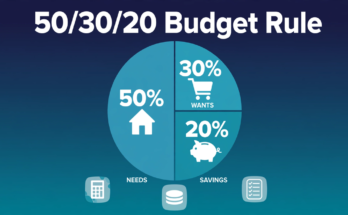
You’ve probably heard of the 50/30/20 budget rule: 50% of income to needs, 30% to wants, 20% to savings. It’s good advice — for people who aren’t living paycheck to paycheck. If rent alone eats 40% of your income, 50/30/20 is a fantasy that makes you feel like a failure.
Start where you actually are:
- Phase 1 — The 95/5 split: 95% covers life, 5% goes to savings. That’s it. If you bring home $3,000 a month, that’s $150 to savings. It feels tiny. It isn’t — it’s the habit that breaks the cycle.
- Phase 2 — The 70/20/10 split: Once debt is under control, aim for 70% needs and lifestyle, 20% debt paydown, 10% savings.
- Phase 3 — The 50/30/20 split: The classic rule, now actually reachable — because you built the muscle in phases 1 and 2.
The goal was never perfection on day one. A 95/5 split beats a 100/0 split every single time, because 5% compounds into a buffer, and a buffer compounds into freedom.
5 Mistakes That Keep You Stuck
Mistake 1: Waiting for a raise to fix it
“I’ll start saving when I earn more.” Here’s the problem: lifestyle expands to fill income. The household earning $88,000 that can’t pay its bills proves it — more money without a system just means more expensive leaks. Start the system now, on this income. The raise will accelerate it later.
Mistake 2: Trying to overhaul everything in week one
Canceling every subscription, meal-prepping seven days, deleting all the apps, starting a side gig — all on Monday. By Friday you’re exhausted and ordering takeout. Pick two changes. Master them. Add a third next month. Slow is smooth, and smooth is fast.
Mistake 3: Keeping savings in your checking account
Money sitting next to your spending money will get spent. Your buffer needs its own account — ideally at a different bank, or at least a separate savings account you don’t check daily. Out of sight really is out of mind, and that’s exactly what you want.
Mistake 4: Treating the buffer as a second income
The $1,000 buffer is for true emergencies: the car repair, the medical bill, the broken furnace. It is not for concert tickets, a sale, or “I had a hard week.” Every non-emergency withdrawal restarts the cycle. When you do use it for a real emergency, rebuilding it becomes priority #1 — before anything else.
Mistake 5: Doing it alone in silence
Money shame keeps people stuck. Tell one person — a partner, a friend, a sibling — what you’re doing. Not the numbers, just the mission: “I’m building a $1,000 buffer and cutting delivery apps.” Accountability is free, and it works.
The biggest mistake isn’t a bad budget — it’s waiting for perfect conditions. The second biggest is trying to change everything at once.
FAQs: How to Stop Living Paycheck to Paycheck
What does it mean to live paycheck to paycheck?
It means nearly all of your income goes to expenses, leaving little or nothing for savings — so an unexpected $400 expense would force you to borrow, skip a bill, or use a credit card. About 48% of Americans described themselves this way in a 2026 survey. It’s not about how much you earn; plenty of six-figure households live paycheck to paycheck because spending expanded to match income.
How much money do I need to stop living paycheck to paycheck?
Your first milestone is a $1,000 mini buffer — enough to absorb common emergencies without new debt. That alone breaks the worst part of the cycle. After that, work toward one full month of expenses saved, which means you start each month already funded instead of waiting for payday. The full expert recommendation is 3–6 months of expenses, but don’t let that distant number stop you from starting with $1,000.
Can I stop living paycheck to paycheck on a low income?
Yes — the method doesn’t require a high income, it requires margin: the gap between income and expenses. On a tight income, margin comes from plugging leaks (the average household finds $200–$400 a month in untracked spending) and starting savings at just $25 per paycheck. The dollar amounts are smaller, but the mechanics are identical. If income truly can’t cover basic needs after cuts, that’s the signal to focus on the income side — negotiating a raise or adding one steady side gig.
What is the 50/30/20 rule, and does it work for paycheck-to-paycheck budgets?
The 50/30/20 budget rule says 50% of take-home pay goes to needs, 30% to wants, and 20% to savings and debt payoff. It’s a solid long-term framework, but it’s usually unrealistic as a starting point when you’re living paycheck to paycheck — housing alone can eat 40%+ of income. Start with a 95/5 split (5% to savings), graduate to 70/20/10 as debt shrinks, and grow into 50/30/20 over time.
How long does it take to break the paycheck-to-paycheck cycle?
With consistent effort, most people feel real relief within 90 days: leaks plugged, a few hundred dollars buffered, and a system running. Reaching the full $1,000 buffer typically takes 2–6 months depending on how much leak money you redirect. Getting a full month ahead of expenses — the point where payday stops mattering — usually takes 6–12 months. It’s not overnight, but every week of the plan leaves you measurably better than the week before.
Your First Move Is Tonight
Here’s the truth about how to stop living paycheck to paycheck: nobody is coming to fix this for you, and that’s actually good news — because it means you don’t need permission, a raise, or a windfall to start. You need one week of watching, two leaks plugged, and an automatic transfer set up for the day after payday.
Tonight, pull up last month’s bank statement. Sort it into the three buckets. Find your $200. Set up that $25 transfer. That’s it — that’s day one.
Ninety days from now, you’ll either have a $1,000 buffer and breathing room, or you’ll be doing the same Tuesday math with $43 in the account. The days pass either way. Make them count.