Here’s the truth about budgeting: most people don’t fail because they’re bad with money. They fail because they start with a 40-category spreadsheet that takes three hours to build and dies by week two.
A monthly budget template fixes that. It’s just a simple one-page list: your income at the top, your spending categories below, and one rule — every dollar gets a job before the month starts. In this guide, you’ll get a fill-in monthly budget template for beginners, a step-by-step walkthrough for how to make a monthly budget that actually survives the month, and a fully worked example with real numbers.
What Is a Monthly Budget Template?
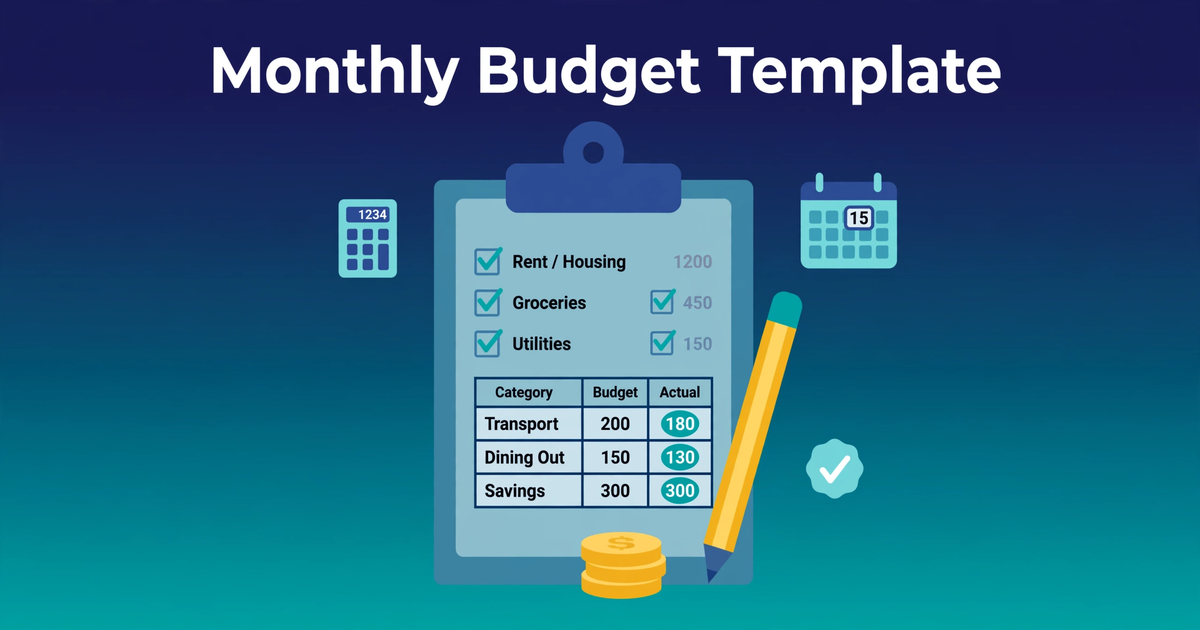
A monthly budget template is a pre-made list of budget categories — housing, food, transport, and so on — with blank spaces where you write your planned spending for the month. Think of it as a coloring book for your money: the outlines are already drawn, you just fill in your numbers.
The whole thing fits on one page (or one spreadsheet tab) and has three parts:
- Income — every dollar coming in this month (take-home pay only, not your salary before taxes).
- Expenses — every category you’ll spend on, split into fixed bills and variable spending.
- The bottom line — income minus expenses. In a good template, that number is $0 — not because you spent everything, but because every dollar was assigned somewhere, including savings.
A monthly budget template isn’t about restriction — it’s about giving every dollar a job before the month starts.
Why does the template format matter so much? Because a blank page is where budgets go to die. Staring at nothing, you’ll forget categories (hello, twice-a-year car insurance), underestimate others (groceries — always groceries), and quit by week two. A template reminds you what to include and does the “did I miss anything?” thinking for you.
Why Most Budgets Fail (and Why This One Won’t)
Let’s be honest about why your last budget didn’t work. It’s almost always one of these three:
It was too complicated. Forty categories, color codes, formulas you don’t understand. You spent Sunday building it and never opened it again. The simpler the system, the longer it survives — that’s just how habits work.
It was built on fantasy numbers. You wrote “$200 for groceries” because it sounded nice, not because you checked what you actually spent ($487, probably). A budget built on wishes collapses the first week reality shows up.
Nobody told it what to do with leftover money. “I’ll save what’s left” means you’ll save nothing. Money without a job gets spent — that’s not a character flaw, it’s just how brains work.
A simple template beats all three: few categories, real numbers from your bank statements, and savings written in as a bill you pay first.
The best budget isn’t the most detailed one — it’s the one you’ll still be using in month three.
Your Fill-in Monthly Budget Template
Here’s the template. Copy it into a notebook, a notes app, or a spreadsheet — the format doesn’t matter, the categories do. The “Example” column shows realistic numbers for a single person taking home $3,500 a month (we’ll build this exact budget together below).
| Category | Budgeted | Actual | Difference |
|---|---|---|---|
| INCOME | |||
| Paycheck 1 (take-home) | $1,750 | ||
| Paycheck 2 (take-home) | $1,750 | ||
| Side income / other | $0 | ||
| Total income | $3,500 | ||
| FIXED EXPENSES (same every month) | |||
| Rent / mortgage | $1,200 | ||
| Car payment | $280 | ||
| Car insurance | $140 | ||
| Phone | $45 | ||
| Internet | $60 | ||
| Subscriptions (total) | $35 | ||
| Minimum debt payments | $120 | ||
| VARIABLE EXPENSES (changes month to month) | |||
| Groceries | $400 | ||
| Gas / transport | $150 | ||
| Dining out | $100 | ||
| Personal care | $50 | ||
| Household supplies | $40 | ||
| Entertainment | $60 | ||
| Clothing | $50 | ||
| Miscellaneous / buffer | $100 | ||
| SAVINGS & GOALS (pay yourself first) | |||
| Emergency fund | $200 | ||
| Other savings goal | $100 | ||
| Extra debt payment | $120 | ||
| Total expenses + savings | $3,500 | ||
| Left to budget | $0 |
Three columns, and each one has a job:
- Budgeted — what you plan to spend. Fill this in before the month starts.
- Actual — what you really spent. Fill this in as the month goes (once a week is plenty — daily is overkill).
- Difference — budgeted minus actual. Positive means you came in under; negative means that category needs attention next month.
The “Left to budget” row is the whole point: $3,500 in, $3,500 assigned, $0 unassigned. That’s called a zero-based budget — every dollar has a name. Savings isn’t what’s left over; it’s a line item, right up there with rent.
If your “Left to budget” isn’t $0, you don’t have a budget yet — you have a wish list.
How to Fill Out Your Template in 5 Steps
Step 1: Write down your real take-home pay
Not your salary — your take-home pay: what actually lands in your bank account after taxes, health insurance, and retirement contributions. If you’re paid biweekly, add up two paychecks for your monthly income (twice a year you’ll get a third paycheck — treat it as bonus savings, not spending money).
$3,500/month take-home is our example. Yours might be $2,200 or $5,800 — the template works the same. The only rule: budget the money you actually receive, not the money you wish you received.
Step 2: List your fixed expenses first
Fixed expenses are the bills that barely change: rent, car payment, insurance, phone, internet, subscriptions, minimum debt payments. These are the easiest because there are no decisions — just copy the amounts from your last statements.
Add them up. In our example: $1,920. That’s 55% of the $3,500 income — already more than half, before buying a single grocery. This is the moment most beginners realize why money felt tight: the fixed bills were eating the paycheck before the month even started.
List fixed bills first — they’re non-negotiable, so they get the first claim on your income.
Step 3: Estimate variable expenses from real data
Variable expenses — groceries, gas, dining out — are where budgets usually lie to themselves. Don’t guess. Open your bank app, look at the last two months of spending in each category, and average them. Spent $430 and $470 on groceries? Budget $450, not $300.
This step takes 20 minutes and it’s the difference between a budget that works and one that doesn’t. Every “I have no idea where my money goes” problem gets solved right here.
Step 4: Pay yourself first — savings as a bill
Here’s the move that changes everything: write your savings in BEFORE the fun categories. Emergency fund, debt payoff beyond minimums, that vacation — they get line items just like rent does.
In our example: $200 to the emergency fund, $100 to another goal, $120 extra toward debt. That’s $420/month (12% of income) going to your future self before a single dollar is assigned to dining out. If you wait to save “what’s left,” what’s left is always $0. Pay yourself first and the math takes care of itself.
Step 5: Assign every remaining dollar until you hit $0
Add up everything so far and spread what’s left across your variable and fun categories until Left to budget = $0. The template forces this honesty — and that’s exactly why it works.
A budget with unassigned dollars is unfinished. Keep assigning until “Left to budget” hits exactly $0.
Zero-Based Budget vs 50/30/20: Which Method Fits the Template?
Two methods dominate beginner budgeting advice. Both work with the template above — they just divide the money differently.
Zero-based budgeting (the method in our template): income minus expenses equals zero. Every dollar is assigned to a category, including savings. Best for people who want total control and don’t mind 20 minutes of planning a month.
The 50/30/20 budget: 50% of take-home to needs, 30% to wants, 20% to savings and extra debt payments. Simpler — three buckets instead of twenty lines. Best for people who want guardrails without line-item detail.
Here’s how they compare on our $3,500/month example:
| Zero-based | 50/30/20 | |
|---|---|---|
| Needs | Itemized: $1,920 fixed + essentials | $1,750 (50%) |
| Wants | Itemized: ~$610 fun/variable | $1,050 (30%) |
| Savings + extra debt | Itemized: $420+ | $700 (20%) |
| Monthly effort | ~20 minutes | ~10 minutes |
| Best for | Detail lovers, tight budgets | Simplicity lovers |
Notice something important: in our zero-based example, fixed needs alone were $1,920 — already over the 50/30/20 “needs” allowance of $1,750. That’s normal. The 50/30/20 split is a starting target, not a law. If your rent is high, protect the 20% savings first and let “wants” shrink — don’t force the ratio and sacrifice savings to hit it.
Pick zero-based for control, 50/30/20 for simplicity — but either way, protect your savings percentage first.
A Worked Example: $3,500/Month, Down to $0
Let’s finish the example budget completely — every dollar assigned, nothing left floating. This is what a finished first month looks like:
| Category | Amount | Notes |
|---|---|---|
| Income | $3,500 | Two $1,750 paychecks |
| Rent | $1,200 | 34% of income — the big one |
| Car payment | $280 | |
| Car insurance | $140 | Shop this yearly; loyalty costs you |
| Phone | $45 | |
| Internet | $60 | |
| Subscriptions | $35 | Audit these every few months |
| Minimum debt payments | $120 | |
| Groceries | $450 | Two-month average, not a wish |
| Gas / transport | $150 | |
| Dining out | $100 | The fun budget — capped, not banned |
| Personal care | $50 | |
| Household supplies | $40 | |
| Entertainment | $60 | |
| Clothing | $50 | |
| Misc buffer | $110 | For the stuff you forgot |
| Emergency fund | $300 | Pay-yourself-first line |
| Vacation fund | $100 | A named goal beats vague “savings” |
| Extra debt payment | $160 | Attacks the highest-rate balance |
| Total assigned | $3,500 | |
| Left to budget | $0 | Done |
Check the math: fixed bills $1,920 + variable spending $1,060 + savings and extra debt $560 = $3,500. Every dollar named. And notice the fun categories survived — a good budget doesn’t ban dining out; it just decides the amount in advance.
Mid-month check: it’s the 15th and you’ve spent $260 on groceries. The template says $450 budgeted, so you have $190 left for the rest of the month. No guilt, no math anxiety — just a number. That’s the whole payoff: decisions made once, calmly, instead of twenty stressed decisions at checkout.
What to Do When You Blow a Category Mid-Month
It will happen. It’s the 20th, groceries are at $430 of a $450 budget, and there’s still 10 days left. Most beginners react one of two ways: they either abandon the whole budget (“I already failed”), or they steal from savings to cover it. Both are wrong. Here’s the right move:
Step 1: Don’t panic — reallocate. A budget is a plan, not a prison. Look at your template and find a category with room. Dining out has $60 left? Move $40 of it to groceries. Update both “Budgeted” cells: dining becomes $60, groceries becomes $490. The total is still $3,500, and “Left to budget” is still $0. You didn’t break the budget — you used it.
Step 2: Borrow from wants, never from savings. This is the one hard rule. Move money between spending categories all you want, but the emergency fund line is sacred. The moment you raid savings to cover overspending, the template loses its power — savings becomes “whatever’s left” again, which is always nothing.
Step 3: Ask why, once. Was it a one-time thing (hosting dinner for family) or a pattern (groceries overshoot every month)? One-time: reallocate and move on. Pattern: raise next month’s grocery budget by $30–$50 and trim somewhere honest. A budget that reflects reality beats a budget that punishes you for it.
Here’s what that mid-month fix looks like:
| Category | Was budgeted | Now budgeted | Why |
|---|---|---|---|
| Groceries | $450 | $490 | Week 3 stock-up ran long |
| Dining out | $100 | $60 | Skipping two takeout nights |
| Emergency fund | $300 | $300 | Untouched — non-negotiable |
| Total | $3,500 | $3,500 | Still zero-based |
Overspending a category isn’t failure — it’s information. Reallocate from wants, protect savings, adjust next month.
Your First 90 Days: What Actually Happens
Knowing the timeline keeps you from quitting in week three. Here’s the honest version:
Month 1: Discovery (it will be wrong). You’ll forget categories, underestimate groceries, and blow the misc buffer by the 12th. Perfect — that’s the month doing its job. Your only goal in month one is finishing it with real “Actual” numbers filled in. Those numbers are gold: they’re your data, not guesses.
Month 2: Adjustment (it starts working). Now you budget groceries at $470 instead of fantasy-$400, add the $50/month car-insurance slice you forgot, and give the misc buffer a real $110. The template finally matches your life. Most people feel the first real sense of control here — not because they’re spending less, but because nothing surprises them anymore.
Month 3: Habit (it gets boring — good). Filling in the template takes 10 minutes. The weekly check-in is routine. This is when the magic compounds: three months of $300 emergency fund contributions is $900 sitting there, and for the first time a surprise bill doesn’t become a crisis. Boring is the goal. Boring means it’s working.
Give the template 90 days. Month one teaches, month two adjusts, month three pays off.
Paper, Spreadsheet, or App: Pick Your Format
The template works in any format. Pick the one you’ll actually open:
Paper (notebook or printed sheet). Free, no learning curve, weirdly satisfying to fill in by hand. Best if you distrust apps or want something on the fridge. Downside: you do the adding yourself — keep a calculator nearby.
Spreadsheet (Google Sheets or Excel). Free, does the math for you, easy to copy month to month. The sweet spot for most beginners: one tab per month, formulas only for totals. Don’t build a dashboard; build the template above and stop.
Budgeting app. Apps can auto-import transactions and categorize them, which kills the manual “Actual” column work. The trade-off: subscriptions cost money (ironic for a budgeting tool), and auto-categorization still needs your corrections. Fine if you’ll actually open it weekly.
The right format is the one you’ll open on the 1st of the month. Everything else is decoration.
5 Mistakes Beginners Make With Budget Templates
Mistake 1: Budgeting your salary instead of your take-home pay. You earn $4,500 but take home $3,500. Budget $4,500 and you’ll “find” an extra $1,000 that doesn’t exist — then wonder why the account is empty on the 25th. Always use take-home.
Mistake 2: Forgetting irregular bills. Car insurance every 6 months, annual subscriptions, holiday gifts — they ambush every budget. Fix: divide each by 12 and budget it monthly. A $600 twice-a-year insurance bill is $50/month in the template. When the bill arrives, the money’s already there.
Mistake 3: No misc buffer. Something always comes up — a pharmacy run, a birthday card, a parking meter. Without a $50–$100 misc line, every surprise breaks the budget and makes you feel like budgeting “doesn’t work.” The buffer isn’t failure; it’s engineering.
Mistake 4: Tracking daily. Logging every coffee burns people out by week two. Update the “Actual” column once a week (Sunday evening, 10 minutes) and you’ll get 95% of the benefit with none of the burnout.
Mistake 5: Quitting after one bad month. Your first budget will be wrong — that’s normal, it’s a draft, not a verdict. Month one teaches you your real numbers; month two is when the template starts working. Nobody’s first budget survives contact with reality. The second one does.
Month one is a draft. Don’t judge the system until month two.
FAQs: Monthly Budget Template Questions, Answered
How do I make a simple monthly budget?
Write down your take-home pay, list your fixed bills, estimate variable spending from your last two bank statements, add savings as a line item, and assign every dollar until nothing is unassigned. That’s it — five steps, about 30 minutes the first time, 10 minutes a month after that. Start with the template above and adjust the categories to fit your life.
What should be included in a monthly budget?
Every dollar in and every dollar out: all income (take-home pay, side income), fixed expenses (rent, car, insurance, phone, subscriptions, debt minimums), variable expenses (groceries, gas, dining, personal care, entertainment, clothing), a misc buffer for surprises, and savings goals (emergency fund first). If money leaves your account, it belongs in the template.
What is the 50/30/20 budget rule?
It’s a simple framework: 50% of take-home pay to needs (housing, food, transport, minimum bills), 30% to wants (dining out, hobbies, entertainment), 20% to savings and extra debt payments. On $3,500 take-home, that’s $1,750 / $1,050 / $700. It’s a starting target — if your rent pushes needs over 50%, protect the 20% savings first and shrink wants.
What is a zero-based budget?
A method where income minus expenses equals zero — every dollar gets assigned to a category before the month starts, including savings. Take home $3,500 and your template assigns all $3,500 (bills, spending, AND savings), leaving $0 unassigned. It doesn’t mean spending everything; it means nothing is left to drift.
How much should a beginner budget for groceries?
Look at your last two months of actual grocery spending and average them — that’s your honest starting number, usually $300–$500 a month for one person in 2026. Don’t budget a fantasy number like $200 if you’ve never spent less than $400; you’ll blow past it by week two and quit. Start honest, then trim gradually with meal planning.
Your First Monthly Budget Template Starts Tonight
You now know more about the monthly budget template than 90% of people who “should really start budgeting someday.” The template is above. The five steps are above. The worked example with every dollar assigned is above.
Tonight’s homework takes 30 minutes: open your bank app, write down your take-home pay, list your fixed bills, and fill in the template. It won’t be perfect — month one never is. But next month, you’ll adjust with real numbers instead of guesses, and the month after that, you’ll wonder why you waited so long.
Every dollar needs a job. Give them their assignments tonight.