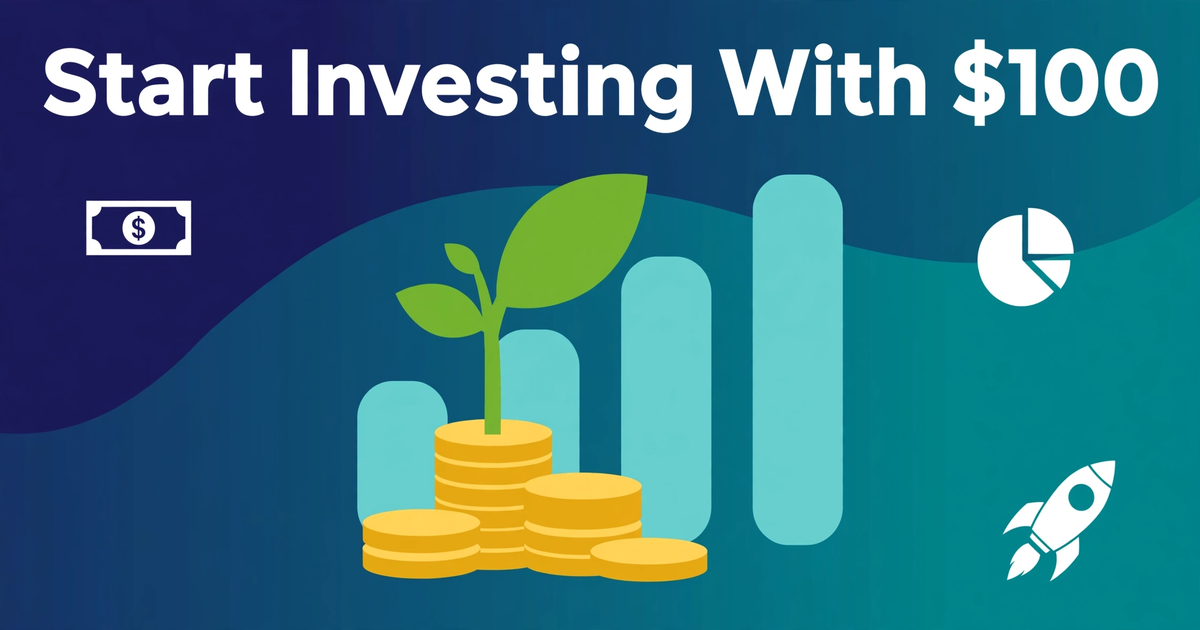
Here’s the lie most people believe about investing: you need thousands of dollars to start. You don’t. If you’re wondering how to start investing with $100, the honest answer is that $100 is plenty — and in 2026, it’s never been easier.
A decade ago, most brokerages demanded $1,000 or more just to open an account, and buying a single share of a good fund could eat your whole budget. Today, the big brokerages let you open an account with $0, charge $0 commissions, and let you buy fractional shares — slices of expensive stocks and funds starting at $1. The barrier isn’t money anymore. It’s knowing what to do.
This guide walks you through the whole thing in plain English: where to open your account, what to actually buy with your $100, the real math of what it grows into, and the mistakes that trip up beginners. No hype, no get-rich-quick promises — just the simple system that actually works.
Can You Really Start Investing With Just $100?
Yes — completely. And you’re not settling for some watered-down version of investing, either. Your $100 buys the exact same investments wealthy people buy. The only difference is the amount.
Here’s what changed. Fractional shares let you buy a slice of any stock or fund instead of the whole share. If one share of an S&P 500 fund costs $600, your $100 buys you one-sixth of a share. You own a real piece of it — same percentage gains, same dividends, just scaled to your money. Every major brokerage — Fidelity, Charles Schwab, Vanguard — offers fractional shares now, most starting at just $1.
And $0 minimums are standard in 2026. Fidelity, Schwab, and Vanguard all let you open a brokerage account or Roth IRA with no minimum deposit and charge zero commissions on stock and ETF trades. There is literally no financial reason to wait until you have “enough.”
Now the reality check, because honesty matters more than hype: $100 alone won’t make you rich. If you invest $100 once and never add another dollar, at a 10% average annual return it becomes about $259 in 10 years and $1,745 in 30 years. Nice, but not life-changing. The real magic isn’t the first $100 — it’s what the first $100 starts: the habit of adding money every month and letting compound growth do the heavy lifting. We’ll run those numbers later, and they’re genuinely exciting.
Your first $100 isn’t a portfolio — it’s the on-ramp. The habit you build around it matters more than the amount.
One more thing before we go further: this guide is educational, not financial advice. Investing involves risk — the value of your investments can go down as well as up, especially in the short term. Nothing here guarantees a return. What it does give you is the same boring, proven approach that has built wealth for millions of ordinary people: low costs, broad diversification, and time.
Do These Two Things Before You Invest a Dollar
This is the part most “how to invest” articles skip, and it’s the most important section in this guide. Investing your first $100 is a bad move if either of these is true:
1. You have no emergency fund
If every dollar you own is about to go into the stock market, what happens when your car breaks down next month? You sell your investments — possibly at a loss — and pay taxes or penalties to get your own money back. That’s not investing; that’s gambling with your safety net.
The rule is simple: keep at least $500–$1,000 in a regular savings account first (a high-yield one is even better). This is your “life happens” money. Only invest money you won’t need for at least a few years. If you don’t have that cushion yet, your $100 belongs in savings, not stocks — and that’s completely fine. Build the cushion, then come back here.
2. You’re carrying high-interest debt
Math doesn’t care about your enthusiasm. If your credit card charges 24% interest and the stock market returns roughly 10% in a good year, every dollar you invest instead of paying down that card is losing you money. Paying off a 24% APR balance is like earning a guaranteed 24% return — no investment on earth beats that reliably.
The order of operations for your money:
- $500–$1,000 mini emergency fund in savings
- Pay down high-interest debt (credit cards, payday loans — anything above ~8% APR)
- Grab your employer’s 401(k) match if you have one (free money — more on this below)
- Then invest your $100 and keep adding monthly
If you’re clear on steps 1 and 2, you’re ready. Let’s open the account.
Investing before you have a small emergency fund isn’t brave — it’s fragile. Cushion first, stocks second.
Where to Open Your Account: 3 Beginner-Friendly Options
You need an account to hold your investments — that’s called a brokerage account. Think of it like a bank account, except instead of just holding cash, it lets you buy stocks and funds. Opening one takes about 10–15 minutes online with your ID and Social Security number. Here are your three options, simplest first:
Option 1: A regular brokerage account (taxable)
This is the plain vanilla account. You put money in, buy investments, and sell whenever you want. No age restrictions, no contribution limits, no tax breaks. The downside: you pay taxes on dividends and on profits when you sell. For a beginner’s first $100, though, simplicity wins — and at this size, the taxes are tiny anyway.
Option 2: A Roth IRA (the tax-free retirement account)
A Roth IRA for beginners is arguably the single best place for your first $100 if you’re investing for the long term. Here’s why: you put in money you’ve already paid taxes on, and then it grows completely tax-free — you never pay taxes on the growth or the withdrawals in retirement. For 2026, you can contribute up to $7,000 per year (a limit you’ll grow into, not hit on day one).
The catch: it’s a retirement account, so there are rules. You generally shouldn’t withdraw the growth before age 59½ without penalties — but you can withdraw your original contributions anytime, penalty-free. That flexibility makes a Roth IRA surprisingly beginner-friendly: your $100 isn’t locked away forever.
To open one you need earned income (a paycheck, freelance income — anything you pay taxes on). If you qualify, this is where most experts would tell you to put your first $100.
Option 3: Your employer’s 401(k) — but only for the match
If your job offers a 401(k) with an employer match, listen up: many employers match your contributions — commonly 50 cents for every dollar you put in, up to 6% of your salary. That’s an instant 50% return before your money even hits the market. Nothing beats it.
So before you open a brokerage account, check: does your employer match 401(k) contributions, and are you contributing enough to get the full match? If not, redirect your first investing dollars there. A $100 contribution that your employer turns into $150 is the best deal in all of personal finance. Once you’ve captured the full match, then fund your Roth IRA or brokerage account.
Here’s how the three compare for a beginner:
| Account | Tax break | Minimum to open | Withdrawal rules | Best for |
|---|---|---|---|---|
| Regular brokerage | None | $0 | Anytime, no penalty | Flexibility; money you might need before retirement |
| Roth IRA | Tax-free growth + withdrawals | $0 | Contributions anytime; growth after 59½ | Long-term wealth; most beginners’ best pick |
| 401(k) with match | Pre-tax contributions | $0 | Penalties before 59½ | Grabbing the employer match first |
If your employer matches 401(k) contributions, that’s your first $100 — a 50% instant return beats every investment on this page.
Which brokerage? For beginners in 2026, Fidelity and Charles Schwab are the two names that come up most: no minimums, no commissions, fractional shares from $1, and both offer Roth IRAs. Vanguard is the pioneer of low-cost index funds and equally solid, though its app feels a bit dated. Any of the three works — don’t spend weeks choosing. The account you open this week beats the “perfect” one you research for a month.
What to Buy With Your First $100
Here’s where beginners freeze. Thousands of stocks, hundreds of funds, everyone on the internet shouting a different ticker. Ignore all of it. With $100, you have exactly one job: buy one broad, low-cost index fund and stop thinking about it.
An index fund is a single investment that automatically holds hundreds or thousands of companies at once. When you buy one share (or a fraction of a share) of an S&P 500 index fund, you instantly own a tiny piece of Apple, Microsoft, Amazon, NVIDIA, and about 496 other big American companies. If one company stumbles, the other 499 carry you. That built-in safety net is called diversification, and it’s the closest thing to a free lunch in investing.
The two beginner favorites:
- VTI (Vanguard Total Stock Market ETF) — owns 3,500+ US companies of all sizes. One purchase = the entire American stock market. Expense ratio: 0.03% (that’s $3 per year on $10,000 invested — basically free).
- VOO (Vanguard S&P 500 ETF) — owns the 500 largest US companies. Slightly more concentrated in big names. Expense ratio: 0.03%.
Either one is an excellent first purchase. Buy a fractional share with your full $100 — at Fidelity or Schwab you can invest the entire amount down to the penny, no leftover cash sitting idle.
What about the other things people suggest? Here’s the honest comparison:
| Option | Cost | Diversification | Beginner-friendly? |
|---|---|---|---|
| S&P 500 / total-market index fund (VTI, VOO) | 0.03%/yr | 500–3,500 companies | Yes — the default answer |
| Individual stocks (Apple, Tesla, etc.) | $0 commission | 1 company — all your eggs, one basket | No — one bad earnings report can cut your $100 in half |
| Robo-advisor | 0.25–0.50%/yr + fund fees | Automatic and diversified | Okay, but unnecessary fees at $100 — learn the one-fund approach first |
| Crypto | Varies, often 1–2% per trade | Extremely volatile | No — your first $100 shouldn’t ride a rollercoaster |
| High-yield savings account | $0 | N/A (not investing) | Fine for your emergency fund — but it won’t grow wealth long-term |
Notice the pattern: at $100, fees are the enemy. A robo-advisor charging 0.25% plus fund fees, or a broker charging commissions, eats a meaningful slice of a small balance. A 0.03% index fund costs you 3 cents a year on $100. That’s why the simple answer wins.
With $100, don’t split it six ways and don’t pick stocks. One broad index fund, the whole $100, done.
A quick note on something you’ll hear about: dollar-cost averaging. It just means investing a fixed amount on a regular schedule — say $25 every week or $100 every month — instead of trying to guess the “right” moment. You’ll automatically buy more shares when prices are low and fewer when they’re high, and you’ll never have to predict the market. It’s not a trick; it’s just automation removing your emotions from the equation. Set it up once and forget it.
How to Start Investing With $100: The 5-Step Plan
You’ve got the concepts. Here’s the exact sequence — most people finish this in under an hour:
Step 1: Confirm your foundation (5 minutes). You have at least a $500–$1,000 emergency fund in savings, and you’re not carrying high-interest credit card debt. If your employer offers a 401(k) match, make sure you’re contributing enough to get all of it.
Step 2: Choose your account (5 minutes). No 401(k) match to grab? Open a Roth IRA if you have earned income and you’re investing for the long term. Open a regular brokerage account if you want maximum flexibility or don’t qualify for an IRA. Either way: Fidelity or Schwab, no minimums, no commissions.
Step 3: Open it and link your bank (15 minutes). You’ll need your Social Security number, a photo ID, your address, and your bank’s routing and account numbers. The application is one online form. Linking your bank usually takes 1–2 business days to verify with tiny test deposits.
Step 4: Transfer your $100 and buy one index fund (10 minutes). Move the $100 in, then place your first trade: a fractional share of VTI or VOO for the full amount. Congratulations — you now own a slice of thousands of companies.
Step 5: Automate $25–$100 a month (5 minutes). This is the step that actually builds wealth. Set up an automatic transfer from your bank and automatic investment into the same fund, scheduled for the day after payday. Start with whatever you can — even $25 a month turns into real money over time, as you’re about to see.
That’s the whole plan. One account, one fund, one automatic transfer. Everything else in investing is optimization — and optimization can wait until you’ve got the habit running.
The 5-step plan takes under an hour: confirm your cushion, open a Roth IRA or brokerage account, transfer $100, buy one index fund, automate monthly additions.
What Your Money Actually Grows Into (Real Numbers)
Time for the fun part. Below is what happens when you invest your first $100 and then add $100 every month, assuming a 7% average annual return (a conservative estimate — the US stock market has averaged roughly 10% per year over the long run, before inflation):
| Timeframe | Total you put in | Investment growth | Account value |
|---|---|---|---|
| 1 year | $1,300 | ~$57 | ~$1,357 |
| 5 years | $6,100 | ~$1,167 | ~$7,267 |
| 10 years | $12,100 | ~$5,309 | ~$17,409 |
| 20 years | $24,100 | ~$28,297 | ~$52,397 |
| 30 years | $36,100 | ~$85,897 | ~$121,997 |
Read the last row slowly. You put in $36,100 of your own money over 30 years. Growth added $85,897 — more than double what you contributed. Your money earned more than you did. That’s compound growth: your returns start earning their own returns, and the curve bends upward the longer you leave it alone.
And if you can only manage $25 a month instead of $100? At 7% over 30 years, that’s still roughly $30,000 from $9,000 of contributions. Not retirement money — but a life-changing emergency buffer, a house down payment, or a kid’s college head start, built from the cost of a few takeout dinners a month.
Two honest caveats. First, 7% is an average, not a promise — some years the market drops 20%, other years it jumps 25%. The average only works if you stay invested through the scary years instead of selling. Second, these numbers ignore inflation: $122,000 in 30 years won’t buy what $122,000 buys today. It’ll still be worth far more than the $36,100 you put in — just don’t mistake the nominal number for today’s purchasing power.
$100 a month at 7% becomes ~$122,000 in 30 years — and $86,000 of that is growth, not your contributions. Time does the heavy lifting.
5 Mistakes That Cost Beginners Real Money
Starting is the hard part — but these five traps catch almost everyone in year one. Learn them here for free instead of paying tuition to the market:
Mistake 1: Waiting until you have “enough” to start
“I’ll start investing when I have $5,000.” That sentence has cost ordinary people more wealth than every market crash combined. Every year you wait is a year of compounding you’ll never get back. Someone who starts with $100/month at 25 ends up with roughly twice as much at 65 as someone who waits until 35 to start with $200/month — starting early beats starting big. The best time was ten years ago; the second-best time is this week.
Mistake 2: Trying to pick winning stocks
Your coworker’s crypto tip, the stock that’s “about to explode,” the company you love as a customer — with $100, stock-picking is entertainment, not investing. Study after study shows that even professional fund managers fail to beat a simple index fund over the long run. If the pros can’t do it with research teams, your hunch about one company isn’t an edge. Buy the whole market and get on with your life.
Mistake 3: Checking your balance every day
Your index fund will bounce around daily — that’s normal and meaningless. But watching it turns investing into an emotional sport: you’ll feel brilliant on green days and panicked on red ones, and panic is what makes people sell at the bottom. Check quarterly at most. The investors who do best are the ones who forget they have an account.
Mistake 4: Paying fees you don’t need to pay
At $100, a 1% annual fee is only a dollar — sounds harmless. But fees compound just like returns, in reverse. Over 30 years, a 1% annual fee can devour roughly a quarter of your total wealth compared to a 0.03% index fund. That’s tens of thousands of dollars on a $100/month habit. The 0.03% fund and the 1% fund buy essentially the same stocks — one just charges you 30 times more for the privilege. Always check the expense ratio before you buy anything.
Mistake 5: Selling when the market drops
This is the big one — the mistake that turns temporary dips into permanent losses. Markets fall regularly: on average, there’s a 10%+ drop roughly once a year and a 20%+ drop every few years. Every single time, it feels like “this time is different.” It never is. Investors who sold during the 2008 crash or the 2020 crash locked in their losses; investors who kept their automatic contributions running bought shares on sale and recovered within a couple of years. Your automation is your discipline — set it, and let it buy through the scary months.
The market drops regularly and recovers reliably. The investors who lose are the ones who sell the dip — automation keeps you from becoming one of them.
FAQs: How to Start Investing With $100
How much money do you need to start investing?
In 2026, effectively $0 to $100. Major brokerages like Fidelity, Schwab, and Vanguard have no account minimums, charge zero commissions, and offer fractional shares starting at $1. The old $1,000–$3,000 minimums are gone. What you actually need is a small emergency cushion first ($500–$1,000 in savings) and no high-interest debt — then $100 is a perfectly real starting point.
What is the best way to invest $100 for beginners?
Put the entire $100 into one broad, low-cost index fund — like VTI (total US stock market) or VOO (S&P 500) — inside a Roth IRA or regular brokerage account, using fractional shares. Don’t split it across six investments and don’t pick individual stocks. One fund, full amount, 0.03% expense ratio. Then automate $25–$100 a month into the same fund.
Are fractional shares worth it?
Yes — they’re the reason $100 investing works at all. Fractional shares let you buy a slice of any stock or ETF starting at $1, so a $600 share price is no barrier. You get the same percentage returns and dividends as full-share owners, proportional to what you invested. There’s no meaningful downside for a beginner; it’s simply how small amounts buy into big funds.
Should I open a Roth IRA or a regular brokerage account with $100?
If you have earned income and you’re investing for the long term (retirement or decades away), the Roth IRA usually wins — your money grows tax-free forever, and you can withdraw your original contributions anytime without penalty. Choose a regular brokerage account if you want zero restrictions or might need the money within a few years. When in doubt, the Roth IRA is the better default for a beginner’s first $100.
Can you lose your $100 investing?
Yes — that’s the honest answer. Investments go up and down, and in a bad year your $100 could temporarily become $80. But two things protect you: diversification (an index fund holding thousands of companies won’t go to zero unless the entire economy does) and time (the market has recovered from every crash in history). The real risk isn’t volatility — it’s selling during a dip or never starting at all.
Your $100 Is Waiting — Start This Week
Let’s bring it home. How to start investing with $100 isn’t a mystery and it isn’t a gamble: confirm your emergency cushion, open a Roth IRA or brokerage account with no minimums, put the full $100 into one broad index fund, and automate a monthly addition you barely notice.
You won’t feel like an investor on day one. You’ll feel like someone who moved $100 and bought 0.17 shares of something with a confusing ticker. That’s fine. Investors aren’t made in a day — they’re made by the unsexy habit of showing up every month while compound growth quietly does the work.
Thirty years from now, that habit is worth roughly $122,000 on $100 a month. The only question is whether your future self gets to thank you for starting today — or wish you had. Open the account this week. Future you is counting on it.
Educational note: This guide is for learning purposes and isn’t financial advice. All investing involves risk, including possible loss of principal. Past market performance doesn’t guarantee future results.