You’ve got a car loan application next month. Or a landlord who checks credit. Or you just looked at your score and thought, “that number is embarrassing.” Whatever brought you here, you want to know how to raise your credit score in 30 days — and you want the truth, not a fairy tale.
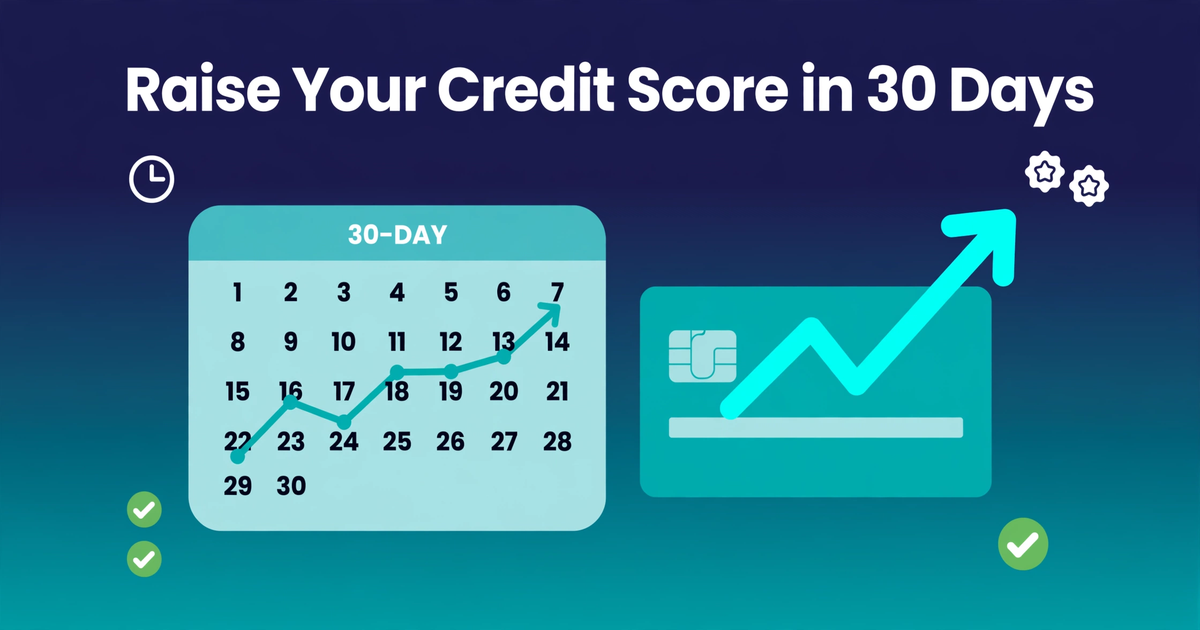
Here’s the truth up front: yes, you can raise your credit score in 30 days. Most people who take the right actions see 20 to 50 points in a single month. Some see 80 to 100 points if they fix a big problem, like maxed-out cards or a serious reporting error. But anyone promising you 200 points in 30 days is selling something — that almost never happens that fast.
This guide gives you a week-by-week plan, the real math behind each move, and an honest look at what’s possible in one month versus what takes longer. No gimmicks, no paid “credit repair” nonsense — just the fastest legitimate levers that exist.
Be Honest First: What 30 Days Can (and Can’t) Do
Let’s set expectations before you lift a finger, because the internet is full of lies on this topic. Your credit score updates when your lenders report new information to the bureaus — and most lenders report once a month. That monthly cycle is why 30 days is a magic number: it’s roughly one full reporting cycle. Do the right things now, and one cycle later your score reflects them.
But not everything moves in one cycle. Here’s the honest breakdown:
| Your situation | Realistic 30-day gain | Why |
|---|---|---|
| High card balances (60%+ utilization) paid down to under 10% | +30 to +80 points | Utilization has no memory — it resets every month |
| A real error removed from your report (wrong late payment, account that isn’t yours) | +25 to +100 points | Depends on how damaging the error was |
| One or two small cleanups (limit increase, autopay, small paydown) | +15 to +40 points | Modest but real movement |
| Recent missed payments, collections, or charge-offs | +0 to +20 points | Payment history has a long memory — this takes months |
| Already good score (740+) with low balances | +5 to +15 points | There’s just less room to climb |
Twenty to fifty points in 30 days is a realistic win for most people — and 30 points can be the difference between a denial and an approval.
The pattern is simple: things about how much you owe move fast. Things about your payment history move slow. Credit utilization — how much of your credit limits you’re using — is recalculated fresh every month with zero memory of last month. Missed payments, on the other hand, stay on your report for seven years — one good month doesn’t erase them, though their sting fades over time.
So if someone tells you they went from 550 to 750 in 30 days, they’re either lying or they had one massive error removed. For everyone else, a focused month of the right moves is worth 20 to 80 points — and that’s genuinely worth doing, because even 20 points can drop your car insurance rate, get you approved for an apartment, or save you thousands on a mortgage.
How Credit Scores Actually Update (Why Timing Matters)
To increase credit score fast, you need to understand the machine you’re dealing with. Your FICO score — the one most lenders used in 2026 — is built from five ingredients:
| Factor | Weight | Moves in 30 days? |
|---|---|---|
| Payment history | 35% | Slowly — one on-time month helps a little |
| Amounts owed (utilization) | 30% | Yes — resets monthly, fastest lever |
| Length of credit history | 15% | No — only time fixes this |
| New credit | 10% | Careful — new applications hurt short-term |
| Credit mix | 10% | Barely — don’t open new accounts for this |
Two things matter most for your 30-day sprint. First, utilization is 30% of your score and has no memory — last month’s 90% utilization is completely forgotten the moment this month’s 10% gets reported. That’s the closest thing to a cheat code that legitimately exists. Second, payment history is 35% and has a very long memory — you can’t fix old late payments in 30 days, but you can absolutely avoid adding new ones.
Here’s the timing detail most articles skip: your card company reports your balance once a month, usually on your statement closing date — not your due date. Whatever your balance is on that one day is what the bureaus see for the whole next month. So if your statement closes on the 15th and you pay your card down on the 20th, the bureaus still see the high balance for another month. Pay 2–3 days BEFORE your statement closing date, and the low balance is what gets reported.
Your statement closing date — not your due date — is the day that decides what the credit bureaus see.
That single insight is worth more than half the “credit hacks” on the internet. Now let’s turn it into a plan.
Your 30-Day Action Plan, Week by Week
Here’s exactly what to do and when. Each week has a theme, and every task is designed to hit the bureaus before your next reporting cycle.
| Week | Theme | Actions | Time needed |
|---|---|---|---|
| Days 1–3 | Audit | Pull all 3 credit reports; list every card’s balance, limit, and statement closing date; spot errors | ~1 hour |
| Days 4–10 | Pay down | Attack high-utilization cards; make payments 2–3 days before statement closing dates | ~30 min |
| Days 11–17 | Fix and boost | Dispute errors; request credit limit increases; bring any past-due account current | ~1 hour |
| Days 18–30 | Protect | Autopay everything; no new applications; let the reporting cycle do its work | ~15 min |
Days 1–3: Audit everything
Start by getting your free credit reports from all three bureaus — Experian, Equifax, and TransUnion. Federal law gives you free reports, and checking your own report is a soft inquiry — it never hurts your score, no matter how often you look.
Go through each report and hunt for four things: accounts that aren’t yours (mix-ups and fraud happen more than you’d think), late payments marked wrong (an on-time payment reported as 30 days late can cost 60–100 points), wrong balances or limits (a $5,000 limit showing as $500 makes your utilization look ten times worse), and duplicate accounts (the same debt listed twice). About 1 in 5 consumers has an error on at least one report — finding one could be your biggest 30-day win.
While you’re at it, make a simple list of every credit card: its current balance, its credit limit, and its statement closing date (find it on your last statement or in your online account). This list is your battle map for week two.
One wrong late payment on your report can cost more points than everything else combined — the audit is the highest-value hour you’ll spend.
Days 4–10: Pay down strategically
This is where the points live. Your goal: get your overall credit utilization under 30% at minimum, and under 10% if you possibly can.
But don’t just throw money randomly. Prioritize like this:
- Maxed-out cards first. Scoring models look at per-card utilization too, not just your total. A card at 95% hurts more than the same balance spread across three cards at 30% each.
- Highest utilization percentage second. A $400 balance on a $500 limit (80%) hurts more than a $2,000 balance on a $10,000 limit (20%).
- Time every payment to the statement closing date. Pay 2–3 days before each card’s closing date so the low balance is what gets reported. Then pay any remaining balance by the due date to avoid interest.
Here’s what the math looks like on a typical situation:
| Starting point | Action | New utilization | Likely score change |
|---|---|---|---|
| $4,500 balance on $5,000 limit (90%) | Pay $4,000 before closing date | 10% | +40 to +80 points |
| $3,000 balance on $10,000 limit (30%) | Pay $2,000 before closing date | 10% | +15 to +35 points |
| $1,500 spread over $15,000 limits (10%) | Pay $750 | 5% | +5 to +15 points |
Don’t have cash to pay down much? That’s okay — the next week’s moves cost nothing.
Days 11–17: Fix errors and boost limits
Dispute the errors you found. You can dispute online with each bureau, by mail, or by phone — online is fastest. Attach any proof you have (bank statements showing on-time payment, letters from the lender). The bureau has 30 days to investigate, so file now — some disputes resolve within the window, and even if yours takes the full 30 days, you’ve started the clock. Disputing never hurts your score.
Request credit limit increases. This is the free lunch of credit scores: a higher limit with the same balance means lower utilization — instantly. Call your card issuer or use their online request form and ask for double or triple your current limit. Many issuers approve with only a soft inquiry (no score damage), but ask first: “Will this be a soft or hard inquiry?” If it’s a hard inquiry and you’re applying for a mortgage soon, skip it. Good candidates: cards you’ve had 6+ months with on-time payments and rising income.
Bring any past-due account current. If you’re behind on anything — even by a little — getting current stops the bleeding. You won’t erase the late mark in 30 days, but “currently 30 days late” is worse than “was late once, now current,” and every on-time month from here starts rebuilding.
A credit limit increase is the only move that lowers your utilization without costing you a dollar — just confirm it’s a soft inquiry first.
Days 18–30: Protect the gains
The work is mostly done — now don’t sabotage it. Set up autopay for at least the minimum on every account: one new late payment can wipe out everything you gained. Then do nothing dramatic — no new applications (each hard inquiry costs a few points), no closing old cards, no co-signing. Check your score weekly, not daily: scores update in cycles, not in real time.
How to Raise Your Credit Score in 30 Days: 7 Fast Moves, Ranked by Impact
Not all credit moves are equal. Here’s every legitimate fast lever, ranked by how much it can move your score in a single month:
| Rank | Move | Typical 30-day impact | Cost |
|---|---|---|---|
| 1 | Pay balances below 10% utilization (before statement dates) | +30 to +80 pts | Whatever you can pay |
| 2 | Remove a major reporting error (wrong late payment, not-your-account) | +25 to +100 pts | Free |
| 3 | Bring a past-due account current | +10 to +40 pts | The overdue amount |
| 4 | Get a credit limit increase (soft inquiry only) | +15 to +40 pts | Free |
| 5 | Pay off a collection account | +0 to +50 pts | The collection amount |
| 6 | Become an authorized user (on a well-managed card) | +10 to +30 pts | Free |
| 7 | Set up autopay + make every payment on time | +5 to +15 pts | Free |
A few honest footnotes on this table, because the details matter:
On paying collections (#5): this one’s tricky. Newer scoring models — FICO 9, FICO 10, and VantageScore 3.0 and 4.0 — ignore collection accounts with a $0 balance. So paying off a collection can give you a real boost under those models. But older models, including the FICO versions most mortgage lenders still use, don’t care whether the collection is paid — it’s the presence of the collection that hurts. Before you pay a collector a dime, get any “pay for delete” agreement in writing — that’s where they agree to remove the account entirely in exchange for payment. A verbal promise is worth nothing.
On authorized user (#6): being added to someone else’s well-managed card can help — their on-time history and low utilization show up on your report. But it only helps when the issuer reports it (on their monthly cycle, not the day you’re added), and only if the card is genuinely well-managed. A maxed-out card with late payments will hurt you. Some newer scoring models also weight authorized-user accounts less than your own.
On “rapid rescoring” (#8, the bonus move): if you’re mid-mortgage-application in 2026, your lender can request a rapid rescore — the bureaus update your file in days instead of weeks. Only lenders can request it (you can’t), and they usually charge per account. If a mortgage is your reason for this sprint, ask your loan officer about it.
Paying a collection only helps if you get the deletion in writing first — otherwise you might pay hundreds of dollars for zero points.
What NOT to Do in the Next 30 Days
Almost as important as the right moves: avoid the wrong ones. Every one of these is something people do with good intentions that backfires:
Mistake 1: Applying for new credit
Every application triggers a hard inquiry, which shaves a few points off your score and stays on your report for two years. Worse, a brand-new account lowers your average account age. If you’re trying to raise your score for an upcoming application, new applications are the exact opposite of what you want. The one exception: a credit limit increase that the issuer confirms is a soft inquiry.
Mistake 2: Closing old credit cards
You paid off a card — congratulations! Now leave it open. Closing it does two bad things at once: it erases that card’s limit from your total available credit (driving your utilization up), and eventually it shortens your credit history. Paid-off and open is the winning combination. Use it for a tiny purchase every few months so the issuer doesn’t close it for inactivity.
Mistake 3: Paying for “credit repair”
Here’s the truth the credit repair industry doesn’t want you to know: there is nothing a credit repair company can legally do that you can’t do yourself for free. They dispute items (which you can do free), tell you to pay down balances (which you already know), and charge you $50 to $150 a month for the privilege. Some are outright scams — if anyone guarantees a specific score increase, promises to remove accurate negative items, or asks you to lie on a dispute, walk away. That’s illegal, and it can get your disputes flagged as frivolous.
Mistake 4: Carrying a balance “to build credit”
This myth refuses to die: “you need to carry a balance for the bank to respect you.” Completely false. You build credit by having accounts open and paying on time — not by paying interest. Paying your statement balance in full every month builds exactly the same payment history as carrying a balance, and it keeps your utilization low. The banks make money either way; don’t donate interest to them out of superstition.
Mistake 5: Maxing out a card “just this once” before the closing date
Remember the golden rule: whatever your balance is on the statement closing date is what gets reported. A big purchase three days before closing — even if you pay it off on time — shows up as high utilization for the whole next month. If you must make a big purchase, make it right after the closing date, then pay it down before the next one.
Real Examples: What 30 Days Actually Looks Like
Theory is nice. Here’s what the math looks like for three real situations:
Maria, 34 — score 640, needs 680 for a car loan. Two cards: Card A at $3,800 on a $4,000 limit (95% utilization), Card B at $200 on $6,000. She pays Card A down to $400 before its statement closing date, and gets Card B’s limit raised from $6,000 to $9,000 (soft inquiry). Total utilization drops from 40% to under 5%. One cycle later: score 684 (+44 points) — approved at a lower rate that saves her roughly $1,800 in interest on a $22,000 car loan.
James, 41 — score 590, held back by one collection. A $450 medical collection from two years ago is his main anchor; recent history is clean. He negotiates a written pay-for-delete, pays the $450, and the collection disappears from all three reports within the month. One cycle later: score 638 (+48 points). Honest caveat: without the written deletion agreement, his gain under older FICO models might have been near zero.
Priya, 28 — score 710, wants 740+ for the best mortgage rates. Clean file — no lates, no collections. Her only issue: $2,100 on $7,000 total limits (30% utilization). She pays down to $350 (5%) before her statement closing dates and sets up autopay everywhere. One cycle later: score 733 (+23 points). Smaller gain, because there was less broken to fix — one more clean month will likely get her to 740.
Your starting point decides your ceiling — the worse the specific problem, the bigger the 30-day fix. Clean files gain 15–25 points; messy utilization or real errors can gain 40–80.
After Day 30: Keep the Momentum
Thirty days gets you the quick win. But here’s what separates people whose scores stay up from people who bounce back down: the habits after the sprint.
Keep utilization low permanently. You don’t need to obsess — just make the statement-closing-date payment a monthly habit. A calendar reminder (“pay cards down 3 days before closing”) takes five minutes a month and protects everything you gained.
Never miss a payment again. Autopay the minimum on every account, then pay extra manually toward whatever you’re targeting. Payment history is 35% of your score — the biggest slice — and every on-time month slowly dilutes old mistakes. A late payment from three years ago stings less each year; a new one resets the pain.
Let time work. Length of credit history is 15% of your score, and there’s no shortcut — accounts just need to age. Every month your oldest card stays open, your average account age grows. This is the quiet engine of long-term score growth, and it runs on autopilot as long as you don’t close accounts.
Check your reports once or twice a year. Errors creep back in. A 20-minute check every six months catches problems while they’re small.
One more honest note: if your score is still below where you need it after 30 days, that’s normal for deeper problems. A bankruptcy, multiple collections, or a string of late payments needs 6 to 12 months of clean history to meaningfully heal. The 30-day sprint still helps — it just becomes month one of a longer plan.
FAQs: How to Raise Your Credit Score in 30 Days
How many points can I realistically gain in 30 days?
For most people, 20 to 50 points is realistic. If you’re fixing high utilization — say, paying maxed-out cards down under 10% — 40 to 80 points is common. Removing a serious reporting error can add 25 to 100+ points depending on how damaging it was. What’s not realistic: 150–200 point jumps in a single month, unless you had one massive error removed. Anyone guaranteeing a specific number is guessing or lying — your starting file decides your ceiling.
Can I raise my credit score 200 points in 30 days?
Almost certainly not. A 200-point gain typically requires multiple billing cycles — usually 6 to 12 months of sustained improvement. The math just doesn’t work in 30 days: even fixing utilization (the fastest lever, 30% of your score) has limits, and payment history damage heals slowly by design. The one exception: if a single huge error — like a wrongly reported collection or a late payment that wasn’t yours — gets deleted, big jumps are possible. But that’s error correction, not score building.
Does checking my own credit score hurt it?
No — never. Checking your own score or pulling your own credit reports is a soft inquiry, and soft inquiries have zero effect on your score. Check daily if you want (though weekly is saner — scores move in monthly cycles). What does hurt is hard inquiries — those happen when you apply for new credit, like a credit card, auto loan, or mortgage. Each hard inquiry costs a few points and stays on your report for two years.
Should I hire a credit repair company?
Generally no. Everything a legitimate credit repair company does — disputing errors, writing goodwill letters, advising you to pay down balances — you can do yourself for free, and this guide just taught you how. The industry charges $50 to $150 a month, often for months, and the shady operators promise things they can’t legally deliver (like removing accurate negative items). Red flags: guaranteed score increases, asking you to lie on disputes, or suggesting you create a “new credit identity.” Save the money and put it toward your balances instead.
Does paying off a collection remove it from my credit report?
Not automatically. Paying a collection changes its status to “paid,” but the account itself typically stays on your report for seven years from the original delinquency. Whether that helps your score depends on the scoring model: newer models (FICO 9, FICO 10, VantageScore 3.0/4.0) ignore paid collections, so paying can boost your score under those models. Older models — including versions many mortgage lenders still use — don’t give credit for paid collections. That’s why a written pay-for-delete agreement (the collector removes the account entirely in exchange for payment) is so valuable. Get it in writing before you pay a cent.
Your 30 Days Start Today
Learning how to raise your credit score in 30 days comes down to a simple truth: fix what you owe first, because that’s what moves fastest. Pull your reports this week. Pay your balances down before those statement closing dates. Dispute what’s wrong. Ask for limit increases. Then protect it all with autopay and patience.
You probably won’t gain 200 points. But 30, 40, 50 points? That’s real, that’s achievable, and that’s often the difference between “denied” and “approved” — between a punishing interest rate and a fair one. On a car loan or mortgage, those points can be worth thousands of dollars.
The reporting cycle doesn’t wait. Start your 30 days today, and let next month’s update surprise you.