Here’s a secret about the whole roth ira vs traditional ira for beginners debate: the entire difference comes down to one question — WHEN do you pay taxes?
That’s it. Once you truly get that, everything else clicks into place. The contribution limits, the income rules, the withdrawal penalties — they’re all just details hanging off that one big idea.
So let’s skip the jargon and the Wall Street talk. By the end of this guide, you’ll know exactly how each account works, which one fits your life, and how to open one in about 20 minutes. No finance degree required.
The One-Sentence Difference
Here it is, the whole thing in two sentences:
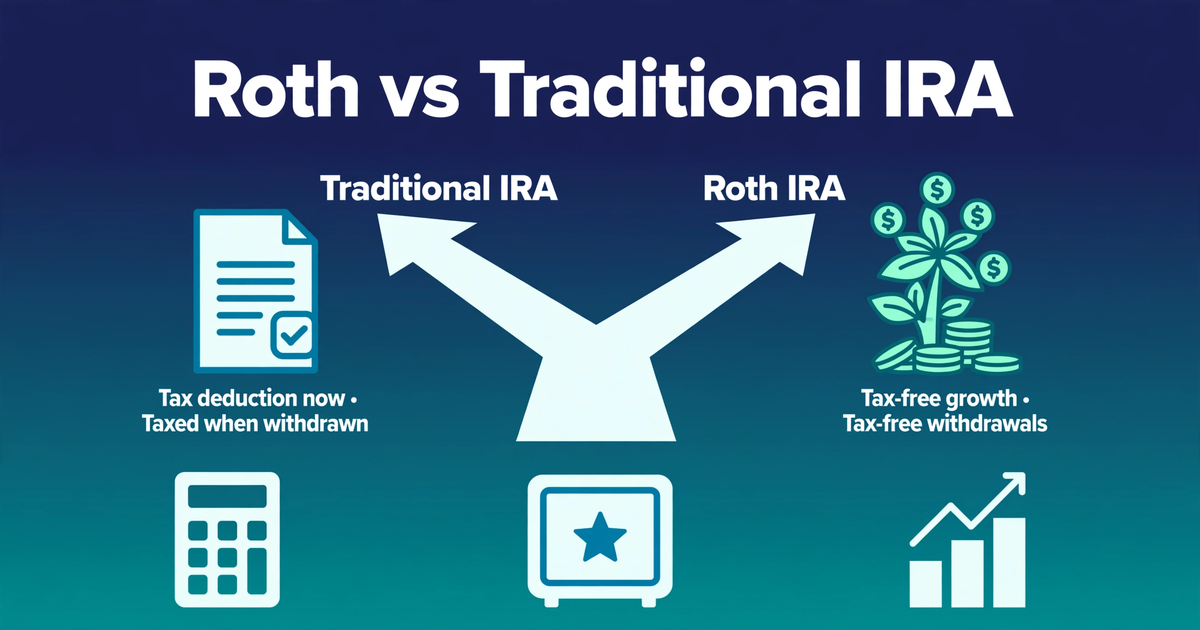
- Roth IRA: You pay taxes on the money now, then withdraw it tax-free in retirement.
- Traditional IRA: You skip taxes now (a tax deduction), then pay taxes when you withdraw in retirement.
Think of it like planting a garden. With a Roth, you pay tax on the seed — a tiny amount — and the entire harvest is yours, tax-free. With a Traditional IRA, you plant the seed tax-free, but the government takes a cut of the whole harvest later.
Same garden. Same sunshine. Just a different deal about when the tax bill arrives.
So which deal is better? It depends on one big guess: will your tax rate be higher now or in retirement? If you’re young and earning less today than you will later, paying taxes now (Roth) is usually the smarter move. If you’re in your peak earning years and expect a lower income in retirement, the Traditional deduction might win.
Don’t worry — we’ll make this concrete with real numbers in a minute.
The whole Roth vs Traditional question is just this: pay taxes on the seed now (Roth) or on the harvest later (Traditional).
Roth IRA vs Traditional IRA: Side-by-Side Comparison
Let’s put everything next to each other. This is the table you’ll want to bookmark:
| Roth IRA | Traditional IRA | |
|---|---|---|
| When you pay taxes | Now — contributions are after-tax | Later — contributions may be tax-deductible now |
| Taxes in retirement | $0 on qualified withdrawals | Withdrawals taxed as ordinary income |
| 2026 contribution limit | $7,000 ($8,000 if you’re 50+) | $7,000 ($8,000 if you’re 50+) |
| Income limits? | Yes — high earners are phased out (see 2026 table below) | No limit to contribute; deduction phases out if you have a 401(k) |
| Early withdrawals (before 59½) | Contributions anytime, penalty-free; earnings have rules | 10% penalty + taxes on most early withdrawals |
| Required withdrawals | None — ever. Your money can sit there forever | RMDs start at age 73 — the IRS forces withdrawals |
| Best for | Young savers, lower earners, anyone who wants tax-free retirement income | Peak earners wanting a tax break now |
A few things jump out. First, the contribution limit is the same for both — $7,000 in 2026, or $8,000 if you’re 50 or older. (That limit is combined: you can’t put $7,000 in each. It’s $7,000 total across both accounts.)
Second, notice the Roth’s superpower in that table: no required withdrawals, ever. A Traditional IRA forces you to start pulling money out at 73 whether you want to or not. A Roth lets your money grow untouched for as long as you live — and even pass tax-free to your heirs.
Same $7,000 limit for both in 2026 — but the Roth gives you tax-free withdrawals AND no forced withdrawals at 73.
How a Roth IRA Works (With Real Numbers)
Let’s walk through a Roth IRA the way it actually plays out in real life.
Meet Jordan. She’s 25, earns $55,000 a year, and decides to put $6,000 into a Roth IRA this year. Here’s what happens, step by step:
Step 1: She contributes after-tax dollars.
The $6,000 comes from her paycheck after taxes are taken out. She gets no tax deduction this year. That part stings a little — but watch what happens next.
Step 2: The money grows for 40 years.
Jordan invests it in a simple index fund earning an average of 7% per year. She doesn’t touch it. Compound growth does the heavy lifting:
| Year | Age | Account value |
|---|---|---|
| 0 | 25 | $6,000 |
| 10 | 35 | $11,803 |
| 20 | 45 | $23,218 |
| 30 | 55 | $45,674 |
| 40 | 65 | $89,846 |
Step 3: She withdraws it all tax-free.
At 65, Jordan pulls out the full ~$90,000 and pays $0 in taxes on it. Not on the original $6,000. Not on the $84,000 of growth. Zero.
That’s the Roth magic. She paid maybe $1,320 in taxes on that $6,000 back when she earned it (at a 22% bracket). In exchange, she shielded $84,000 of growth from taxes forever.
And here’s the part people love most: she can pull out her original $6,000 in contributions anytime — next year, in five years, whenever — with no penalty and no taxes. (The earnings have rules before age 59½, which we’ll cover in the mistakes section. But your own contributions are always accessible.)
This is why the Roth is so beginner-friendly. It feels less scary because your contributions are never locked away from you.
Put in $6,000 at 25, let it grow to ~$90,000 by 65, withdraw every penny tax-free. That’s the Roth deal.
How a Traditional IRA Works (With Real Numbers)
Now let’s run the same scenario through a Traditional IRA. Same Jordan, same $6,000 — but a completely different tax deal.
Step 1: She deducts the contribution this year.
Jordan puts $6,000 into a Traditional IRA and subtracts it from her taxable income. At a 22% tax bracket, that deduction saves her $1,320 on this year’s tax bill. That’s real money back in her pocket right now — enough for a nice vacation or a solid emergency fund boost.
Step 2: The money grows exactly the same.
Inside the account, the $6,000 grows at the same 7% to the same ~$90,000 by age 65. The investments don’t care which account type holds them — growth is growth.
Step 3: She pays taxes on every dollar she withdraws.
Here’s the flip side. When 65-year-old Jordan starts pulling money out, every withdrawal is taxed as ordinary income. If she’s in a 22% bracket in retirement, that $90,000 costs her roughly $19,800 in taxes over time.
So the honest math:
| Roth IRA | Traditional IRA | |
|---|---|---|
| Tax break today | $0 | $1,320 saved |
| Taxes in retirement | $0 | ~$19,800 on withdrawals |
| Net tax outcome | Paid $1,320 once, decades ago | Saved $1,320 now, paid ~$19,800 later |
Ouch. When you see it laid out like that, the Traditional looks like a bad deal — but only because Jordan was young and in a low bracket. Flip the scenario: if Jordan were 55, earning $150,000 in a 32% bracket, that $6,000 deduction would save her $1,920 today, and she might retire into a much lower 12% bracket. Then the Traditional wins easily.
The lesson: neither account is “better” in the abstract. It all depends on your tax rate now versus your tax rate later.
A Traditional IRA gives you $1,320 back on this year’s taxes — but you’ll pay taxes on every dollar you withdraw in retirement.
Which IRA Is Best for Beginners?
Okay, decision time. Here’s the rule of thumb that covers about 90% of beginners:
👉 If you’re young or earning a modest income → choose Roth
This is most beginners. If you’re in your 20s or 30s, or earning under ~$80,000, you’re probably in a lower tax bracket now than you’ll ever be again. Paying taxes today at 12% or 22% to get tax-free money forever is a steal.
The Roth also forgives beginner mistakes better: you can withdraw contributions anytime without penalty, there are no forced withdrawals at 73, and the rules are simpler to live with.
👉 If you’re in your peak earning years → consider Traditional
If you’re earning well into six figures and in the 32%+ bracket, that upfront deduction is worth real money right now. And if you expect your income to drop in retirement, you’ll pay withdrawals at a lower rate. That’s the Traditional sweet spot.
The 60-second decision table
| Your situation | Lean toward |
|---|---|
| Under 35, or earning under ~$80k | Roth |
| In the 32%+ tax bracket now | Traditional |
| Expect higher income later in life | Roth |
| Expect lower income in retirement | Traditional |
| Want the simplest, most flexible account | Roth |
| Need the tax break this year | Traditional |
And here’s the thing nobody tells beginners: you don’t have to pick just one forever. You can contribute to a Roth this year and a Traditional next year (remember, the $7,000 limit is combined). Many people do Roth in their 20s and 30s, then switch to Traditional in their peak earning years. That’s not indecisive — that’s smart tax planning.
Young or earning less now? Roth, almost every time. The tax-free growth over 30-40 years is worth far more than today’s small deduction.
Real Examples: Who Should Pick Which?
Rules of thumb are nice, but real people make it click. Here are four:
Priya, 24 — freelance graphic designer, $42,000/year → Roth
Priya’s in the 12% bracket, which means taxes are about as cheap as they’ll ever be for her. She puts $6,000 a year into a Roth. Over 40 years at 7% average growth, that turns into roughly $1.2 million — and she’ll withdraw every penny tax-free.
If she’d picked a Traditional instead, she’d save just $720 a year in taxes now (12% of $6,000) — and owe taxes on $1.2 million of withdrawals later. Trading $720 today for taxes on a million dollars is a terrible deal. Roth wins by a landslide.
Marcus, 47 — software engineer, $165,000/year → Traditional
Marcus is in the 32% bracket. A $7,000 Traditional contribution saves him $2,240 on this year’s tax bill — real money, right now. He plans to retire at 62 with a much lower income, likely in the 22% bracket or below, so he’ll pay far less on withdrawals than the 32% he saved today.
One wrinkle: Marcus earns too much to contribute to a Roth directly anyway (remember those income limits from the table above). The Traditional is his natural fit — and the deduction is worth more to him than it would be to almost anyone else.
Elena, 35 — freelance writer, income swings between $50k and $90k → Roth
Elena’s income is unpredictable, but most years she lands in the 22% bracket or lower. The Roth fits her for a second reason too: she can withdraw contributions anytime, penalty-free. For a freelancer with no steady paycheck, knowing her IRA doubles as a last-resort safety net makes investing feel much less scary — and that confidence is worth a lot.
James and Aisha, 52 — married, $210,000 combined → a split strategy
In their peak earning years, James and Aisha take the Traditional deduction to save thousands in taxes right now. But they have a longer game planned: after retiring at 62 but before RMDs kick in at 73, they’ll convert chunks of the Traditional to a Roth during low-income years — paying taxes at a much lower rate. It’s called a Roth conversion ladder, and it’s how smart planners get the best of both worlds.
See yourself in one of these? That’s your answer. The right account is the one that matches your tax bracket today and your plans for tomorrow — and you’re allowed to change your mind as life changes.
2026 Limits and Rules You Must Know
Here’s your clean reference sheet for the Roth IRA contribution limits 2026 and the other rules that trip people up. Save this section.
Contribution limits (both accounts)
| Under 50 | 50 and older | |
|---|---|---|
| 2026 limit | $7,000 | $8,000 |
| Counts across… | Both IRAs combined | Both IRAs combined |
That last row matters: if you put $4,000 in a Roth, you can only put $3,000 in a Traditional the same year. The IRS counts them together.
Roth IRA income limits 2026
This is the Roth’s one real catch: earn too much and you can’t contribute directly. The limits phase out gradually (these are approximate — the IRS adjusts them yearly, so double-check current figures):
| Filing status | Full contribution allowed | Phase-out range |
|---|---|---|
| Single | Under ~$150,000 | ~$150,000 – $165,000 |
| Married filing jointly | Under ~$236,000 | ~$236,000 – $246,000 |
Earn above the phase-out range? You can’t contribute to a Roth directly — though there’s a legal workaround called a “backdoor Roth” (contribute to a Traditional, then convert). That’s beyond beginner territory, but good to know it exists.
Traditional IRAs have no income limit for contributing. Anyone with earned income can put money in. The income limits only affect whether you can deduct the contribution — and only if you (or your spouse) have a 401(k) at work.
Required minimum distributions (RMDs)
| Roth IRA | Traditional IRA | |
|---|---|---|
| RMDs? | None — ever | Yes, starting at age 73 |
Traditional IRA required minimum distributions at age 73 mean the IRS forces you to withdraw a calculated percentage each year — and pay taxes on it — whether you need the money or not. Miss an RMD and the penalty is steep (25% of the amount you should have withdrawn). The Roth has no such rule, which is a big reason people love it for estate planning.
Know these three numbers cold: $7,000 limit ($8,000 if 50+), Roth income phase-outs around $150k single / $236k married, and Traditional RMDs kick in at 73.
5 Mistakes Beginners Make
These are the traps that catch almost every first-timer. Learn them here instead of the expensive way.
Mistake 1: Contributing more than the limit
The IRS is strict about the $7,000 cap. Put in $8,000 by accident and you’ll owe a 6% penalty every year until you fix it. This usually happens when people open IRAs at two different brokerages and lose track. Keep a simple note of your total contributions for the year — one number, updated each time you contribute.
Mistake 2: Ignoring the Roth income limits
High earners sometimes contribute to a Roth for years without realizing they phased out — then face penalties and paperwork to unwind it. If your income is anywhere near the phase-out range, check the current year’s limits before contributing, not after.
Mistake 3: Forgetting about RMDs on a Traditional IRA
This one sneaks up at 73. The IRS doesn’t send you a friendly reminder — it’s your job to calculate and take your required minimum distribution each year. Set a calendar reminder for age 72 to learn the RMD rules. The 25% penalty on missed RMDs is one of the harshest in the tax code.
Mistake 4: Withdrawing Roth earnings early (the 5-year rule, simplified)
Your Roth contributions can come out anytime — but the earnings (the growth) have two conditions for tax-free withdrawal: you must be 59½ or older AND your first Roth contribution must be at least 5 years old. Break those rules and you’ll owe taxes plus a 10% penalty on the earnings portion. (There are exceptions for first-home purchases and a few other cases, but don’t count on them.)
Mistake 5: Leaving the cash uninvested inside the IRA
This is the most common beginner mistake of all. You open the IRA, contribute $6,000… and it just sits there as cash, earning almost nothing. An IRA is just an account — a container. You still have to invest the money inside it (usually in an index fund). Check your account a week after funding: if it says “cash” or “money market” instead of a fund name, your money isn’t actually invested yet. Fix it with two clicks.
An IRA is just a container — if you don’t invest the cash inside it, you’re getting a fancy savings account, not retirement growth.
5 Roth vs Traditional IRA Myths Debunked
Myth 1: “You have to pick one forever”
Nope. You can contribute to a Roth this year and a Traditional next year — or even split $4,000 into one and $3,000 into the other in the same year. The $7,000 limit is combined, not per account. Life changes, brackets change, and your IRA strategy is allowed to change too.
Myth 2: “Roth is always better because tax-free sounds better”
Tax-free withdrawals are great — but only if you paid a low rate going in. A 45-year-old in the 32% bracket who’ll retire in the 22% bracket does better with the Traditional deduction. “Tax-free later” isn’t magic; it’s a trade. Make sure the trade favors you.
Myth 3: “Traditional IRAs are only for rich people”
Anyone with earned income can contribute to a Traditional IRA — there’s no income limit on contributing at all. The income limits only affect whether high earners who also have a 401(k) can deduct the contribution. A 22-year-old barista can open one just as easily as a CEO.
Myth 4: “You need thousands of dollars to start”
You need $100. Maybe less. Fidelity, Schwab, and Vanguard all let you open an IRA with no minimum and buy fractional shares — meaning your $100 buys a slice of an index fund, not a whole share. Waiting until you have “enough” is the most expensive myth on this list: every year you wait is a year of compounding gone forever.
Myth 5: “Every dollar from a Roth comes out tax-free, no exceptions”
Almost every dollar. Your contributions are always tax- and penalty-free to withdraw. But the earnings need you to be 59½ with the account open 5+ years for the full tax-free treatment. Withdraw earnings early and you’ll owe taxes plus a 10% penalty. Know the line between contributions and earnings, and you’ll never be surprised.
How to Open Your First IRA in 20 Minutes
Enough learning — here’s the exact playbook. Set a timer; this really does take about 20 minutes.
Step 1: Pick a brokerage (5 minutes).
For beginners, the big three are all excellent and beginner-friendly: Fidelity, Schwab, or Vanguard. All offer $0-minimum IRAs, $0 annual fees, and fractional shares. Don’t overthink this — they’re all fine. Pick one and move on.
Step 2: Choose Roth or Traditional (2 minutes).
Use the decision table from earlier. If you’re young or earning under ~$80k, pick Roth. You can always open the other type later.
Step 3: Open the account online (10 minutes).
It’s like opening a bank account: name, address, Social Security number, employment info, beneficiary (pick someone you trust — this is who gets the money if something happens to you). Choose “individual” account type, not joint.
Step 4: Fund it (2 minutes).
Link your bank account and transfer your contribution. Start with whatever you can — even $100 gets the account open. You have until Tax Day (usually April 15) of the following year to contribute for the current tax year, so there’s no rush to fund it all at once.
Step 5: INVEST the money (1 minute — don’t skip this!).
This is Mistake #5 from above. After funding, buy one total-market index fund (examples: Fidelity’s FZROX, Schwab’s SWTSX, or Vanguard’s VTI). One fund. Done. You can get fancier later — but a single broad index fund is a genuinely great portfolio for a beginner.
Then automate: set up a monthly automatic transfer — even $100 or $200 a month. Automation turns “I should invest” into “it’s already done.”
Open it at Fidelity, Schwab, or Vanguard. Pick Roth if you’re young. Fund it, buy ONE index fund, automate monthly contributions. Twenty minutes today, decades of growth tomorrow.
FAQs
What’s the real difference between a Roth and a Traditional IRA?
Roth vs Traditional IRA tax differences explained simply: with a Roth, you pay income tax on contributions now and withdraw everything tax-free in retirement. With a Traditional, you (usually) deduct contributions now and pay income tax on withdrawals later. Same $7,000 limit in 2026. The Roth also has income limits for contributing and never forces withdrawals; the Traditional forces withdrawals starting at age 73.
What are the 2026 contribution limits?
$7,000 if you’re under 50, $8,000 if you’re 50 or older — and that’s the combined total across both Roth and Traditional IRAs. You can’t do $7,000 in each.
Are there income limits for a Roth IRA?
Yes. In 2026, single filers earning roughly above $150,000 (phasing out completely around $165,000) and married couples filing jointly above roughly $236,000 (phasing out around $246,000) can’t contribute directly. These figures adjust yearly, so verify the current numbers with the IRS before contributing if you’re near the line.
What are required minimum distributions?
RMDs are annual withdrawals the IRS forces you to take from a Traditional IRA starting at age 73 — calculated as a percentage of your balance, taxed as income. Miss one and the penalty is 25% of what you should have withdrawn. Roth IRAs have no RMDs, ever.
Which IRA is better if I’m young?
Almost always the Roth. When you’re young, you’re usually in a lower tax bracket than you’ll ever be in again — so paying taxes now is cheap. Then you get 30–40 years of tax-free growth, penalty-free access to your contributions anytime, and no forced withdrawals at 73. It’s the most beginner-friendly retirement account that exists.
The Bottom Line
The roth ira vs traditional ira for beginners question isn’t really a debate — it’s a mirror. Look at your tax bracket today, guess at your tax bracket in retirement, and the answer usually appears on its own.
Young, or earning a modest income? Open a Roth, fund it, buy one index fund, and let 40 years of tax-free compounding do the work. In your peak earning years with a high bracket? The Traditional deduction might serve you better.
Either way, the worst choice is no IRA at all. Twenty minutes today — that’s all that stands between you and a retirement account working in your favor. Future you is counting on it.