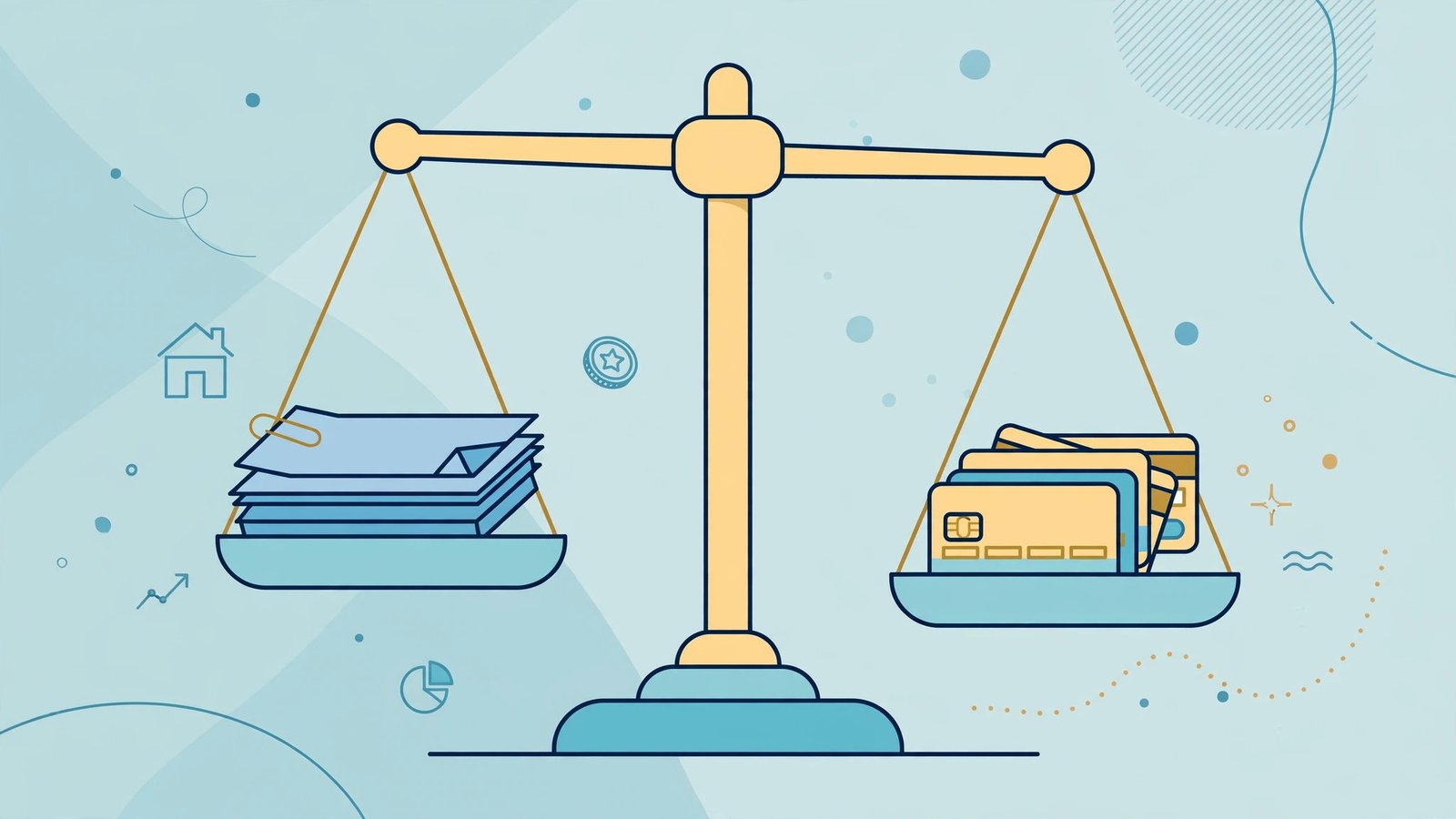
Carrying high-interest debt feels like running on a treadmill. You make payments every month, but the balance barely moves. Two popular ways to break that cycle are a debt consolidation loan and a balance transfer credit card. Both can lower what you pay in interest, but they work very differently.
This guide walks through how each option works, what each one costs, and how to figure out which one actually saves you more.
What Is a Debt Consolidation Loan?
A debt consolidation loan is a personal loan you take out to pay off multiple existing debts. Instead of juggling five credit card bills with five different due dates and interest rates, you roll them into one single loan with one monthly payment.
These loans are usually unsecured, meaning you do not have to put up collateral like a car or house. The lender looks at your credit score, income, and existing debts to decide your interest rate and loan term, which is typically 2 to 7 years.
How it works
- You apply for a personal loan covering the debts you want to consolidate.
- You use the funds to pay off your credit cards or other debts.
- You make one fixed monthly payment until the loan is paid off.
- You apply for a balance transfer card with a 0% introductory APR offer.
- You move existing balances to the new card, up to its credit limit.
- You pay no interest during the promo period — but minimum monthly payments are still required.
- After the promo ends, any remaining balance is charged the card's regular APR.
- Transfer fee: $240 (added to the balance: $8,240 total)
- Monthly payment to clear it in 18 months: about $458
- Total interest: $0 — total cost of the debt: $240
- Monthly payment: about $258
- Total interest paid: roughly $1,288
- Total cost: the interest plus any origination fee
- If you can pay off the debt within the promotional period, a balance transfer usually saves more because of the 0% interest window.
- If you need more time, or you want predictable payments, a debt consolidation loan is usually safer and cheaper than letting a leftover balance roll into a high APR.
- One fixed payment with a definite payoff date — no more juggling due dates.
- Lower rate than most credit cards. If your cards charge 20%+ and you qualify for 10% to 12%, you save real money.
- No surprise rate jumps. The rate is fixed for the life of the loan.
- Origination fees of 1% to 8% eat into your savings.
- Longer terms mean more total interest, even at a decent rate.
- Requires discipline. Run the cards back up and you end up with the loan and new debt.
- 0% interest period. Every dollar you pay goes to principal during the promo window.
- Cheapest payoff if you clear the balance in time.
- Transfer fees of 3% to 5% are added to your debt on day one.
- The clock is ticking. Miss the deadline and the remaining balance gets hit with a high APR.
- Minimum-payment trap. Paying only minimums leaves a big balance when the promo ends.
- Applying for both at once. Multiple hard inquiries in a short time can ding your credit score. Pick your path first.
- Ignoring the fine print on balance transfers. Some cards charge deferred interest or apply the regular APR to new purchases immediately.
- Taking a longer loan term just for a lower payment. You pay more interest over time. Choose the shortest term you can afford.
- Consolidating without a budget. If overspending caused the debt, a new loan without a spending plan just moves the problem.
The main appeal is simplicity and structure. You know exactly when the debt will be gone, and the fixed payment makes budgeting easier.
What Is a Balance Transfer?
A balance transfer is when you move debt from one or more credit cards onto a new credit card that offers a low or 0% introductory APR (annual percentage rate) for a set period, often 12 to 21 months.
How it works
Balance transfers come with a balance transfer fee, typically 3% to 5% of the amount transferred. That fee is added to your balance right away.
Side-by-Side Comparison
| Factor | Debt Consolidation Loan | Balance Transfer Card |
|—|—|—|
| Interest | Fixed rate for the whole term | 0% intro APR, then high regular APR |
| Payment | Fixed monthly payment | Minimum payment required; you set the pace |
| Term | 2 to 7 years, definite end date | Promo period of 12 to 21 months |
| Fees | Possible origination fee (often 1% to 8%) | Balance transfer fee of 3% to 5% |
| Credit score needed | Usually fair to good | Usually good to excellent |
| Discipline required | Lower — fixed payments keep you on track | Higher — easy to pay only minimums |
Which One Costs Less? Running the Numbers
The "which saves more" question depends on three things: your total debt, the interest rates you can actually get, and how fast you can pay it off.
Example: $8,000 in credit card debt
Option A: Balance transfer at 0% APR for 18 months with a 3% fee
This is the cheapest option, but only if you finish within the 18 months.
Option B: Debt consolidation loan at 10% APR over 3 years
The loan costs more than a successful balance transfer, but the monthly payment is lower and the payoff date is locked in. You do not risk a rate spike at month 19.
The general rule
Pros and Cons of a Debt Consolidation Loan
Pros
Cons
Pros and Cons of a Balance Transfer
Pros
Cons
How to Choose: 5 Questions to Ask Yourself
1. How much debt do you have?
Balance transfers work best for smaller balances you can realistically kill within the promo period. Larger debts often need the longer runway of a consolidation loan.
2. What is your credit score?
Check your score before applying. Excellent credit opens up the longest 0% offers and the lowest loan rates. Fair credit may only qualify you for a loan — and possibly at a higher rate.
3. Can you pay it off in 12 to 21 months?
Be honest. Divide your balance (plus the transfer fee) by the number of promo months. If that monthly number fits your budget comfortably, a balance transfer is a strong choice. If it would stretch you thin, the loan's lower payment is safer.
4. What fees will you actually pay?
Compare the balance transfer fee against the loan's origination fee plus total interest. Do the math for your specific numbers instead of guessing.
5. Will you stop using the old cards?
This is the question people skip. Consolidation only works if you do not rack up new debt. Consider cutting up the cards or locking them away until the debt is gone.
Common Mistakes to Avoid
Frequently Asked Questions
Does a debt consolidation loan hurt your credit score?
Applying causes a small, temporary dip from the hard inquiry. Over time it can help, since on-time payments build history and paying off cards lowers utilization.
Does a balance transfer hurt your credit score?
Similarly, the application causes a small dip. A new card lowers your average account age, but the utilization improvement usually helps more than it hurts.
Can I do a balance transfer with bad credit?
It is difficult. The best 0% offers go to borrowers with good to excellent credit. With fair or poor credit, a consolidation loan or a nonprofit debt management plan may be more realistic.
Is it better to get one big loan or several balance transfers?
One loan is simpler and has a fixed end date. Multiple balance transfers can work if you are organized, but juggling several promo deadlines adds risk and complexity.
What happens if I miss a payment on a 0% balance transfer card?
Many issuers can cancel the promotional APR if you miss a payment, and the regular (much higher) rate applies to the remaining balance. Set up autopay for at least the minimum to avoid this.
This content is for general educational purposes only and is not professional financial advice.