You just got paid. For about 48 hours, you feel rich. Then rent hits, the car insurance auto-drafts, groceries happen, and suddenly you’re doing that mental math we all do: how much of my paycheck should I have saved?
If you’ve been searching for how much of paycheck should you save, here’s the short answer experts keep repeating: 20% of your take-home pay. That’s the headline number. But the honest answer is longer — because 20% is easy to say and hard to do when rent alone eats half your check.
This guide gives you the real numbers: what the 20% rule actually means, what’s realistic at your income level, where that money should go first, and what to do when 20% is a fantasy. No shame, no impossible math — just a plan that works in 2026.
The Short Answer: How Much of Your Paycheck Should You Save
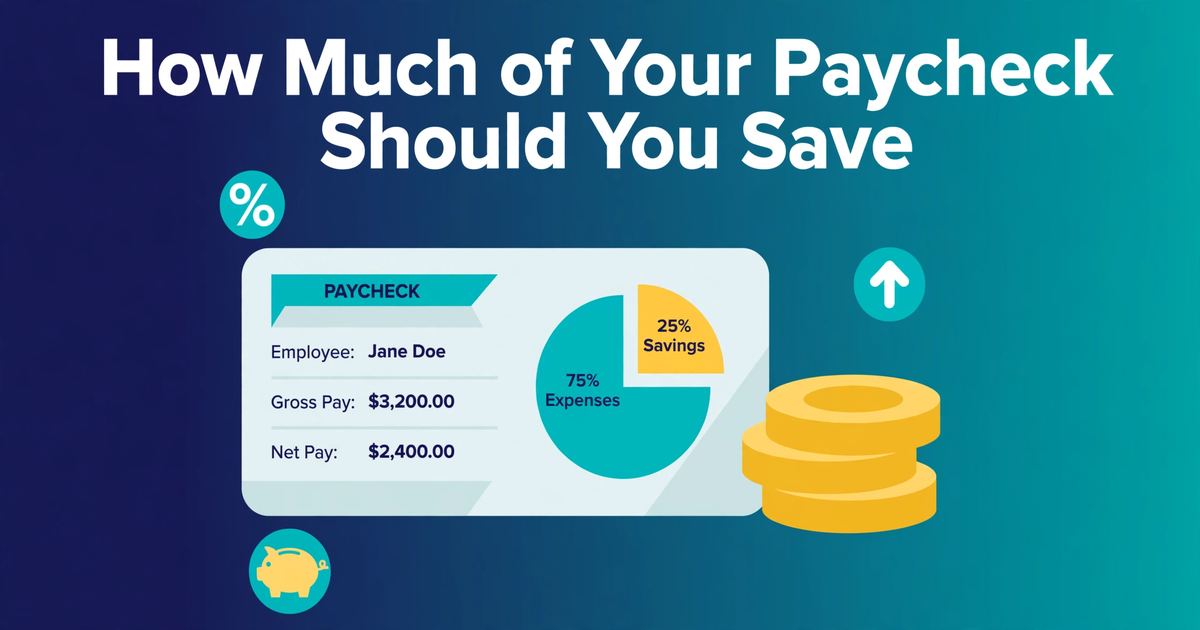
Financial experts land in the same neighborhood: save 10% to 20% of your take-home pay, with 20% as the target. Take-home pay means what’s left after taxes — the number that actually lands in your bank account, not your salary on paper.
So on a $4,000 monthly take-home, 20% is $800 a month. On a $2,500 take-home, it’s $500. On a $1,000 biweekly paycheck, it’s $200 per check.
But here’s what the experts whisper after giving you that number: 34% of Americans save nothing at all, and roughly the same share saves less than 10%. So if you’re saving 5% consistently, you’re already ahead of a third of the country. The goal isn’t perfection on day one — it’s a number you can hit every single payday without fail, then grow.
The standard target is 20% of your take-home pay — but any percentage you automate beats a bigger one you never get around to.
What percentage of paycheck should go to savings if you’re just starting? 10% is the classic beginner target. It’s big enough to matter and small enough that most budgets can absorb it. Once 10% feels normal — usually after 3 to 6 months — bump it to 12%, then 15%, then 20%. You’ll barely feel each step.
The 50/30/20 Rule: Where the 20% Comes From
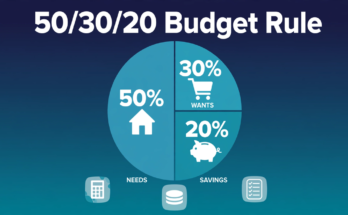
That 20% number didn’t fall from the sky. It comes from the 50/30/20 rule, a budgeting framework popularized by Senator Elizabeth Warren in her book All Your Worth. The idea is dead simple — split your after-tax income three ways:
- 50% for needs: rent, utilities, groceries, insurance, transportation, minimum debt payments
- 30% for wants: dining out, entertainment, subscriptions, hobbies
- 20% for savings: emergency fund, retirement, extra debt payments, other goals
Here’s what that looks like at three different income levels:
| Monthly take-home | 50% needs | 30% wants | 20% savings |
|---|---|---|---|
| $2,500 | $1,250 | $750 | $500 |
| $4,000 | $2,000 | $1,200 | $800 |
| $6,000 | $3,000 | $1,800 | $1,200 |
See the problem? On $2,500 a month, that $1,250 for “needs” has to cover rent in 2026 — good luck in most cities. The rule assumes your needs actually fit in half your income, and for millions of people, they don’t. That’s not a personal failure. That’s expensive housing.
So treat 50/30/20 as a starting line, not a law. If your needs take 65% right now, your version might be 65/25/10 — and that’s completely fine. The framework’s real value isn’t the exact numbers. It’s the idea that savings gets its own slice on purpose, not whatever’s left over at the end of the month (spoiler: there’s never anything left over).
The 50/30/20 rule is a starting line, not a law — adjust the numbers to fit your rent, your city, and your life.
What’s a Realistic Savings Rate at Your Income Level?
Let’s get honest about how much to save per paycheck when the textbook answer doesn’t fit your life. Your realistic rate depends mostly on one thing: how much of your income is already spoken for by non-negotiable costs.
| Situation | Realistic savings rate | What that looks like |
|---|---|---|
| High cost of living, rent eats 40%+ of pay | 5–10% | $125–$250/mo on $2,500 take-home |
| Average costs, some breathing room | 10–15% | $400–$600/mo on $4,000 take-home |
| Low costs or dual income, no debt | 20–25% | $1,200–$1,500/mo on $6,000 take-home |
| Living at home / very low expenses | 30–50% | Bank it while you can — this phase never lasts |
Two things matter more than which row you’re in. First, consistency beats percentage. Someone who saves 8% every payday for five years ends up richer than someone who saves 25% for three months and then quits. Second, your rate should rise with your income. Got a 5% raise? Send 2–3% of it straight to savings before your lifestyle absorbs it. You’ll never miss money you never saw.
If you’re living paycheck to paycheck right now, your first target isn’t even a percentage — it’s $20 per paycheck. That’s it. Twenty dollars, moved automatically, every payday. It builds the account, the habit, and the proof that you can do this. Then grow it.
Where Should Your Savings Actually Go?
Here’s the part most articles skip: a percentage without a destination is just a number sitting in a savings account earning nothing. When you save 20 percent of income, that money needs marching orders. Fund things in this order:
| Priority | Goal | Target amount |
|---|---|---|
| 1. Starter emergency fund | Cover small surprises without credit cards | $1,000–$2,000 |
| 2. Full 401(k) employer match | Free money — an instant 50–100% return | Enough to get the full match |
| 3. High-interest debt | Anything charging ~7–8% or more | Pay it down aggressively |
| 4. Full emergency fund | 3–6 months of essential expenses | $9,000–$24,000 for most people |
| 5. Retirement + other goals | IRA, house down payment, etc. | Everything left over |
Let’s make it concrete. Say your take-home is $4,000 a month and you’re saving the full 20% — $800. A smart split once your starter emergency fund exists:
- $400 (10%) → retirement (401(k) and/or IRA)
- $200 (5%) → emergency fund until it’s full, then redirect to goals
- $200 (5%) → other goals (house, car, vacation, extra debt payments)
Notice retirement gets the biggest slice. That’s intentional — 10% to 15% of your income should go toward retirement over the long run, and that can include your employer’s 401(k) match. If your company matches 5% and you contribute 5%, you’re already at 10% without feeling it.
Save for three things in this order: a starter emergency fund, the full 401(k) match, then everything else.
What If 20% Is Impossible Right Now?
For a lot of people reading this, 20% isn’t a goal — it’s a joke. Rent is $1,600, take-home is $2,800, and someone on the internet says “just save $560 a month.” Sure. With what?
Here’s the truth: the worst savings rate is 0%, and the second worst is a big number you abandon by March. If 20% breaks your budget, it was never your number. Your number is the biggest percentage you can save without quitting.
Start with the “pay yourself first” method. Instead of saving what’s left over, move savings out first — the day after payday, automatically. Even 5% works: on a $2,800 take-home, that’s $140 a month, $1,680 a year. That’s a real emergency fund started from nothing.
Then use the 1% rule: every time you get a raise, a bonus, or pay off a bill, add 1% to your savings rate. A 3% annual raise on $3,500 take-home is about $105 more per month — send $35 of it to savings and you just went from 10% to 11% without changing your lifestyle at all. Do that for five years and you’re at 15%. Ten years, 20%. You never felt a single step.
Also, be honest about the denominator. If your needs genuinely exceed 60% of your take-home, no budgeting trick fixes that — the fix is usually one structural change (a cheaper apartment, a paid-off car, a roommate), not a hundred small sacrifices. Percentages can’t fix a housing problem.
If 20% is impossible, start with 5% — the habit matters more than the amount in year one.
What 10% vs 20% Actually Grows Into
This is the section that changes minds. People think the difference between saving 10% and 20% is “twice as much money.” It’s not — thanks to compound growth, it’s more than twice as much, because every extra dollar also earns returns for decades.
Assume a $4,000 monthly take-home and a 7% average annual return (a reasonable long-term stock market assumption):
| Monthly savings | % of $4,000 | After 10 years | After 20 years | After 30 years |
|---|---|---|---|---|
| $200 | 5% | ~$34,600 | ~$104,200 | ~$244,000 |
| $400 | 10% | ~$69,200 | ~$208,400 | ~$488,000 |
| $600 | 15% | ~$103,800 | ~$312,600 | ~$732,000 |
| $800 | 20% | ~$138,400 | ~$416,800 | ~$976,000 |
Read the last column twice. The person saving 10% ends up with $488,000. The person saving 20% ends up with $976,000. That gap — nearly half a million dollars — came from just $400 extra a month. Not a windfall. Not a lucky stock pick. Just a bigger automatic transfer, every payday, for 30 years.
And look at the 10-year column: even 5% ($200 a month) becomes $34,600 in a decade. That’s a house down payment in many markets, built from money you barely noticed leaving.
The flip side is brutal too: every year you wait costs you. Starting that $400-a-month habit at 25 instead of 35 doesn’t cost you 10 years of contributions ($48,000) — it costs you roughly $250,000 in lost growth. Time is the ingredient you can’t buy back.
Time does the heavy lifting: $400 a month at 7% becomes roughly $488,000 in 30 years — starting late costs more than saving small.
5 Ways to Raise Your Savings Rate Without Feeling It
Knowing your number is step one. Hitting it every payday is step two. These five tactics make the second part automatic:
1. Automate the transfer for the day after payday
This is the single highest-impact move on this list. Set up an automatic transfer from checking to savings for the day after each payday. The money leaves before you can spend it, and within two months you stop missing it — because your brain budgets around what’s there, not what was there. The savings rate you keep is the one that never touches your hands.
2. Split your direct deposit
Most employers let you split your paycheck into two accounts. Send your savings percentage straight to savings and the rest to checking. You never see it, you never “decide” to save it, and there’s no willpower involved. If 10% goes directly to savings, your checking account simply feels like your whole paycheck — a slightly smaller one you’ve already adapted to.
3. Save half of every raise
Got a 4% raise? That’s roughly $140 more per month on a $3,500 take-home. Send $70 to savings, keep $70 for lifestyle. You still feel richer — because you are — but your savings rate climbs every single year without a single painful cut. Do this for a decade and you’ll be shocked where you land.
4. Kill one “invisible” subscription
The average American spends over $200 a month on subscriptions, and most people underestimate theirs by half. Audit yours tonight — streaming, apps, boxes, memberships. Cancel two you barely use (say $30 total) and redirect that $30 to savings. You just raised your savings rate by nearly 1% on a $3,500 income, and your life didn’t change at all.
5. Bank your windfalls
Tax refund? $1,800 average. Bonus? Birthday money? Side-gig payout? The rule: save at least half of every windfall before it hits your spending brain. A $1,800 refund split 50/50 is $900 straight to the emergency fund — that’s two-plus months of 10%-rate savings in a single day. Future you says thanks.
Automate the transfer for the day after payday — the savings rate you keep is the one that never touches your hands.
Other Savings Rules Worth Knowing
The 50/30/20 rule gets all the fame, but it’s not the only framework. Two others are worth a look:
The 60/20/20 rule: 60% for needs (including all debt payments), 20% for wants, 20% for savings. This one’s built for people carrying debt — it folds debt payoff into “needs” so you’re honest about where the money’s really going. Once the debt’s gone, that 10% extra shifts to savings and you’re suddenly at 30%.
The 75/15/10 rule: 75% for living expenses, 15% for investing, 10% for short-term savings. This flips the priority toward long-term wealth: it assumes your emergency fund already exists and pushes the biggest slice toward investments that grow. Better for higher earners who’ve covered the basics.
| Rule | Needs / expenses | Wants | Savings | Best for |
|---|---|---|---|---|
| 50/30/20 | 50% | 30% | 20% | Beginners, general purpose |
| 60/20/20 | 60% (incl. debt) | 20% | 20% | People paying off debt |
| 75/15/10 | 75% | — | 25% (15 invest + 10 save) | Higher earners, basics covered |
Don’t overthink the choice. Pick the rule whose “needs” percentage is closest to your actual life, then adjust. The best budgeting framework is the one you’ll still be using in six months.
How Much of Your Paycheck Should You Save If You’re in Debt?
This is the question that splits financial experts into camps, and you deserve a straight answer: it depends on the interest rate.
If your debt charges more than ~7–8% (credit cards at 20%+, personal loans, payday loans): save a $1,000 starter emergency fund, then throw everything else at the debt. Every dollar earning 0.5% in savings while you pay 24% on a card is a dollar working against you. That starter $1,000 keeps small surprises from landing back on the card — that’s its whole job.
If your debt charges less than ~7% (federal student loans, a reasonable mortgage, a low-rate car loan): split your savings. Put 10–15% toward retirement and goals, and make your regular debt payments on schedule. The math favors investing over rushing to kill cheap debt, and you need the retirement years compounding.
The trap to avoid: saving 20% while minimum-paying a 24% APR credit card. You’re “saving” $800 a month while the card quietly eats $160+ a month in interest. That’s not a plan — that’s treading water in a riptide. Kill the expensive debt first, then ramp savings to 20%.
Raise your savings rate by 1% with every raise and you’ll hit 20% without ever feeling a single cut.
How Much Should You Save at Every Age?
Your savings rate shouldn’t stay frozen for 40 years — it should evolve as your life does. Here’s a rough roadmap by decade:
In your 20s: build the habit (10%+). Income is usually lowest now, but time is your superpower. Even $200 a month from age 25 becomes roughly $525,000 by 65 at 7% returns. Priorities: starter emergency fund, 401(k) up to the employer match, and killing high-interest debt. Don’t stress about hitting 20% yet — stress about never missing a month.
In your 30s: ramp to 15–20%. Income typically jumps in this decade — and so do expenses (kids, house, bigger life). This is where the “save half of every raise” rule earns its keep. If you went from 10% at 28 to 18% at 38, you added hundreds of thousands to your retirement without a single painful year. Also finish the full 3–6 month emergency fund here if you haven’t.
In your 40s: push toward 20–25%. You’re in peak earning years, and retirement is close enough to see. Max out tax-advantaged accounts if you can — in 2026 that’s $23,500 for a 401(k) plus $7,000 for an IRA. Every extra percent now has 20+ years to compound, which still doubles your money nearly three times over.
In your 50s and beyond: save aggressively (25%+). Catch-up contributions kick in (an extra $7,500 for 401(k)s in 2026 if you’re 50+), the kids’ costs fade, and every dollar saved now lands almost directly in your retirement. This is also when you shift new savings toward safer ground as the retirement date approaches.
| Decade | Target savings rate | Top priority |
|---|---|---|
| 20s | 10%+ | Habit + employer match + kill bad debt |
| 30s | 15–20% | Full emergency fund + ramp investing |
| 40s | 20–25% | Max tax-advantaged accounts |
| 50s+ | 25%+ | Catch-up contributions + protect gains |
Behind in your 40s with little saved? You’re not alone — and the math still works. Saving $1,000 a month from 45 to 65 at 7% grows to roughly $525,000. Starting late costs you, but starting now still changes everything.
FAQs: How Much of Your Paycheck Should You Save?
How much of a $1,000 paycheck should I save?
Financial experts recommend 10% to 30%, with 20% as the target — so $100 to $300 per $1,000 check, with $200 as the bullseye. If money is tight, saving even $50 (5%) builds the habit and the account. On biweekly pay, 20% of a $1,000 check is $200 × 26 paychecks = $5,200 a year without ever thinking about it twice.
What percentage of my paycheck should go to savings vs investing?
Think of it as one bucket first, then a split: aim for 20% total, then divide it roughly 10–15% toward retirement investing (401(k), IRA — this can include your employer match) and 5–10% toward short-term savings (emergency fund, house down payment, other goals). Once the emergency fund is full at 3–6 months of expenses, redirect that slice to investing or goals.
Is it good to save 50% of your income?
If you can genuinely do it without misery, it’s fantastic — you’ll hit every goal years early. But 50% is realistic only in special situations: living at home, a very high income with low costs, or a short-term sprint (like a one-year house down payment push). For most people it’s not sustainable, and an unsustainable rate always ends at 0%. A steady 20% beats a heroic 50% that collapses in four months.
Is saving $500 a month good?
Yes — genuinely. $500 a month is $6,000 a year, which covers a starter emergency fund in two months and, invested at 7%, becomes roughly $610,000 in 30 years. Whether it’s “enough” depends on your income: $500 is 20% of a $2,500 take-home (perfect) but only 8% of $6,000 (room to grow). Judge it as a percentage of your pay, not as a raw number.
How can I save money if I live paycheck to paycheck?
Start smaller than you think: $20 per paycheck, automated. Then do a 30-minute subscription and bill audit — most people find $50–$100 a month in forgotten subscriptions and negotiable bills. Bank half of every windfall (tax refunds average ~$1,800). And attack the big fixed costs, not the lattes: one structural change like a cheaper phone plan or refinancing a car loan can free up more than a year of skipped coffee.
The Bottom Line
So, how much of paycheck should you save? 20% of your take-home pay — split roughly 10–15% to retirement and 5–10% to short-term savings and your emergency fund. That’s the target the math supports and the experts agree on.
But the number that matters most is the one you’ll actually hit, every payday, without quitting. If that’s 5% today, that’s your number — automate it, grow it 1% at a time, and let compounding do the rest. $400 a month becomes $488,000 in 30 years. The perfect savings rate is the one that’s already moving, the day after payday, whether you feel like it or not.
Set the transfer tonight. Your future self is counting on it.