No credit history? Then as far as lenders are concerned, you’re invisible.
That’s not a judgment — it’s just how the system works. When you apply for a car loan, an apartment, or even some jobs, they check your credit file. And if that file is empty, most of them just say no. Not because you’ve done anything wrong. Because there’s nothing to look at.
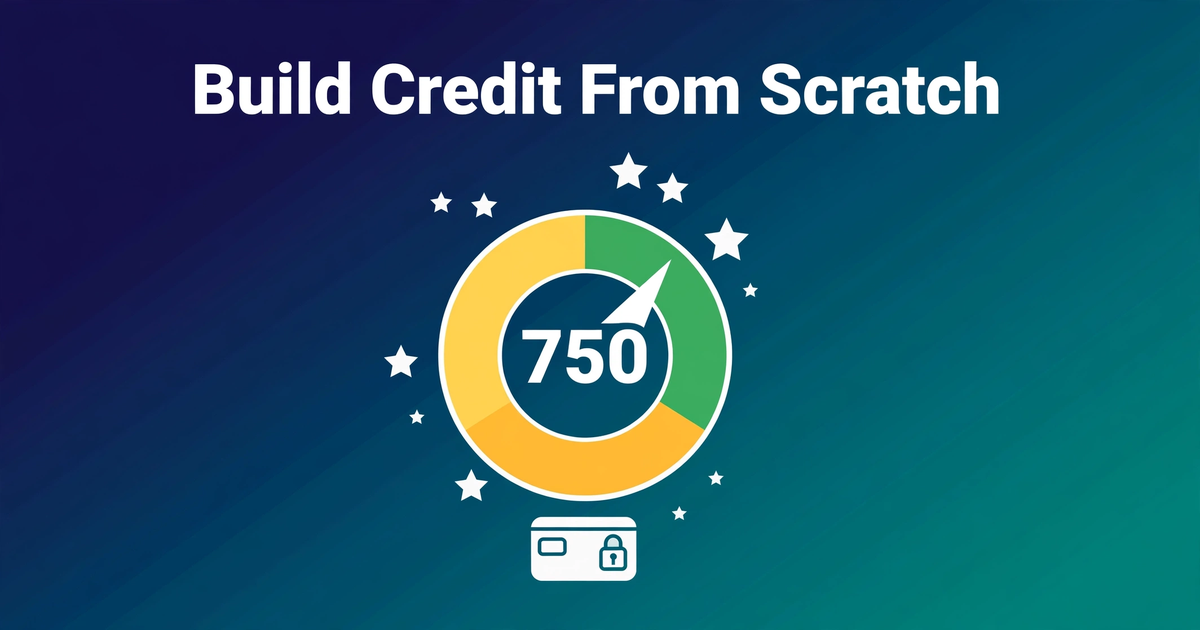
If you’re searching for how to build credit with no credit history, you’re already asking the right question. And here’s the good news: going from zero to a real, usable credit score takes about six months. Not years. Six months of doing a few simple things right, and you’ll show up in the system with a number lenders actually respect.
This guide walks you through the whole thing in plain English — no jargon without an explanation, no rich-kid advice, just four methods that work and a month-by-month plan to follow.
How Credit Scores Actually Work
Before you build credit, you need to understand what you’re building. A credit score is just a number — from 300 to 850 — that predicts how likely you are to pay borrowed money back. Lenders use it to decide whether to approve you and what interest rate to charge.
The most common score is called a FICO score (named after the company that invented it). Your score is calculated from five ingredients, and they don’t all matter equally:
| Factor | Weight | What it means in plain English |
|---|---|---|
| Payment history | 35% | Do you pay every bill on time, every time? This is the big one. |
| Amounts owed (utilization) | 30% | How much of your available credit are you using? Less is better. |
| Length of credit history | 15% | How long have your accounts been open? Older is better. |
| New credit | 10% | Have you opened a bunch of accounts recently? That looks risky. |
| Credit mix | 10% | Do you have different types of credit (a card plus a loan, for example)? |
Two things jump out. First, paying on time is more than a third of your score — one missed payment hurts more than anything else. Second, “utilization” (a fancy word for how much of your credit limit you’re using) is almost another third. If your card limit is $200 and you regularly owe $180, that looks bad — even if you pay it off. Keep what you owe under 30% of your limit, and ideally under 10%.
Here’s what the numbers mean once you have a score:
| Score range | Rating | What it gets you |
|---|---|---|
| 800–850 | Exceptional | The best rates on everything |
| 740–799 | Very Good | Great rates, easy approvals |
| 670–739 | Good | Solid approvals, decent rates — this is your first big goal |
| 580–669 | Fair | Approved sometimes, higher rates |
| 300–579 | Poor | Mostly denied |
Your first realistic target is 670 — “Good.” That’s the line where doors start opening: car loans, apartments, better cards.
One more thing worth knowing: you can’t get a FICO score until you have at least six months of credit history. That’s just a rule of their system. So everything below is designed around that six-month clock.
Method 1: Secured Credit Card — The Fastest Way to Start
A secured credit card for no credit history is the single most popular way beginners build credit, and for good reason: almost anyone can get one.
Here’s how it works. A normal credit card gives you a credit limit based on trust — the bank hopes you’ll pay it back. A secured card skips the trust part. You put down a refundable deposit — say $200 — and the bank gives you a $200 credit limit. The deposit is their safety net. If you ever stop paying, they keep it.
That deposit is not a fee. You get it back when you close the account or upgrade to a regular card later. Think of it as a security deposit on an apartment — it’s your money, just parked for now.
How to use it right
Getting the card is step one. Using it correctly is what actually builds your score:
- Make one small purchase a month. A tank of gas, a grocery run, a streaming subscription — something in the $20–$50 range. That’s it.
- Pay the full balance before the due date. Not the minimum — the whole thing. This is how you build that golden 35% payment history, and you pay zero interest doing it.
- Keep utilization tiny. With a $200 limit, owing $30 means 15% utilization. Owing $150 means 75% — and that drags your score down even if you pay in full. Small charges, paid off monthly.
What to avoid
- Don’t max it out, even temporarily. High utilization is the #1 beginner mistake.
- Don’t miss a payment. Set up autopay for the full balance on day one and you’ll never have to think about it.
- Don’t apply for five cards at once. One secured card is plenty to start. Each application dings your score a little, and multiple at once looks desperate.
- Make sure the card reports to all three bureaus. (The credit bureaus — Equifax, Experian, and TransUnion — are the three companies that keep your credit files.) A few prepaid-style cards don’t report at all, which makes them useless for building credit. Check before you apply.
One secured card, one small purchase a month, paid in full — that’s 90% of the method. Boring is beautiful here.
Method 2: Credit Builder Loan — Save Money While Building Credit
A credit builder loan sounds backwards, and honestly, it kind of is. Understanding credit builder loan how it works is worth your time, though, because it builds the “credit mix” part of your score while forcing you to save.
Here’s the twist: with a normal loan, you get the money first and pay it back later. With a credit builder loan, you pay first and get the money later. Here’s the step-by-step:
- You “borrow” a small amount — typically $300 to $1,000 — from a bank, credit union, or online lender that offers these.
- The lender does not hand you the cash. Instead, they lock it in a savings account in your name.
- You make fixed monthly payments — say $25 to $50 a month for 12 months. Every payment gets reported to the credit bureaus, building your payment history.
- When you’ve finished all the payments, the lender unlocks the account and hands you the full amount (minus any small fees).
So you end up with 12 months of on-time payments on your record and a few hundred dollars in savings. It’s like a savings account that also builds your credit score.
Where to get one
Credit unions (nonprofit, member-owned banks) are the best place to look — many offer them with tiny fees. Some online companies specialize in them too. What to watch for:
- Fees and interest. Some charge an setup fee or interest that eats into your payout. A good one costs you very little — compare two or three before committing.
- Bureau reporting. Same rule as the secured card: if they don’t report to all three bureaus, walk away.
- Payment size. Pick a monthly payment you can make in your sleep. Missing payments on a credit builder loan hurts exactly like missing any other payment.
This method pairs beautifully with a secured card. The card builds your revolving credit history; the loan adds an installment account to your mix. Together, they cover more of the scoring formula than either one alone.
A credit builder loan turns $25 a month into 12 on-time payments plus a few hundred dollars in savings at the end.
Method 3: Become an Authorized User
To become an authorized user to build credit, you borrow someone else’s good history — with their permission.
Here’s how it works. Someone you trust — a parent, a spouse, a close relative — adds you to their credit card as an authorized user. You get your own card with your name on it, but the account is still theirs. The key part: their payment history on that account starts showing up on your credit report too. If they’ve paid on time for five years, you suddenly look like someone with five years of on-time payments.
Who to ask (and how to ask right)
This only works with the right person and the right account:
- Pick someone with a long, clean history. An old card with zero missed payments and low balances. Their good habits become your good habits — on paper.
- The account should have low utilization. If their card is maxed out, their high balance shows up on your report too, and it hurts you.
- You don’t even need to use the card. Many people become authorized users and never touch the card. The history still counts. In fact, not using it is often smarter — it removes all temptation and all risk of messing up their account.
The honest risks — for both sides
This method runs on trust, so go in with eyes open:
- If they miss a payment, it hits your report too. Their mistake becomes your problem. Only do this with someone rock-solid reliable.
- If you overspend, it’s their bill. As an authorized user, you’re generally not legally responsible for the debt — the primary holder is. Spending recklessly on someone else’s account is a fast way to ruin a relationship.
- Have the awkward conversation first. Agree upfront: will you actually use the card, or just sit on the account for the history? Get it in writing if the amounts matter. Clear expectations prevent resentment later.
Not everyone has someone to ask, and that’s completely fine — this is a bonus method, not a requirement. The secured card and credit builder loan work perfectly well on their own.
The right authorized-user account can add years of clean history to your file overnight — but only borrow history from someone whose habits you’d want as your own.
Method 4: Report Your Rent and Utility Bills
Here’s something most people don’t realize: the rent you’ve been paying on time for two years? The phone bill you’ve never missed? None of it has been building your credit — because landlords and utility companies usually don’t report to the credit bureaus.
Services exist to fix that. The best-known is Experian Boost — a free tool from Experian (one of the three bureaus) that scans your bank account for utility, phone, and streaming payments and adds the on-time ones to your Experian credit file. Experian Boost rent and utility reporting works like this:
- You connect your bank account through their secure system.
- It finds qualifying payments — electricity, water, gas, phone, internet, even some streaming services.
- On-time payments get added to your Experian file, which can lift your score — sometimes immediately.
A few honest caveats:
- It only helps your Experian score. The other two bureaus (Equifax and TransUnion) don’t see this data. Some lenders check all three; some check just one.
- Results vary. If you have a thin file, a handful of on-time utility payments can make a real difference. If your file is already decent, the bump is smaller.
- Rent is trickier. Experian Boost covers utilities and phone bills well, but rent usually needs a separate rent-reporting service, some of which charge a monthly fee ($5–$10). Only worth it if the math makes sense for you — don’t pay $10 a month for 3 points.
This method won’t build credit all by itself, but it’s free money on the table: payments you’re already making, finally getting counted.
You’re probably already paying bills on time — Experian Boost just makes those payments count toward your score. Free to try, nothing to lose.
Your 6-Month Roadmap to Build Credit With No Credit History
You’ve got the methods. Here’s exactly when to do what. This plan assumes you’re starting from absolute zero:
| Month | Action | What’s happening behind the scenes |
|---|---|---|
| Month 1 | Open a secured card ($200–$300 deposit); set up autopay for full balance | Your first account opens; the 6-month FICO clock starts |
| Month 1 | Sign up for Experian Boost; connect bank account | Utility/phone history added to your Experian file |
| Month 2 | Make first small purchase on the secured card; pay in full | First on-time payment reported to bureaus |
| Month 2 | Open a credit builder loan ($25–$50/month) if budget allows | Second account type added (credit mix); more on-time payments stacking up |
| Month 3 | Ask a trusted person about authorized user status (optional) | If yes: years of their clean history may appear on your file |
| Month 4 | Keep spending small; check your free credit report for errors | 3–4 months of clean history building; catch mistakes early |
| Month 5 | Stay the course — no new applications | Almost there; don’t rock the boat now |
| Month 6 | Your first FICO score appears 🎉 | Typically lands in the mid-600s; check it free and celebrate |
A few notes on this timeline. First, you don’t need all four methods — the secured card alone gets you a score in six months. Adding the credit builder loan just makes that score stronger. Second, everything here assumes on-time payments; one missed payment in month 3 can set you back months. Autopay is your best friend.
You can check your progress for free along the way. Federal law gives you a free credit report from each bureau every year, and many banks and free apps show you your score monthly at no cost. Watching that first score appear is genuinely exciting — you’ve earned it.
Six months, one secured card, zero missed payments — that’s the whole formula. Everything else just makes the result stronger.
5 Mistakes That Wreck New Credit
Building credit is simple, but beginners reliably trip on the same five things. Learn them here instead of learning them the expensive way:
Mistake 1: Maxing out the secured card
You got a $200 limit and spent $190 on textbooks. You pay it in full — so what’s the problem? Utilization. The bureaus saw you using 95% of your available credit, and your score took a hit. Remember: with a small limit, even normal spending looks huge. Keep charges under $60 on a $200 limit (that’s 30%), and under $20 if you want to be excellent about it.
Mistake 2: Missing even one payment
This is the big one. Payment history is 35% of your score — the single largest factor. One 30-day-late payment in your first year can knock 60–100 points off a new score and linger on your report for years. It doesn’t matter that the bill was only $25. Set up autopay for the full statement balance the day you open the account, and this mistake becomes impossible.
Mistake 3: Applying for five cards at once
You got approved for the secured card, felt confident, and applied for three store cards and two more bank cards in the same week. Each application triggers a hard inquiry — the bureau’s record that someone checked your credit — and each one dings your score a few points. Worse, a burst of applications makes you look desperate to lenders. One account to start. Maybe a second after six months. Patience beats enthusiasm here.
Mistake 4: Closing the secured card too early
Eighteen months in, your score is 720 and a bank offers you a shiny rewards card. Exciting! But don’t close the secured card — at least not yet. That old card is the backbone of your length of credit history (15% of your score). Closing your oldest account shortens your average account age and can actually drop your score. Better move: keep it open, use it once every few months for a coffee, and let it keep aging quietly. Many issuers will even refund your deposit and convert it to an unsecured card without closing the account — ask about that first.
Mistake 5: Paying for “credit repair”
Ads promise to “erase bad credit” or “boost your score 200 points in 30 days” — for a monthly fee, of course. Here’s the truth: there is nothing a credit repair company can legally do that you can’t do yourself for free. They dispute accurate negative items (which get verified and stay), or they tell you to do the things in this guide while charging you for the privilege. The legitimate free tools — your annual credit reports, bureau dispute processes, secured cards — are all you need. Keep your money.
How Long Until I Have Good Credit? Realistic Timeline
Everyone wants to know how long does it take to build credit from scratch — and most articles give vague answers. Here’s the honest version with real numbers:
| Timeframe | What to expect | Typical score range |
|---|---|---|
| Month 1–5 | No FICO score yet (need 6 months of history); VantageScore may appear sooner | No score / unscored |
| Month 6 | First FICO score appears 🎉 | ~670 (low end of “Good”) |
| Month 12 | A full year of on-time payments; utilization habits established | 700–720 |
| Month 18–24 | Oldest account aging nicely; possibly upgraded to unsecured card | 730–750+ |
A few reality checks. First, that month-6 score of ~670 assumes you did everything right — on-time payments, low utilization, no silly mistakes. Miss a payment and the timeline stretches. Second, “good credit” (670+) is enough for most real-world needs: car loans at reasonable rates, apartment approvals, decent credit cards. You don’t need an 800 to live your life. Third, after the first year, your score mostly takes care of itself as long as the habits continue — credit building is front-loaded effort with long-tail rewards.
The single biggest accelerator? Time plus consistency. There’s no shortcut past the six-month minimum, and no trick beats twelve straight on-time payments. Anyone selling you speed is selling you something else.
Month 6: your first score (~670). Month 12: 700+. After that, good habits do the rest on autopilot.
FAQs: How to Build Credit With No Credit History
How long does it take to build credit from scratch?
About six months to get your first FICO score — that’s the minimum history their system requires. Expect that first score to land around 670 (the low end of “Good”). With another six months of clean habits, most people reach 700+. There are no legitimate shortcuts past the six-month mark, so anyone promising faster results is selling something.
How does a secured credit card help you build credit?
You put down a refundable deposit (usually $200–$300), which becomes your credit limit — so the bank takes no risk and approves almost anyone. Then you use the card for small purchases and pay in full each month. Every on-time payment gets reported to the three credit bureaus, building the payment history that makes up 35% of your score. After 6–12 months of good behavior, many issuers refund your deposit and upgrade you to a regular unsecured card.
What is a credit builder loan and how does it work?
It’s a loan in reverse: instead of receiving money upfront, the lender locks your “loan” amount ($300–$1,000) in a savings account, and you make monthly payments toward it. Each payment is reported to the credit bureaus, building your payment history. When you’ve finished paying, you receive the full amount. You end up with 12 months of on-time payments plus a few hundred dollars in savings — and it adds an installment account to your credit mix.
Does paying rent help build credit?
Not automatically — landlords usually don’t report to credit bureaus, so years of on-time rent are invisible to the system. But you can make it count: free tools like Experian Boost add utility and phone payments to your Experian file, and paid rent-reporting services ($5–$10/month) can add your rent payments too. Worth doing if the cost makes sense, but a secured card builds credit faster on its own.
Can I get a credit score without a credit card?
Yes. A credit builder loan alone will generate a FICO score after six months of payments — no credit card required. Becoming an authorized user on someone else’s well-managed card can also create a score without you ever holding your own card. And rent/utility reporting services add supporting history. That said, a secured card remains the simplest and fastest single method for most people.
You’ve Got This
Six months from now, you could be exactly where you are today — invisible to lenders, getting denied for things you can afford. Or you could have a real credit score, a growing savings account, and doors starting to open.
The system isn’t fair to beginners. Nobody teaches this stuff, the rules are hidden, and one mistake costs more than it should. But now you know the rules — one secured card, small purchases, paid in full, on time, every time. That’s the whole game.
Open that secured card this week. Set up autopay. Make one small purchase. Then let time do what time does. Future you — the one getting approved instead of denied — will be glad you started today.