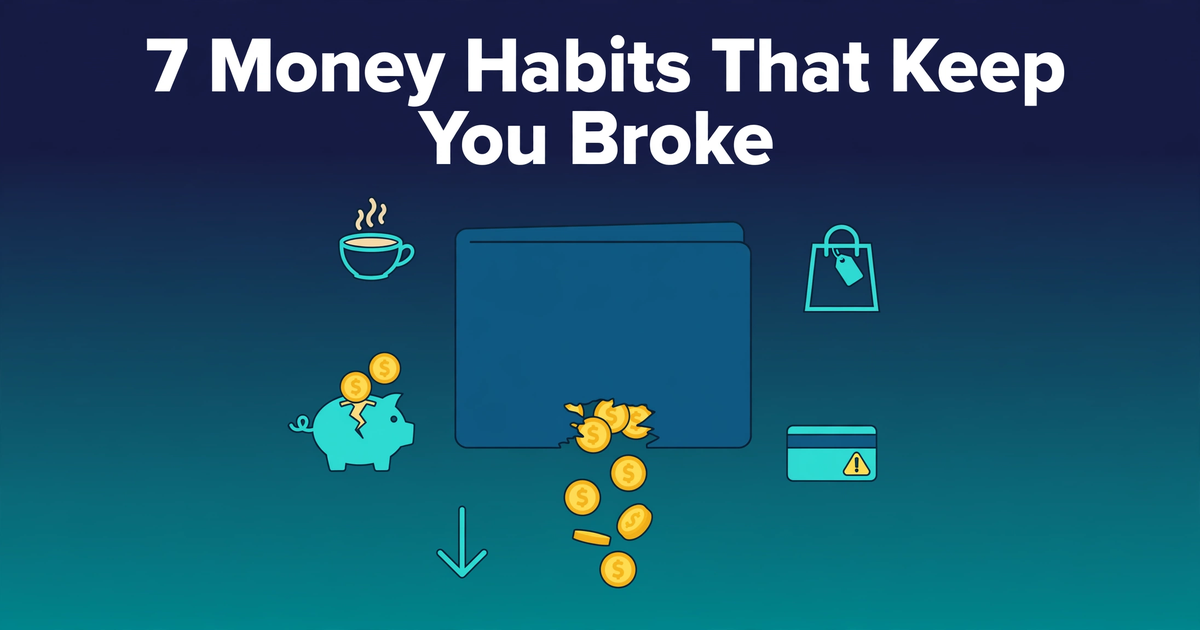
Here’s an uncomfortable truth: most people with money habits that keep you broke don’t earn too little. They earn enough — and then watch it evaporate through a dozen tiny holes they never bothered to patch.
You pay your bills. You don’t buy anything insane. You might even have a savings account with a few hundred dollars in it. But at the end of every month, you’re standing in exactly the same spot. The balance barely moves. The goals stay out of reach.
It’s not bad luck. It’s not the economy. It’s habits — small, automatic, feels-normal decisions you repeat every single month without thinking. And here’s the good news: habits can be changed. This guide breaks down the 7 worst money habits that keep you broke, shows you exactly what each one costs in real dollars, and gives you a simple fix for every one. No shame, no impossible advice — just math and a plan.
How Money Habits That Keep You Broke Actually Work
Before the list, you need to understand the mechanism — because these habits don’t feel expensive. That’s what makes them dangerous.
A bad money habit rarely costs you thousands in one dramatic moment. Instead, it costs you $50 here, $120 there, every single month, quietly, for years. And thanks to compound interest working against you (or the interest you never earn), small leaks become enormous holes over time.
Consider this: $200 a month doesn’t sound life-changing. But $200 a month saved at a modest 7% return for 10 years becomes $34,600. The same $200 a month leaking away on stuff you don’t need costs you that entire $34,600 — plus whatever interest you paid financing it.
Here’s what the seven habits below cost a typical person, added up:
| # | Habit | Monthly leak | Yearly cost |
|---|---|---|---|
| 1 | Paying yourself last | $200 never saved | $2,400/yr |
| 2 | Lifestyle creep | $350 raise absorbed | $4,200/yr |
| 3 | Credit card minimum payments | $180 interest | $2,160/yr |
| 4 | No emergency fund | $75 surprise-debt interest | $900/yr |
| 5 | Impulse buying | $160 unplanned spending | $1,920/yr |
| 6 | Forgotten subscriptions & small leaks | $46 wasted | $552/yr |
| 7 | Waiting to “earn more” before starting | $150 never invested | $1,800/yr |
| Total | ~$13,900/yr |
Nearly $14,000 a year. That’s not a spending problem — that’s a second income you’re throwing away.
Bad money habits don’t feel expensive because the cost arrives in $50 pieces, not $5,000 chunks — but the yearly total is staggering.
Habit 1: Paying Yourself Last
This is the #1 habit on almost every list of bad money habits, and for good reason: it’s the default setting for most people, and it guarantees you’ll save nothing.
Here’s how it works. Your paycheck lands. You pay rent, bills, groceries, the car payment. You live your life. And whatever is left at the end of the month — if anything — goes to savings. The problem? There’s never anything left. Spending expands to fill every available dollar. “Save what’s left” always equals “save nothing.”
Let’s do the math. Say you bring home $3,200 a month. You spend first and save last. In a typical month, $0–$60 makes it to savings. Call it $30 on average: $360 a year.
Now flip it. Pay yourself first: on payday, an automatic transfer moves $200 to savings before you touch a dime. You adjust your spending to the remaining $3,000 — and here’s the secret — you barely notice the difference, because you never “had” that $200 in your spending money.
The math: $200/month × 12 = $2,400 a year. In a high-yield savings account at 4%, that’s $2,448 after one year. Over 10 years, that habit alone builds roughly $29,000 — from money you were previously spending on nothing in particular.
The fix
Set up an automatic transfer on payday — even $50 to start. The amount matters less than the order: savings moves FIRST, spending gets what’s left. Increase it by $25 every few months. You won’t miss money you never saw.
Paying yourself last means saving nothing — paying yourself first, automatically, turns $200 a month into nearly $29,000 in ten years.
Habit 2: Lifestyle Creep (Every Raise Disappears)
You get a $4,000-a-year raise. You’re excited for about a week. Then, somehow, your lifestyle quietly expands to absorb every penny: a nicer apartment, a newer car, pricier restaurants, a bigger wardrobe. A year later, you’re earning more and saving exactly the same as before — which is to say, nothing.
This is lifestyle creep (also called lifestyle inflation), and it’s the reason so many six-figure earners are still broke. The math is brutal in its simplicity: if your spending rises at the same rate as your income, your savings rate stays at zero forever, no matter how much you earn.
Real example: that $4,000 raise is about $280 a month after taxes. You lease a slightly nicer car: +$150/month. You upgrade your apartment hunt budget: +$100/month. You eat out twice more a month: +$80/month. Total new spending: $330/month — you’ve actually gone backwards by $50 a month despite the raise.
Now the alternative. The 50% rule: save half of every raise before you spend a dime of it. That $280/month raise → $140/month straight to savings, $140 to enjoy. You still get a lifestyle upgrade. But you also bank $1,680 a year from this raise alone. Stack three raises over a decade at 7% returns, and that’s roughly $27,000 — from money you never would have missed, because you never lived on it.
The fix
Before any raise hits your account, decide the split: at least 50% to savings or debt, the rest is yours to enjoy. Set up the increased automatic transfer the same week the raise starts. Future you will never know the money existed.
Every raise is a choice: upgrade your lifestyle and stay broke, or save half and let compound interest do the heavy lifting.
Habit 3: Making Only Credit Card Minimum Payments
If you’re carrying a balance and paying the minimum, you’re not paying off debt — you’re renting it. And the rent is obscene.
Credit card companies set minimums low on purpose (usually around 2% of the balance). The lower the payment, the longer you stay in debt, and the more interest they collect. It’s not a convenience. It’s a business model — and you’re the product.
The real numbers on a $6,000 balance at 24% APR:
| Payment strategy | Monthly payment | Time to pay off | Total interest |
|---|---|---|---|
| Minimums only (~2%) | ~$120 (shrinks) | ~12 years | ~$5,500 |
| $200/month | $200 | ~3.5 years | ~$2,900 |
| $300/month | $300 | ~2 years | ~$1,600 |
Read that first row again. Paying only the minimum turns a $6,000 balance into $11,500 and chains you to it for over a decade. Finding an extra $180 a month — the difference between row one and row three — saves you $3,900 in interest and ten years of your life.
This is one of the most expensive bad money habits there is, because the interest compounds against you every single day.
The fix
Stop using the card for new purchases (switch to debit), then pay as much above the minimum as you can — every extra dollar goes straight at the principal. Can’t find extra? Call the card company and ask for a lower APR first; even 3–5% off saves hundreds. Then attack the highest-rate balance first.
Minimum payments aren’t a payoff plan — they’re a subscription to your own debt. Every dollar above the minimum is a dollar the bank can’t charge you interest on.
Habit 4: Having No Emergency Fund (Every Surprise Goes on Credit)
No emergency fund means every surprise becomes a crisis. The car needs a $800 repair. The phone screen shatters: $250. A toothache turns into a $400 dentist bill. Without savings, each of these goes straight onto a credit card — where Habit 3 is waiting to multiply the damage.
Here’s the cycle: $800 emergency on a card at 24% APR, paid at minimums, costs roughly $1,350 and takes three years to clear. Meanwhile, life keeps happening — another surprise lands before the first is paid off, and the balance climbs. This is how people end up with $5,000 in “emergency” debt they can’t explain: it was five $800 surprises, each made 70% more expensive by interest.
The irony? The emergency fund that prevents all of this is smaller than people think. A $500–$1,000 starter fund covers the vast majority of common surprises (car repairs, phone replacements, minor medical bills, appliance fixes). You don’t need six months of expenses on day one. You need enough that a bad Tuesday doesn’t become a three-year debt sentence.
The fix
Build a $500 mini emergency fund first — before extra debt payments, before investing. Sell stuff, cut one subscription, do a no-spend week, whatever it takes. Park it in a separate high-yield savings account so it doesn’t get spent. Then, once high-interest debt is gone, grow it toward 3–6 months of expenses.
A $500 emergency fund isn’t about the $500 — it’s about breaking the cycle where every surprise becomes high-interest debt.
Habit 5: Impulse Buying (Death by a Thousand $20s)
Nobody goes broke buying one yacht. People go broke buying a thousand things they didn’t plan to buy — the $12 phone case at checkout, the $25 gadget from an ad, the $40 “it’s on sale!” shirt, the $18 lunch you grabbed because you were bored.
Impulse buying thrives on three things: zero friction (one-click checkout, saved cards), emotional triggers (stress, boredom, celebration), and the “it’s only $X” lie. Your brain treats each small purchase as harmless. Your bank statement disagrees.
The math: the average impulse buyer spends roughly $40 a week on unplanned purchases. That’s $160 a month, or $1,920 a year. Over 10 years, that’s $19,200 gone — and if even half of it went on credit cards at 24%, the true cost with interest pushes past $25,000.
But here’s the number that really stings: if that same $160 a month went into an index fund earning 8% instead, in 10 years you’d have about $29,000. The gap between impulse buying and investing that money is nearly $50,000 over a decade. Every “it’s only $20” is secretly a $60 decision once you count what that money could have become.
The fix
Use the 48-hour rule: anything unplanned over $30 waits two days. Put it in a notes app “wish list.” After 48 hours, most items lose their appeal — studies of this technique suggest people abandon 60–70% of impulse items. Also: delete saved card numbers from shopping apps, unsubscribe from marketing emails, and never shop when emotional, hungry, or bored.
Impulse buying doesn’t cost you $20 — it costs you $20 plus everything that $20 could have grown into. The 48-hour rule kills most impulses dead.
Habit 6: Ignoring Subscriptions and Small Leaks
Streaming services, music apps, cloud storage, gym memberships, subscription boxes, premium app tiers — individually they’re “only” $7–$16 a month. Collectively, they’re a second utility bill you never agreed to.
The average person now carries 4–6 recurring subscriptions and regularly pays for at least one or two they haven’t used in months. A typical forgotten-subscription stack looks like this:
| Subscription | Monthly cost | Last used |
|---|---|---|
| Streaming service #2 | $15.99 | 4 months ago |
| Music app (free tier would do) | $12.99 | Rarely |
| Cloud storage upgrade | $9.99 | Never checked |
| Subscription box | $24.99 | Skipped 3 boxes |
| Wasted total | $63.96/mo | $767/yr |
$767 a year for services gathering digital dust. And that’s before the smaller leaks: the $4.99 “premium” app feature, the $2.99 game currency, bank fees you could avoid with one phone call, the extended warranty you never needed.
The fix
Do a subscription audit twice a year (January and July). Open your bank and credit card statements, highlight every recurring charge, and cancel anything you haven’t used in 30 days. Be ruthless: you can always re-subscribe if you miss it — and you almost never will. Also call your bank, phone carrier, and insurance company once a year to ask for better rates; loyal customers who ask routinely save $200–$500 a year.
You wouldn’t hand a stranger $767 a year for nothing — but that’s exactly what forgotten subscriptions do. Audit them twice a year.
Habit 7: Waiting to “Earn More” Before Starting
“I’ll start saving when I make more money.” “I’ll invest once I get that promotion.” “Budgeting is for people with real incomes.”
This is the most comforting lie in personal finance — and the most expensive. Because waiting costs you the one thing money can’t buy back: time. Compound growth does its heaviest lifting in the early years, which means every year you wait is the most valuable year you lose.
The math is devastating. Start investing $150 a month at age 25 at an 8% average return: by 55, you have roughly $220,000. Wait until 35 to start the same $150 a month: you end up with roughly $89,000. That ten-year delay — “waiting to earn more” — cost you $131,000. Not because you invested less per month. Because you started later.
And here’s the thing nobody tells you: the habit matters more than the amount. Someone who invests $50 a month at 25 builds the skill of investing — the accounts, the automation, the stomach for market dips. When the bigger income arrives, the system is already running and the money flows in. Someone waiting for “enough” income has no system, no habit, and usually finds a new reason to wait when the raise finally comes.
The fix
Start with whatever you have — even $25 a month. Open the account this week, automate the transfer, and let the habit exist before the money is impressive. Increase the amount with every raise (see Habit 2). The goal isn’t to be rich this year; it’s to make sure you’re not saying “I’ll start when I earn more” ten years from now.
The best time to start was ten years ago. The second-best time is this week’s payday — even $25 a month builds the habit that builds the wealth.
The Real Cost: All 7 Habits in One Table
Let’s put the full damage in one place. These numbers assume a typical earner — not a high roller, just a regular person with regular leaks:
| Habit | What it costs you per year | The one-line fix |
|---|---|---|
| 1. Paying yourself last | $2,400 never saved | Automate savings on payday |
| 2. Lifestyle creep | $4,200 in absorbed raises | Save 50% of every raise |
| 3. Minimum payments only | $2,160 in interest | Pay above minimum; stop new charges |
| 4. No emergency fund | $900 in surprise-debt interest | Build a $500 starter fund |
| 5. Impulse buying | $1,920 unplanned | 48-hour rule over $30 |
| 6. Forgotten subscriptions | $767 wasted | Audit twice a year |
| 7. Waiting to earn more | $1,800 never invested | Start with $25/month now |
| Total yearly damage | ~$14,150 |
$14,150 a year. Over ten years — counting the growth that money could have earned — you’re looking at well over $150,000 lost to habits, not circumstances.
But flip it around: you don’t need to fix all seven today. Fixing just two — automating savings and killing impulse buys — redirects over $4,300 a year back into your life. That’s the power of attacking habits instead of income.
How to Break Bad Money Habits: A 30-Day Reset Plan
Knowing the habits isn’t enough — you need a system to replace them. Here’s a week-by-week plan that tackles all seven habits in 30 days without overwhelming you:
Week 1: See the leaks. Track every dollar you spend for 7 days — every coffee, every app purchase, everything. Use a notes app or your bank’s transaction list. Then highlight every recurring subscription and cancel the ones you haven’t used in a month. (Kills Habits 5 and 6.)
Week 2: Automate the fix. Set up an automatic savings transfer for the day after payday — start with whatever you can ($50 is fine). Open a separate high-yield savings account for your starter emergency fund if you don’t have one. (Kills Habits 1, 4, and 7.)
Week 3: Attack the debt. List every credit card balance with its APR. Switch daily spending to debit so balances stop growing. Set every card payment above the minimum — even $25 extra. Call each card company and ask for a lower rate. (Kills Habit 3.)
Week 4: Lock in the system. Start the 48-hour rule for unplanned purchases over $30. Decide your raise rule now (50% of every future raise to savings). Do a 10-minute money check-in every Sunday — glance at accounts, confirm the automation ran, note what’s coming. (Kills Habit 2 and locks in the rest.)
That’s it. Four weeks, and every one of the seven habits has a counter-system running. You won’t be perfect — nobody is — but you’ll be pointed in the right direction, automatically.
FAQs: Money Habits That Keep You Broke
What are the worst money habits that keep you poor?
The most damaging are: paying yourself last (saving only “what’s left,” which is nothing), lifestyle creep (spending every raise), making only credit card minimum payments (turning $6,000 of debt into $11,500), having no emergency fund (forcing every surprise onto credit), and waiting to earn more before starting (losing the most valuable compounding years). Together these five alone can cost a typical earner over $10,000 a year.
Why am I broke even though I earn good money?
Because income doesn’t determine wealth — the gap between income and spending does. High earners go broke through the same habits: lifestyle creep absorbs every raise, impulse buying scales up with income (“it’s only $200” replaces “it’s only $20”), and minimum payments on bigger balances mean bigger interest. Someone earning $40,000 who saves 15% builds more wealth than someone earning $120,000 who saves nothing. The fix is identical at every income: automate savings first, cap lifestyle upgrades, and kill high-interest debt.
How do I stop impulse buying?
Three tactics that actually work: (1) the 48-hour rule — anything unplanned over $30 waits two days, which kills 60–70% of impulses; (2) add friction — delete saved card numbers and shopping apps from your phone so buying takes effort; (3) shop with a list and a full stomach, and unsubscribe from marketing emails that manufacture urgency. Also try the “hourly wage test”: divide the price by your hourly pay. A $60 impulse item at $20/hour costs three hours of your life — suddenly it looks different.
How much should I save each month to break the cycle?
Start with whatever you can automate — even $50 a month builds the habit. The classic targets: a $500–$1,000 starter emergency fund first, then 10–15% of income toward savings and debt payoff combined, eventually building to 20% (the “pay yourself first” benchmark). But the percentage matters less than the order — automated savings on payday beats a bigger “I’ll save what’s left” promise every time. Increase by $25–$50 every few months and you’ll hit 15% before you feel it.
Can small habit changes really make me wealthy?
Yes — because wealth is just good habits compounded over time. The math: saving $300 a month (less than $10 a day) at a 7% return for 30 years becomes roughly $340,000. Nobody gets there with one brilliant decision; they get there with hundreds of boring automatic ones. The habits in this guide feel small because each one is — but a 1% daily improvement in your finances compounds exactly like interest does. Start with one habit this week.
Breaking the Money Habits That Keep You Broke: Start This Week
Let’s be honest about what this article really says: you’re probably not broke because of your income. You’re broke because of your defaults. The automatic choices — spend first, save last; upgrade everything; pay the minimum; handle emergencies on credit — were never really choices at all. They were just what felt normal.
But normal is negotiable. Every one of the 7 money habits that keep you broke has a fix that takes less than an hour to set up: an automatic transfer, a canceled subscription, a phone call for a lower APR, a 48-hour rule. None of them require a raise, a windfall, or a finance degree.
Pick one habit this week. Just one. Automate $50 to savings on payday, or cancel three subscriptions, or start the 48-hour rule. Then pick another next week. A year from now, you won’t recognize your bank account — and ten years from now, you won’t recognize your life.
The habits built your current finances. New habits will build your future ones. Start today.