When lenders ask what is a good credit score, they’re really asking one thing: how risky are you? Your credit score is a three-digit number — usually between 300 and 850 — that predicts whether you’ll pay borrowed money back on time. And in 2026, that number quietly sets the price of almost everything you finance: your car payment, your mortgage rate, even whether a landlord hands you the apartment keys.
Here’s why it matters more than most people realize: the gap between a “fair” score and a “good” one can cost you tens of thousands of dollars over your lifetime. Same car, same house — wildly different price, all because of three digits.
This guide gives you the straight answer in plain English. What counts as good, what each score range actually gets you, what score you need for a car, a house, and an apartment — and the honest number you should aim for.
What Is a Good Credit Score? The Short Answer
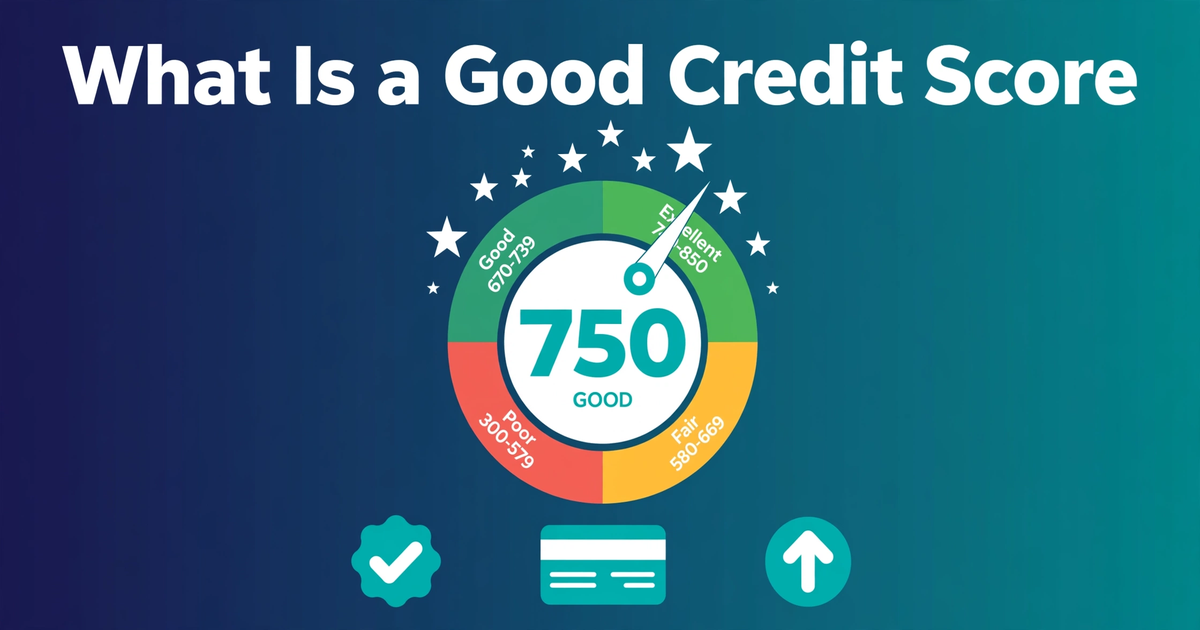
Let’s skip the suspense. For the FICO score — the scoring model used by about 90% of lenders — here are the official ranges:
| Score range | Rating | What it means for you |
|---|---|---|
| 800–850 | Exceptional | Best rates on everything; approvals are easy |
| 740–799 | Very good | Great rates; you’ll qualify for almost anything |
| 670–739 | Good | Solid approvals and decent rates — the key threshold |
| 580–669 | Fair | Approved sometimes, but rates are noticeably higher |
| 300–579 | Poor | Mostly denied; subprime lenders only, at steep prices |
So what is a good credit score in one number? 670. That’s where FICO’s “Good” range starts. Cross that line and doors open: reasonable car loan rates, mortgage eligibility, decent credit cards.
But here’s the more useful truth: most lenders privately treat 700+ as the real “good” line. At 700, you’re above the national average (the average FICO score in the U.S. was 713 in 2025, per Experian), and you stop getting penalized on most mainstream loans.
670 is where “Good” officially starts — but 700 is the number that actually changes how lenders treat you.
One more thing worth knowing: there’s no single universal cutoff. Every lender sets its own bar. A 680 might sail through one bank’s auto loan desk and get a shrug from another’s mortgage department. The ranges above are the industry’s shared language — individual lenders translate them into their own rules.
What Your Score Is Made Of: The 5 Ingredients
Your score isn’t random — it’s a recipe with five ingredients, and they don’t count equally. Here’s the FICO formula:
| Ingredient | Weight | What it means in plain English |
|---|---|---|
| Payment history | 35% | Do you pay every bill on time? The big one. |
| Amounts owed (utilization) | 30% | How much of your credit limits are you using? Less is better. |
| Length of credit history | 15% | How old are your accounts? Older is better. |
| New credit | 10% | Lots of recent applications looks risky. |
| Credit mix | 10% | Different types of credit (card + loan) help a little. |
Two things jump out. First, paying on time is more than a third of your entire score — one 30-day-late payment hurts more than anything else you can do. Second, utilization (that fancy word for “how maxed out your cards are”) is nearly another third. Together, those two habits control 65% of your number.
The practical takeaway: you don’t need to master all five ingredients. Nail the top two — pay on time, keep balances low — and a good score mostly takes care of itself. The other three are fine-tuning.
It also explains why scores move at different speeds. Utilization updates every billing cycle, so paying down a maxed-out card can lift your score within 30–60 days. Payment history builds slowly — it takes months of clean payments to outweigh one old late mark. Knowing which ingredient you’re fixing tells you how patient to be.
FICO vs VantageScore: Why You Have More Than One Score
Quick confusion-clearing, because this trips everyone up: you don’t have a credit score. You have dozens.
The two big scoring brands are FICO and VantageScore. Both use the familiar 300–850 scale, and both look at the same credit reports — but they weigh things slightly differently. FICO is the one ~90% of lenders actually use when deciding. VantageScore is what most free score-tracking apps show you.
On top of that, each brand makes industry-specific versions. FICO builds special scores for auto lenders (FICO Auto Score, which runs 250–900) and credit card issuers. An auto lender might see a slightly different number than a mortgage lender — even on the same day, from the same credit report.
What does this mean for you, practically?
- Don’t panic over small differences. Your FICO might be 712 while your VantageScore shows 728. That’s normal, not an error.
- Watch the trend, not the exact digit. If all your scores are climbing month after month, you’re doing it right.
- When a lender quotes a minimum, ask which score they use. “We need a 680” means nothing until you know whether that’s FICO or VantageScore.
You have dozens of scores, not one — track the trend across months, not the exact digit on any given day.
What Your Score Actually Costs You in 2026
This is where it gets real. A credit score isn’t a grade on a report card — it’s a price tag. Let’s look at what the same purchases cost at different scores, using real 2026 lending data.
The car loan: $30,000 over 5 years
Using average new-car APRs by credit tier (Experian, Q1 2026):
| Your score tier | APR | Monthly payment | Total interest paid |
|---|---|---|---|
| Superprime (781–850) | 4.55% | $560 | $3,598 |
| Prime (661–780) | 6.23% | $583 | $4,992 |
| Nonprime (601–660) | 9.67% | $633 | $7,953 |
| Subprime (501–600) | 13.44% | $689 | $11,362 |
Same car. Same $30,000 loan. The subprime borrower pays $129 more every month and $7,764 more in total interest than the superprime borrower. That’s a second used car, paid entirely in extra interest.
The mortgage: $350,000 over 30 years
Mortgage rates move daily, so treat these as an illustration — but the math pattern never changes:
| Your score | Illustrative rate | Monthly payment | Total interest over 30 years |
|---|---|---|---|
| 760+ | 6.50% | $2,212 | $446,406 |
| ~700 | 7.00% | $2,329 | $488,281 |
| ~640 | 7.75% | $2,507 | $552,679 |
The 640-score buyer pays $295 more per month — over $106,000 extra across the life of the loan — for the exact same house. Let that sink in: six figures, determined by a number you can change.
A lower score doesn’t just mean “worse terms” — on a house it can mean paying $100,000+ extra for the identical home.
This is the honest reason to care about the “what is a good credit score” question. It’s not about bragging rights. It’s about keeping tens of thousands of dollars in your pocket instead of handing them to lenders.
What Credit Score Do You Need to Buy a Car?
There’s no official minimum — no law says “you must have X to buy a car.” But lenders have their own floors, and the data tells a clear story.
According to Experian’s Q2 2026 auto finance data, the average credit score for a new-car loan was 753, and 689 for a used-car loan. About 70% of all auto loans go to borrowers with scores of 661 or higher — that’s the start of the “prime” tier, and it’s the practical line for a competitive rate.
Here’s how lenders actually slice it up (average APRs, Experian Q1 2026):
| Credit tier | Score range | Avg. APR (new car) | Avg. APR (used car) |
|---|---|---|---|
| Superprime | 781–850 | 4.55% | 6.30% |
| Prime | 661–780 | 6.23% | 8.77% |
| Nonprime | 601–660 | 9.67% | 14.03% |
| Subprime | 501–600 | 13.44% | 19.42% |
| Deep subprime | 300–500 | 16.01% | 21.77% |
The practical rules for 2026:
- 661+: You’re in prime territory. Real lender competition, reasonable rates, normal down payments. This is the number to aim for before car shopping.
- 601–660: You’ll get approved, but you’ll pay for it — roughly $50–$100 more per month than a prime borrower on the same car.
- Below 600: Traditional banks mostly say no. You’ll be looking at subprime specialists or buy-here-pay-here dealers, with rates that can top 20% — plus bigger down payments and sometimes GPS trackers on the car. It gets expensive fast.
- Credit unions are your friend below 620. They’re nonprofits and often look at your whole picture — steady job, checking history — not just the number. People get approved at credit unions with scores in the high 500s when banks won’t touch them.
For a car loan in 2026, 661 is the magic number — that’s where prime rates and real lender competition begin.
One smart move before you shop: get pre-approved by your bank or a credit union before visiting the dealership. Walking in with financing already lined up turns the whole negotiation into a simple price discussion — and it keeps the dealer’s finance office from marking up your rate.
What Credit Score Do You Need for a Mortgage?
Mortgages are stricter than car loans — the amounts are bigger and the lender’s risk lasts 30 years. But the minimums are lower than most first-time buyers fear:
| Loan type | Minimum score | Down payment | Who it’s for |
|---|---|---|---|
| Conventional | 620 | 3–5%+ | Most buyers with decent credit |
| FHA | 580 (3.5% down) / 500 (10% down) | 3.5% or 10% | First-time buyers, lower scores welcome |
| VA | No official minimum (lenders often want 620) | 0% | Veterans and active military |
| USDA | 640 (most lenders) | 0% | Rural/suburban buyers, income limits apply |
A few honest notes on this table:
620 gets you in the door, but 740+ gets you the good rates. Mortgage pricing has tiers, and the best rates typically start around 740–760. Between 620 and 739, you’ll be approved — you’ll just pay more every month, as the $350,000 example above showed.
FHA is the most forgiving mainstream option. With a 580, you can put just 3.5% down. Between 500–579, you’ll need 10% down, which is a bigger hill to climb but still a real path to homeownership.
Your score isn’t the only number that matters. Lenders also check your debt-to-income ratio (usually must be under 43–50%), your employment history, and your cash reserves. A 680 with low debt and two years at the same job often beats a 720 drowning in credit card balances.
620 opens the mortgage door, but 740+ is where the best rates live — that 120-point gap is worth tens of thousands over 30 years.
If you’re buying in the next year, the single highest-leverage move is getting your score from the 600s into the 700s before you apply. Even a 40-point bump can drop your rate enough to save $100+ a month. That’s real money, every month, for decades.
What Credit Score Do Landlords Look For?
No law sets a minimum here either, but landlords absolutely check — and in competitive rental markets, your score can be the tiebreaker between you and another applicant.
The informal standards most landlords use:
| Your score | What landlords think | What to expect |
|---|---|---|
| 700+ | “Safe bet” | Smooth approval; sometimes lower deposit |
| 650–699 | “Probably fine” | Usually approved; may ask for pay stubs |
| 620–649 | “Borderline” | Possible approval with larger deposit or a co-signer |
| Below 620 | “Risky” | Many landlords pass; expect extra requirements |
| Below 600 | “Hard no” (for most) | Private landlords and roommates become your best options |
A few things that soften a weak score with landlords:
- Offer a larger deposit. Money talks. Two months’ rent upfront instead of one changes the conversation.
- Show pay stubs and bank statements. A 620 score with steady income and savings looks very different from a 620 with neither.
- Get a co-signer. A parent or relative with strong credit signing the lease removes the landlord’s risk entirely.
- Look for private landlords. Big property management companies run automated screens with hard cutoffs. An individual renting out one unit can actually listen to your story.
Landlords usually want 650+, but a bigger deposit and proof of steady income can overcome a score in the low 600s.
One warning: every rental application can trigger a hard inquiry on your credit. A handful of these in a short apartment-hunting window is normal and barely dents your score — but don’t apply to twelve places “just to see.” Be selective.
What Is a Good Credit Score to Aim For? Honest Targets
Forget chasing 850 — that’s a trophy, not a tool. Here’s what each milestone actually buys you:
650 — “Okay, you’re in the game.” You’ll get approved for basic credit cards and some loans, but you’ll pay above-average rates on everything. Think of 650 as the floor of respectability, not the goal.
700 — “Now we’re talking.” This is the first target worth celebrating. At 700, you’re above average, car loan rates get reasonable, mortgage doors open wider, and landlords stop worrying. If you remember one number from this guide, make it 700.
740 — “The sweet spot.” This is where mortgage lenders start offering their better rate tiers. The jump from 700 to 740 can save you more money than the jump from 740 to 800 — this is the highest-leverage 40 points on the whole scale.
760–780 — “Diminishing returns start here.” You’ll get the best advertised rates on almost everything. Going higher is nice, but each extra point buys you less and less.
800+ — “Bragging rights.” Genuinely excellent. You’ll get approved instantly for the best cards and the lowest rates available. But here’s the secret the credit industry won’t advertise: a 780 and an 830 get treated almost identically. Nobody pays you extra for those last 50 points.
Aim for 700 first, then 740 — those two milestones capture almost all the real-world savings. Everything above 780 is just bragging rights.
How to Raise Your Credit Score
If your score isn’t where you want it, the fix isn’t mysterious. These five moves cover roughly 90% of what actually works:
1. Pay every bill on time — no exceptions
Payment history is 35% of your FICO score, the single biggest factor. One payment marked 30 days late can knock 60–100 points off your score and linger for up to seven years. Set up autopay for at least the minimum on every account. This one habit matters more than all the others combined.
2. Get your utilization under 30% — ideally under 10%
“Utilization” is how much of your credit limits you’re using. Owe $900 on a $1,000-limit card? That’s 90% utilization, and it tanks your score even if you pay in full every month. The people with the highest scores tend to keep utilization in the low single digits. Quick win: pay your cards down before the statement closing date, not just before the due date.
3. Don’t close old cards
Length of credit history is 15% of your score. That starter card from five years ago with no annual fee? Keep it open, charge a coffee to it every few months, and let it age quietly. Closing your oldest account can actually drop your score.
4. Limit hard inquiries
Each credit application dings your score a few points. A couple in a year is nothing — but six applications in two months makes you look desperate. Rate-shop smart: multiple auto loan or mortgage inquiries within a 14–45 day window count as a single inquiry, so do your comparison shopping in one burst.
5. Check your reports for errors — and dispute them
About 1 in 5 credit reports contains an error, according to the FTC. A wrongly reported late payment or an account that isn’t yours could be dragging you down for nothing. You’re entitled to free reports from all three bureaus every year. If you spot a mistake, dispute it — bureaus must investigate, usually within 30 days.
On-time payments plus low utilization is 65% of your score — master those two and the rest is fine-tuning.
Realistic timeline: if you’re starting in the low 600s with no major damage (no collections, no bankruptcy), 3–6 months of clean habits can realistically add 50–100 points. Deeper damage takes longer — but it always moves in the right direction once the habits change.
FAQs: What Is a Good Credit Score?
What is a good FICO score in 2026?
A FICO score of 670–739 is officially “Good.” In practice, 700+ is the number most lenders treat as good — it’s above the national average of 713, and it gets you competitive rates on car loans, mortgages, and credit cards. For the best mortgage rates, aim for 740+.
Is a 700 credit score good?
Yes. A 700 credit score is solidly good — above average, and enough for reasonable rates on most loans. You won’t get the absolute best advertised rates (those usually start around 740–760), but you won’t get penalized either. Think of 700 as “comfortably qualified” for nearly everything.
What credit score do you need to buy a house?
620 is the minimum for a conventional mortgage, and 580 can work for an FHA loan with 3.5% down. But minimums aren’t targets — at 620 you’ll pay significantly more than at 740+. If homebuying is 6–12 months away, pushing your score from the 600s into the 700s first is one of the highest-value financial moves you can make.
Can I get a car loan with a 600 credit score?
Yes, but it’ll cost you. At 600 you’re in subprime territory — expect average APRs around 13–19% depending on new vs. used, versus 4.5–6% for top-tier borrowers. On a $30,000 car, that’s roughly $7,700 more in interest over five years. If you can wait and build to 661+ (prime), you’ll save thousands.
How fast can I raise my credit score?
With clean habits and no major negative marks, 50–100 points in 3–6 months is realistic — mostly from paying on time and dropping utilization below 30%. Paying down a maxed-out card alone can add points within one or two billing cycles, since utilization updates fast. Serious damage like collections takes longer, but consistent on-time payments always move the needle.
The Bottom Line on What Is a Good Credit Score
So what is a good credit score in 2026? Officially, 670 — that’s where “Good” begins. Practically, 700 — that’s where lenders start treating you well. And strategically, 740 — that’s where the best rates live.
But the real lesson isn’t a number. It’s this: your credit score is a price tag, and unlike most prices in life, you get to negotiate it — with habits, not haggling. Every on-time payment, every paid-down balance, every month of patience moves that number in your favor. And every point you gain is money you keep instead of handing to a lender.
Check your score this week — most banks and free apps show it at no cost and checking never hurts it. Whatever number you see, you now know exactly where you stand and exactly what to aim for. 700 first. Then 740. Then stop worrying about it and enjoy the cheaper life that comes with it.